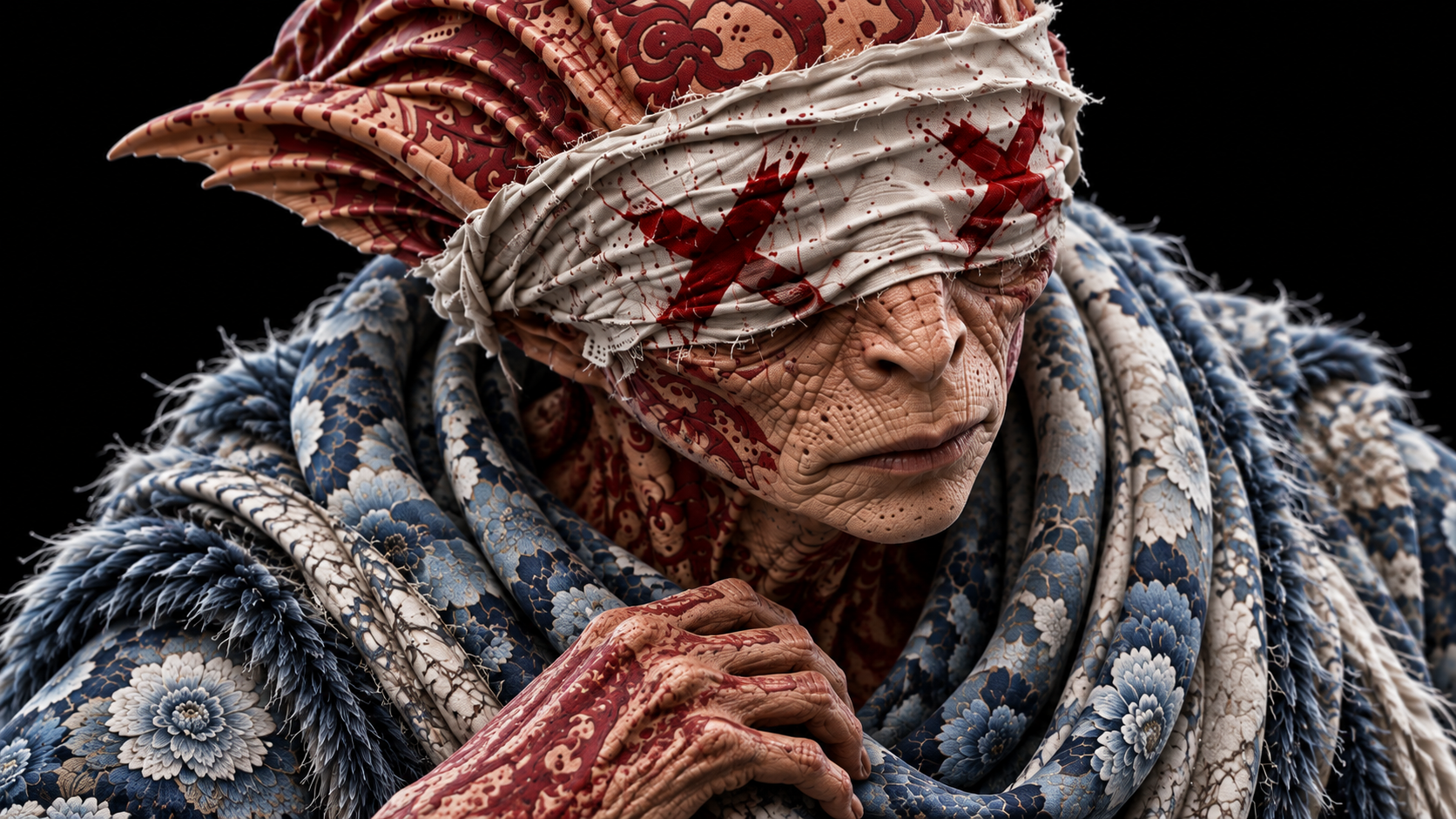
Wessan, The Ink-Son
Wessan is the son of two peoples and the record of neither. His mother is Ishwen, the Weneth girl sent north to seal the Salt Compact. His father was Vessan, the master of the ninth tower, who first threw Bone-salt into a kiln. He was born in the tower his father's salt built. He has spent his life carrying his parents.
He carried his father out of the ninth tower on the night it broke. He carried his mother west across the Bone when her glaze began to fall. He wears a Coil that was never fired. His father inked it into soft skin with a needle. It has been spreading and greying ever since. It is the only Coil in the world that can fade.
- Name
- Wessan
- Called
- The ink-son, in the towers
- People
- Weneth by his mother. Ilvenne by his father. Neither, by either.
- Born
- 1969 F.K., in the ninth tower of Sael-Qor
- Age at the Reckoning
- 118
- Mother
- Ishwen, the Salt Bride
- Father
- Vessan Qor-Tal, master of the ninth tower. Died 2044.
- Marks
- An inked Coil, unfired, spreading
- Wears
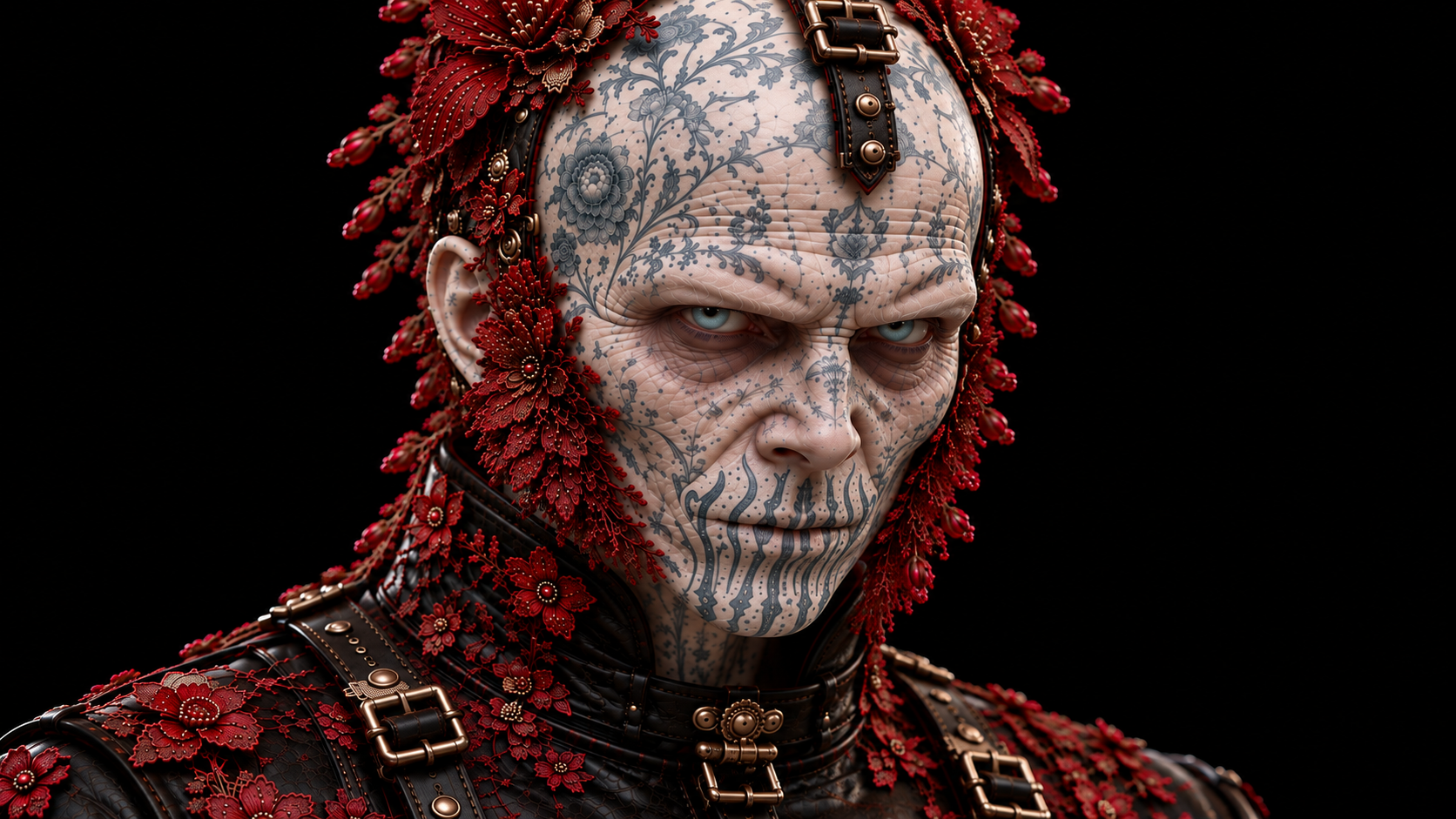
- A bearer's harness. Red lace woven for him at Wennar.
- Eyes
- Pale blue, from his mother's side
- Seen in
- 3 Up: Qorran, Wessan & Vaelith. Chapter One: The Twelfth Day.
Two Peoples
The Kelborn are five peoples who keep the past in five ways. Wessan was born between two of them.
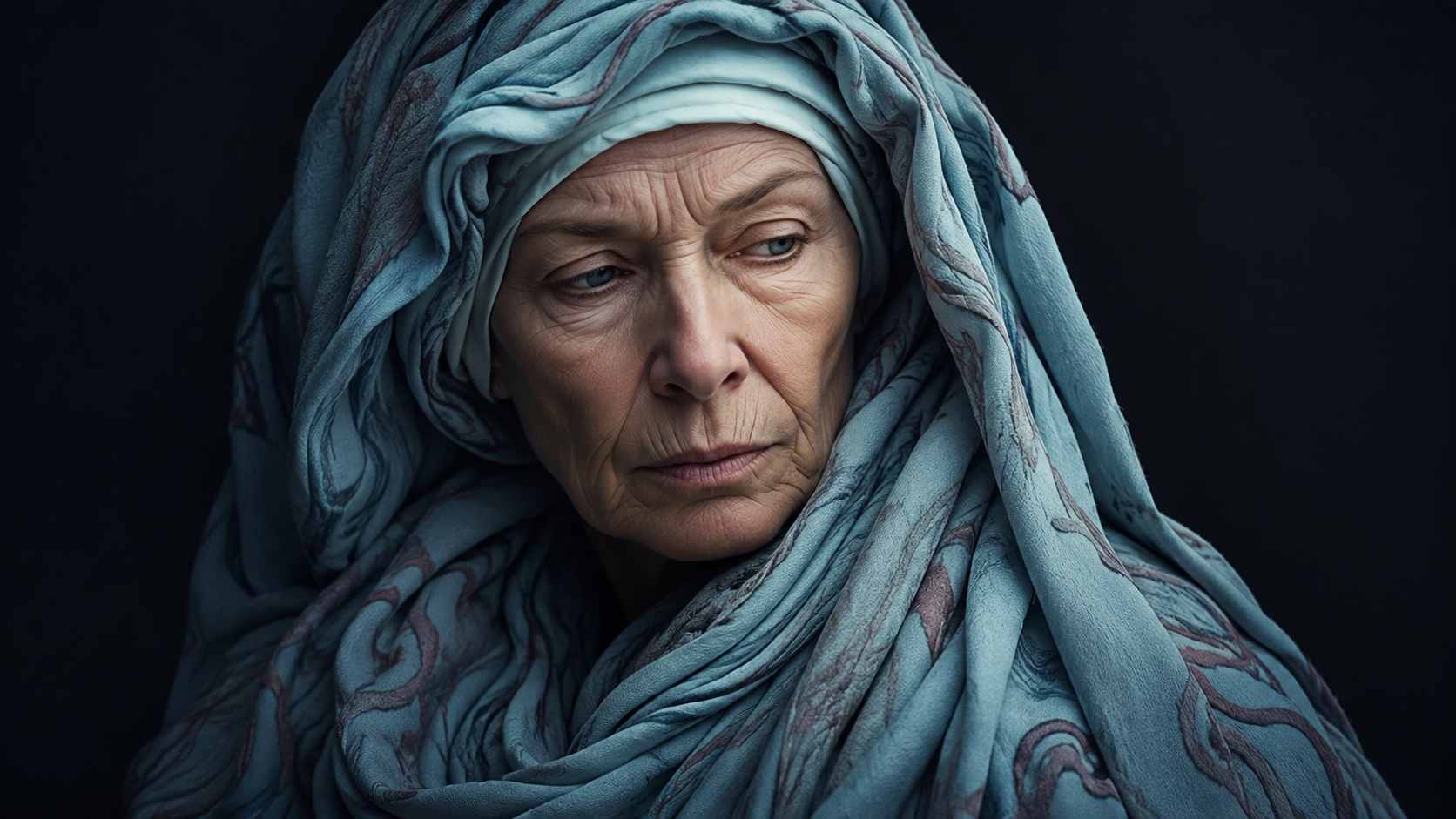
The Weneth live in the wet uplands west of the basin. They have bare, pale skin and they never mark it. Instead they weave. Everything they have agreed is recorded in one continuous weaving called the Great Cloth, kept at the hall of Wennar. A thing is not history until it is woven, and it is not woven until the elders agree how to tell it.
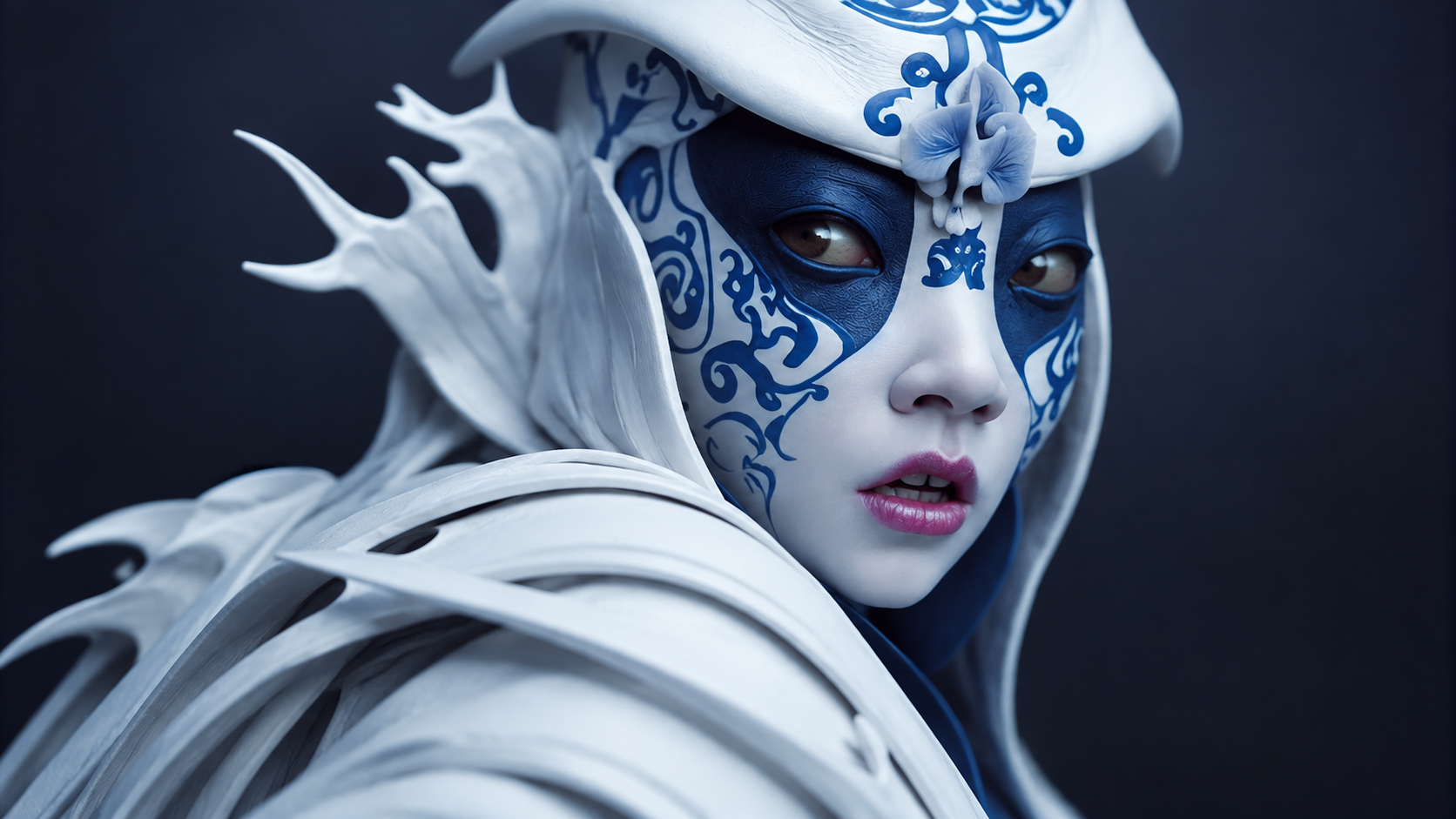
The Ilvenne live in the white mountains to the north, in the nine towers of Sael-Qor. Every Ilvenne child is fired at sixteen. They are glazed white like porcelain, with a Coil painted on them in cobalt. A Coil is a vow written in the future tense. It says what the child will be. A fired body never changes again.
The Compact
In 1951 the ninth tower wanted salt from the Bone, the white crust that floors the southern basin. Only the Weneth wool-beasts could carry heavy loads across it without breaking through. So the towers sent west.
The Keeper at Wennar was a young man named Orrin. He agreed to the Salt Compact. A compact between peoples must be sealed with a person. He gave the one he had: his sister Ishwen, who was thirteen.
She was walked north to the Salt Fold by a young caravan driver named Neshwen. There the Ilvenne envoys cut off her sleeve, which had a thread of the Compact woven into it. A bride of Sael-Qor arrives with nothing woven. She was married to Vessan, the master of the ninth tower. In 1954, at sixteen, she was fired in his tower's own kiln with Bone-salt glaze. She was the first Weneth ever fired.
The firing nearly killed her. A Weneth skin was never meant to hold glaze. She came out white, hard and silent, and her hair never grew again.
The Ninth Tower
Wessan was born in 1969 F.K. in the upper rooms of the ninth tower. His mother was thirty-one. She had been fired for fifteen years. The salt-cutting had been going on for eighteen.
Ilvenne children are born soft and deep blue. Wessan was born pale. He had his mother's bare Weneth skin and her pale blue eyes. The midwives of the tower had never seen a child like him. Neither had anyone else.
The ruling
In 1985, when he was sixteen, he should have gone into the kiln like every other child of Sael-Qor.
The firing-masters of the eight towers met to decide. They had one precedent, and it was his mother. Her firing had nearly killed her. The glaze had fought her skin for days. The masters ruled that Weneth skin could not be fired. They did not mean that it was impossible. They meant that it was forbidden. They would not risk a second Weneth in a kiln.
So Wessan could not be fired. By Ilvenne law, a child who is not fired has no Coil. A child with no Coil is ilv-hesk, ash-clay, a refuser. Refusers are sent to the cobalt mines.
The needle
Vessan would not send his son to the mines. He went to the firing-masters and asked for a way through the law.
The masters found one. The law says a child must be given a Coil at sixteen. It does not say how. Vessan read his son for a year, as masters read their brides. Then he sat with him in the scribes' room of the ninth tower and drew the Coil onto his skin by hand. He used cobalt ink and a fine steel needle, stroke by stroke, over forty nights.
It was legal. It was not a firing. Nobody in Sael-Qor ever pretended it was. The towers called Wessan the ink-son. They meant it as a joke, and then as a name.
He has said that the forty nights were the longest time he ever spent with his father. Vessan did not speak much while he worked. Once, near the end, he said: "This will not hold the way your mother's does. I am glad."
Growing up
Wessan grew up beside his mother's marriage couch. It was red velvet, the Ilvenne colour of the living. A fired bride is white from head to foot, so the ninth tower made her couch red, so that she would always have something living near her.
He spent his childhood in the scribes' room, where his mother's only friend in the tower kept the salt-tallies. Her name was Qaresse. She was fourteen years older than his mother and spoke to her as an equal. She taught Wessan to count by the tallies. He learned his numbers from cartloads of the Bone.
The Ink
A fired Coil never changes. That is the point of it. Wessan's Coil was never fired. It changes every year.
Ink in soft skin does not stay where it is put. Over decades it spreads outward from each stroke, a hair's width at a time. The cobalt turns grey. The sharp spirals his father drew in 1985 have softened into something like lace. They have spread from his cheeks across his whole face, his scalp and the backs of his hands. Some of the original strokes can no longer be told apart. It is the only Coil in the world that can fade.
What it says
A Coil is read like a sentence about the future. What follows is Vessan's sentence, as far as it can still be read.
The cheeks hold the craft. On each cheek is an open spiral, qaru-vel, the Coil for a life of going out: travel, carrying, crossing distances. It is not a scribe's mark or a master's. Vessan did not want his son to keep a tower.
The brow holds what the master is least sure of. On Wessan's it is a crossing of two lines with a loop at the centre. It is the same form Vessan fired at his wife's throat, his attempt at a Weneth knot in Ilvenne strokes. On Ishwen it meant to bind the west to the tower. On Wessan the loop is open.
The mouth carries something no other Coil has: rows of fine vertical strokes over the lips and chin, falling. In Ilvenne Coil there is no standard form like it. Vessan never explained it. The firing-masters read it as qaru-ish, a vow to speak gently. Wessan has spent most of his life keeping that vow the only way he can be sure of, by saying very little.
In 2087 the Weneth reader Amarwen heard his description of those strokes. She said they were the falling strokes of the Law of the Floor, line six: the white will fall after. Vessan had asked about the old marks at the base of the Tally-Wall every year for eighty-six years. He may have understood more than he ever said.
Saelesse
In the Blue Hollow, a Coil-reader named Saelesse now inks chosen vows onto adult refusers. She uses cobalt in soft blue skin, so the vows can be redrawn. To Sael-Qor this is heresy. She learned it from Wessan's face. She went to the ninth tower as a girl to look at the ink-son, and she saw a vow that could change. She has been drawing them ever since.
The Breaking
On the night of the spring equinox, 2044, three hundred refusers from the Blue Hollow came up to the ninth tower carrying brine. Their leader was Qorran. They poured the brine into the salt-kilns at full heat. The firing-chamber cracked from floor to crown.
Wessan was seventy-five. He was asleep in the upper rooms with his mother when the tower shook.
Going down
He went down the stairs against everyone coming up. The lower third of the tower had settled and split. The chamber was full of steam and broken kiln-furniture. Most of the masters had left when they were told to. His father had not.
He found Vessan by the main kiln, cracked through from shoulder to hip, still conscious. Beside him lay a kiln-worker named Tallas, cracked so badly that he did not look like a person any more. Wessan could only carry one of them.
He carried his father. He came back for Tallas. Tallas lived. The Kharrin Reckoner later sent gold from the east to mend him, because there was too little of him left to mend in cobalt. Wessan sees him at the Lid-Stone most days. Tallas has never thanked him. Wessan has never wanted him to.
The week
Vessan died in his rooms a week later. Ishwen sat beside him the whole time. Wessan sat at the door.
On the fourth day, Vessan asked to see the master of the first tower. He wanted to know, one more time, what the old marks at the base of the Tally-Wall said. He had asked every year since 1958. The master told him what he had always been told: decoration, older than any reading.
After the master left, Vessan said to Wessan, "They are lying, or they are afraid. It is the same thing in a tower." They were the last words he spoke to his son.
What Wessan thinks of Qorran
He has never said it in full. He said four words to Qorran's face on the twelfth day of the Reckoning: You killed my father. Qorran said yes. Neither of them has said anything to the other since.
Wessan was not at the Breaking as a victim or a witness. He was the one who went down into the steam and carried the dead and the nearly dead out of it. That is the part no one at the Reckoning asks him about.
The Carrying West
In the 2060s the glaze began to lift from everyone fired with Bone-salt. It came away in scales, and the Coil went with it. The Ilvenne call it the Flaking. Ishwen began to flake in 2063. By 2078 her legs had split and she could no longer stand.
A fired Ilvenne in that state would be laid in the Tally-rooms of the tower to crack quietly. Ishwen asked instead to be carried west, home.
The board
The ninth tower gave her eight Ilvenne bearers and her red marriage couch, lashed to a board. Wessan made himself the ninth. Bearers carry with a strap across the brow, so the weight sits on the head and the hands stay free. He had never carried anything that way in his life. He put the harness on at the foot of the tower and did not take it off for ten days.
They walked down the Salt Road to the Salt Fold, at the edge of the Weneth downs. That was where his mother's sleeve had been cut off, when she was thirteen.
At the Salt Fold, Qaresse was waiting. She had come from the Hollow to meet them. She walked beside the couch for the last day, and spoke to his mother in the old tower way, as an equal. Wessan had not seen his mother smile since his father died.
At the Fold, the Ilvenne bearers handed the board to Weneth bearers. Wessan did not hand over his strap. He carried his mother into Wennar.
Wennar
Wennar is a long stone hall with a turf roof, full of looms. The Great Cloth runs down the middle of it on trestles. Moss grows on everything that does not move.
They laid Ishwen at the end of the first hall. She has not moved since. The weavers began her last cloth on her as she lay there. Each fallen plate of glaze is stitched to her gown. The moss has grown into the sleeves.
Her brother Orrin, the Keeper, met them at the door. Wessan had never met his uncle. Orrin had never once come north to see his sister. That day Orrin cut a fleece from the Keeper's flock and refused to let it be spun until he decided how the Compact should end. He has not decided.
Wessan has lived at Wennar ever since. The Weneth think of him as Ilvenne, because of the Coil. The Ilvenne thought of him as Weneth, because of his skin. At Wennar he sits beside his mother's couch in the evenings, at the opposite end from Orrin. Amarwen sits between them, guiding Orrin's hands over the gown.
What He Wears
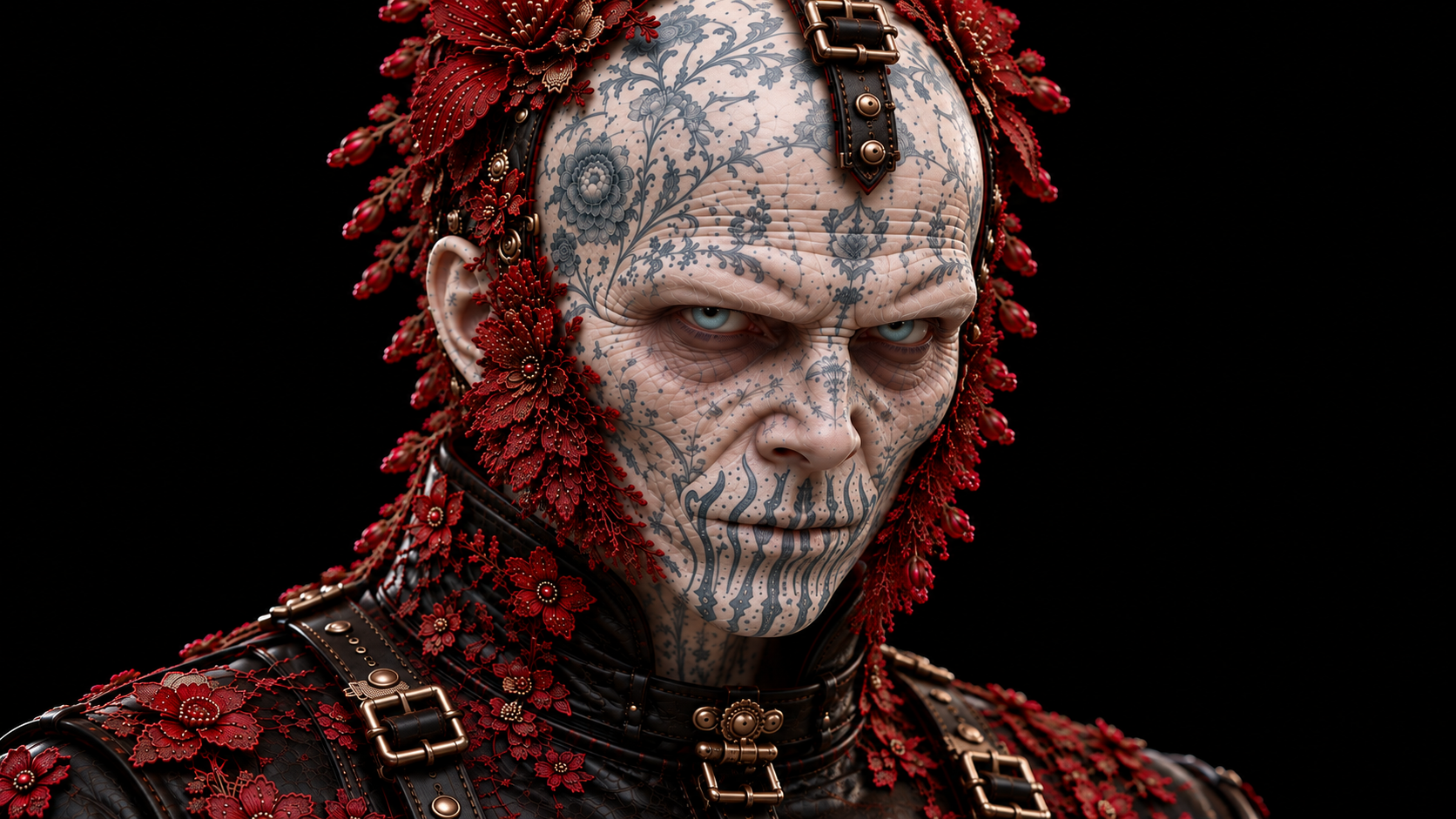
The harness is a ninth-tower bearer's harness, black leather with bronze buckles. One strap runs from the crown of his head down the middle of his brow. That is where the weight sits when you carry the dying. The others cross his chest and shoulders. It is the harness he wore on the ten days west in 2079. He wears it still. He has said it is because he may need to carry her again. Everyone at Wennar knows that is not the only reason.
Under the brow strap, the leather has rubbed his father's Coil away. Beneath it is a pale band down the centre of his forehead, clean of ink. It is the only place on his face where Vessan's vow has gone.
The red lace is Weneth work. The weavers at Wennar made it for him in 2080, at Ishwen's asking. It is wool dyed with red earth and worked into flowers. It is the first Weneth record ever made for him. The Weneth weave a garment with some part of the wearer's story. This one records one thing: the carrying. Ishwen chose red because it is the Ilvenne colour of the living, the colour of her couch. She said that now her son could be the living thing near her.
The red runs from his headdress down his neck, over the leather, and onto his shoulders. In the portraits it looks like flowers growing out of the harness. That is how the weavers meant it.
The ink covers his scalp, face and hands. It is grey-blue and spreading, the Coil his father drew in 1985. The vertical strokes over his mouth are sharper than the rest. He has never said why.
His eyes are pale blue, the eye of the eldest Brine blood. His mother has them. So does his uncle.
At the Reckoning
In 2085 the last carrier of the south called a Reckoning of the Shedding, and in the autumn of 2087 it opened at the Lid-Stone, at the centre of the basin. Wessan did not go. He stayed at Wennar with his mother. Orrin went, with Amarwen and the unspun fleece.
The runner
On the twelfth night, the crossing Vessan had fired at Ishwen's throat came away. It was the last of his vow on her. The weavers sewed it to her gown in the morning. Ishwen had once told Orrin that when it fell, the Compact would end by itself.
She asked to be carried to the Lid-Stone.
The Weneth bearers would not carry her until Orrin decided how the Compact ended. So Wessan carried the message himself. He walked four days across the Bone in the Weneth way, slow and in step with himself, with his feet wrapped in wool. He came into the circle at noon, in the hour of silence. The Ilvenne on their stools went still when they saw his face. Most of them had never seen the ink-son. All of them had heard of him.
He knelt by his uncle and spoke into his ear. Then he stood behind Orrin while Orrin told the Reckoning, for the first time in twelve days, that he did not know how to end what he had begun.
The offer
That evening Qorran came to the Weneth tents without his ruff. He offered to carry Ishwen to the stone with eight bearers from the Hollow.
Wessan stood up. "You killed my father."
"Yes."
"You want to carry my mother."
"If she will let me."
Wessan did not say yes. He did not say no. He sat back down.
The caravan-mistress Neshwen came into the firelight. A hundred and thirty-six years ago she had walked Ishwen north to the Salt Fold. She said she would teach the Hollow's bearers to walk the Bone in eight days. "Then they can carry anyone," she said. She looked at Wessan. "Even someone who is angry with them."
Undecided
Wessan has not sent his answer to Wennar. His mother has not sent hers. He knows what she will say. She let Qorran in, in 2081. She sat with him for a day. She has asked the Reckoning not to judge him on her account.
He has never asked her why.
His Names
Wessan
His mother named him. Wessan is his father's name, Vessan, spoken in his mother's tongue.
Venethic, the language of the Weneth, changed the old v sound to w. So the oldest root of watching, vael, became Venethic wael. The root for spinning, ven, became wen. The same change made Vessan into Wessan. Ishwen did not invent a new name for her son. She translated his father.
She has said she wanted him to carry his father's name in a form his father's people could not quite say.
The ink-son
In the towers he was called the ink-son. In Ilvennic it is sael-ran, "born of blue." It began as a joke about the needle. By the time he was twenty, nobody in the ninth tower used his name. Since he came to Wennar, nobody has used the other one.
The vow at his mouth
The falling strokes over his lips have no name in the Ilvenne Coil. The firing-masters called them qaru-ish, the Coil of still water, and read it as a vow to speak gently. Amarwen says they are the falling strokes from the Law.
Wessan has a third reading. He has only told it to his mother. He thinks his father drew rain.
The People Around Him
Ishwen. His mother, the Salt Bride, lying under moss at Wennar with her glaze falling from her like petals. He has carried her once. Her last cloth will not be finished until the Compact ends. He is in it, in red.
Vessan. His father, who threw the first salt into a kiln and inked his son by hand rather than send him to the mines. Wessan carried him out of the steam. He has not forgiven anyone for his death, including Vessan.
Orrin. His uncle, the Keeper, who gave his mother away and never once came north. They sit at opposite ends of her couch every evening. Wessan carried his uncle's message to the Reckoning because there was no one else to do it.
Qorran. The man who led the Breaking. He sat with Ishwen for a day in 2081 and left her the spur she was fired on. He has offered to carry her. Wessan has said four words to him.
Neshwen. The caravan-mistress who walked his mother north at thirteen. She is teaching the Hollow's bearers to walk the Bone. She keeps asking Wessan to come and walk with them at night. He has not, yet.
Qaresse. His mother's only friend in the tower, who taught him to count by the salt-tallies. She met the board at the Salt Fold in 2079 and walked beside it. She still comes to Wennar every spring.
Amarwen. The Weneth reader who guides Orrin's hands over his mother's gown. She is the only person who has read the strokes over his mouth as part of the Law.
Tallas. The kiln-worker he carried out of the chamber after his father. Gold holds him together now. They do not speak.
Saelesse. The Coil-reader of the Hollow, who learned from his face that a vow could be drawn in ink and redrawn. She has asked him more than once whether he wants his redrawn. He has said no. He has not said why.
Vaelith. The young southern carrier who has begun copying the dead of the new generations onto her own skin. In the portrait 3 Up: Qorran, Wessan & Vaelith he stands between her and Qorran, in red. She carries the dead nobody else will carry. He carries the living. They met for the first time at the Lid-Stone. They talk at night about weight.
What Is Still Unsettled
Is he Weneth or Ilvenne? The Weneth say his Coil makes him northern. The Ilvenne say his skin makes him western. The Hollow says he is un-qaru, without a true Coil, and so one of them. Wessan has never claimed any of them.
What did his father mean? The open loop at his brow and the falling strokes at his mouth are not in any Coil grammar. Vessan read his son for a year before he drew them. He never said what he saw. Wessan thinks he may have been writing something he could not say in the tower.
Will he let Qorran carry her? His mother will say yes. He knows that. The question is whether he will walk beside the board.
Will he let the Coil fade? Every year the ink spreads and greys. In another fifty years it may be unreadable. Saelesse could redraw it. He could let it go. It is the one vow in the world that its wearer is allowed to lose.
The Eighth Place
Out on the Bone at night, Neshwen is teaching the Hollow's bearers to walk in step with an empty board. There are seven of them. Qorran walks at the front corner.
She has left the eighth place empty. She has not said for whom.
Wessan watches them from the edge of the Weneth fires with his harness on. The pale band down his brow is the only part of his father's vow that has worn away. It is where the weight sits.