Alvak, The Dern Kala
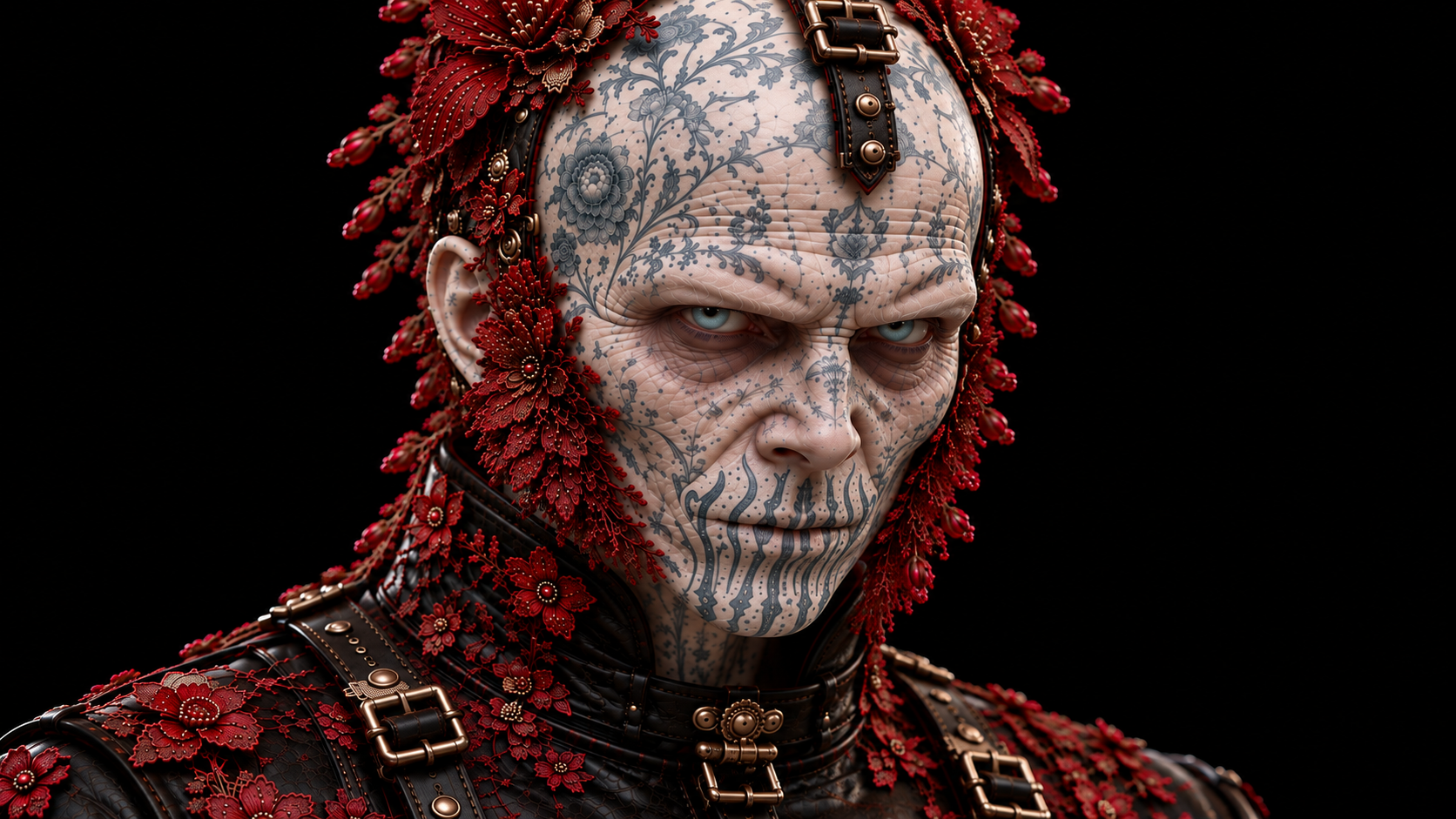
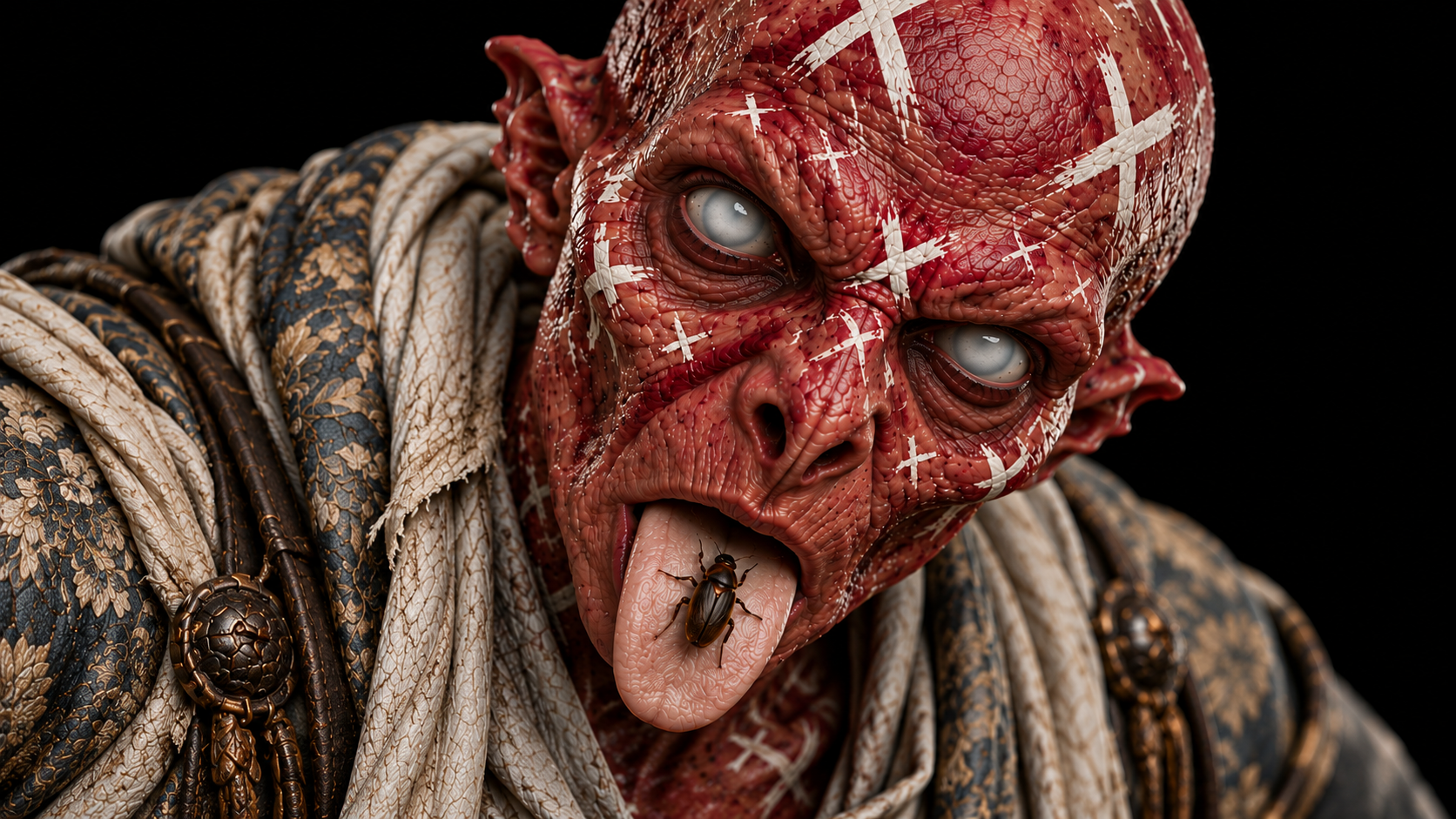
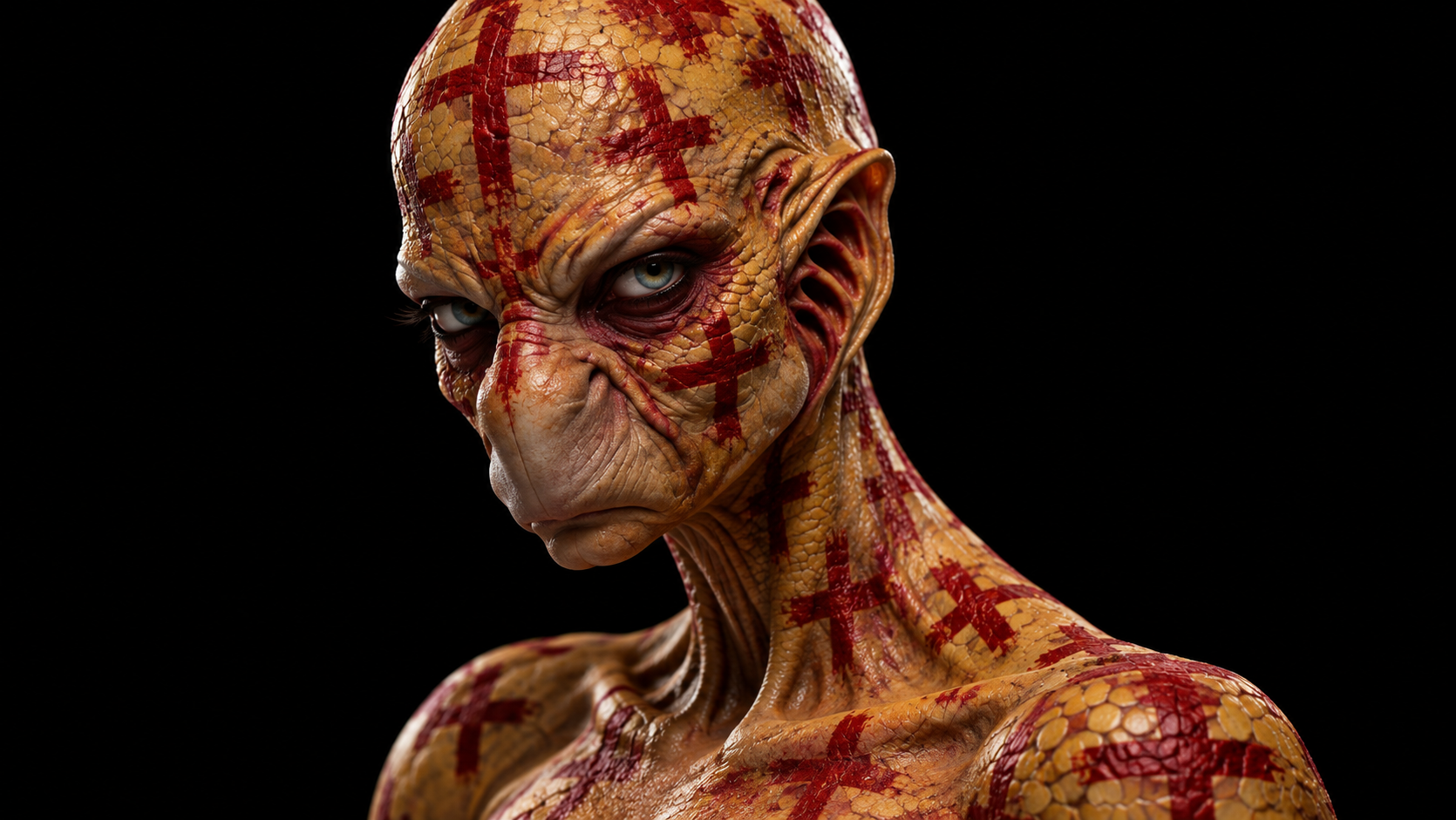
Alvak is a Kharrin of the salt-rakes who stopped counting. Every Kharrin wears what they owe as white dots on a red face, and rubs each one away only when it is paid. Alvak inherited more than three hundred dots he could never pay. One night he scratched a white cross through every one of them and declared himself clean.
The Kharrin call it theft. The road calls it something else. He walks the Ember Road now with a beetle on his tongue, crossing out the debts of anyone who asks. He laughs while he does it. He asks for nothing back.
- Name
- Alvak
- Called
- The Dern Kala, the clean face
- People
- Kharrin, of the eastern salt-rakes
- Born
- 1974 F.K., on the rim of the Bone
- Age at the Reckoning
- 113
- Craft
- Once a salt-raker. Now none.
- Known for
- Crossing out his own debts unpaid, and anyone else's who asks
- Wears
- Cloth given to him by the people he released
- Eyes
- White, from salt glare
- Carries
- A salt-beetle, on his tongue
- Seen in
- Alvak, The Dern Kala. 3 Up: Alvak, Amarwen & Tallas. The Kelborn Arrive.
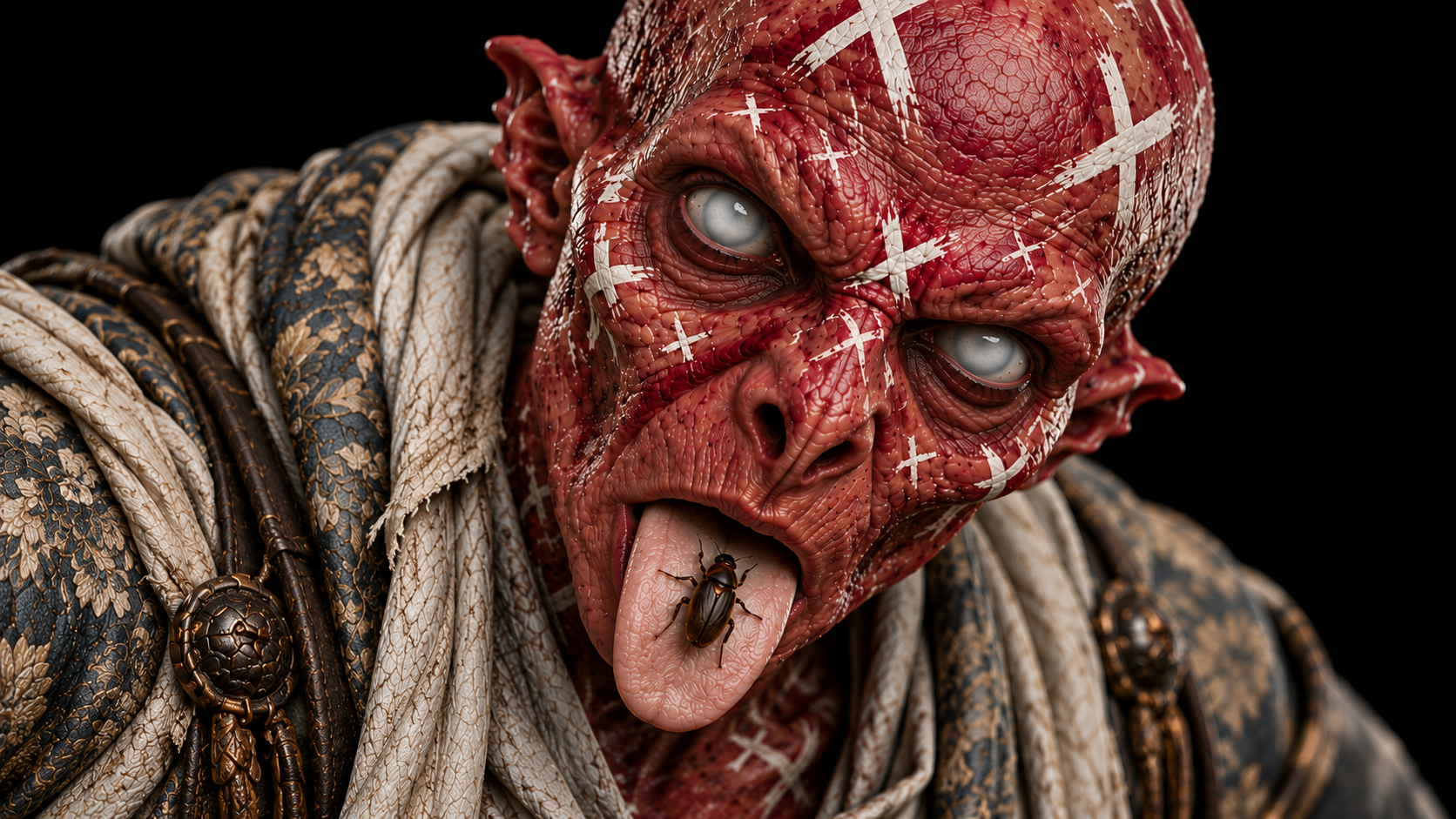
The Kharrin and the Dots
To see what Alvak broke, you have to see what the Kharrin keep.
The Kelborn are five peoples descended from the Brine-children, who climbed out from under the Bone in the Dry Dawn. Each keeps the past in its own way. The Ulmaeth paint what happened. The Ilvenne fire what will happen. The Weneth weave what they have agreed. The Hollow plants what it mourns. The Kharrin keep none of these. They keep only what is owed.
Dar, the Counter
The Kharrin descend from Dar, the second of the Brine-children. He counted the steps out of the caves and never stopped counting. He walked east into the iron mountains, and the red ground came up through his feet into his skin. The Kharrin have been red ever since. They live along the Ember Road in moving camps, trading between all the other peoples. They are the only people who touch everyone.
How the dots work
A Kharrin child is born owing nothing. Its face is clean. Each debt it takes on is laid on its face as a white dot of salt-paste. Each debt it pays is rubbed away.
The dots have a grammar.
A single white dot is a debt owed.
A dot ringed with red is a debt witnessed but not yet claimed.
A dot with a line through it is a debt settled, kept as a reminder.
A line of dots is a debt that passes from one generation to the next.
A dot on the brow is a debt owed by the wearer personally, not by their house.
When two Kharrin meet, they count each other's dots aloud before they say anything else. Conversation begins once both know where the other stands.
Debts outlive debtors
When a Kharrin dies, their dots are copied onto their heir. Nobody can refuse an inheritance. A debt does not end because the debtor did.
A Kharrin who dies with a clean face is honoured above all others. It is rare. Most Kharrin die carrying something. The Reckoner, who carries the debts between whole peoples, never dies clean.
Why the Kharrin are trusted
The other peoples call the Kharrin cold. The Kharrin say everyone else is sentimental about debt. The Ulmaeth call it memory. The Ilvenne call it a vow. The Weneth call it agreement. None of them will simply add it up.
That is why the Kharrin judge between peoples. A Kharrin's whole record is what they owe, so they have every reason to count honestly. Their system has one rule beneath all the others. A dot leaves the face only when the debt is paid.
Alvak broke that rule.
Born Owing
Alvak was born in 1974 F.K. on the salt-rakes, the shallow pans on the eastern rim of the Bone where the Kharrin gather salt. They have done it since before memory. Their oldest rule is that salt is raked from the surface and never cut. For thousands of years no Kharrin knew why.
His family were rakers. It is hard, low work. Rakers spend their lives out on the white crust in the glare, drawing salt into rows with long wooden rakes and carrying it to the camps in baskets. Every Kharrin dot is made from the salt they rake. In a sense, the rakers make the debts of an entire people.
The bitter years
In 1961, thirteen years before Alvak was born, the Bone cracked in the south. The Ulmaeth shed in a single summer and lost their history. The east lost something smaller and more ordinary. The brine that rose through the cracks fouled the eastern pans. For ten years the salt came up bitter. Nobody would buy it. Nobody could make paste from it that would hold on a face.
The raking families borrowed to live through those ten years. They borrowed from the camps, from the traders and from each other. Every loan was a dot. Alvak's mother, Alva, was young then. By the time the salt turned sweet again, her face was white with them.
She worked for fifty years to pay them down. She paid perhaps a third. She died in 2021.
The inheritance
The camp counters copied her dots onto her son's face the morning after she died. It took most of a day. When they finished, he was forty-seven years old and owed three hundred and twelve debts. Nearly all of them dated from a decade he had not been alive for.
He did what Kharrin do. He raked. He paid what he could. Each time a dot was rubbed away, a counter laid a new one, because the old debts had grown while his mother was dying. He was paying the interest on his own birth.
People who knew him then remember that he did not laugh. He counted. He counted his own face every morning in a pan of brine. He counted it at night. When other Kharrin met him on the road, they counted him aloud, as custom required. It took so long that most of them stopped before the end. They would nod and say, Many.
His eyes
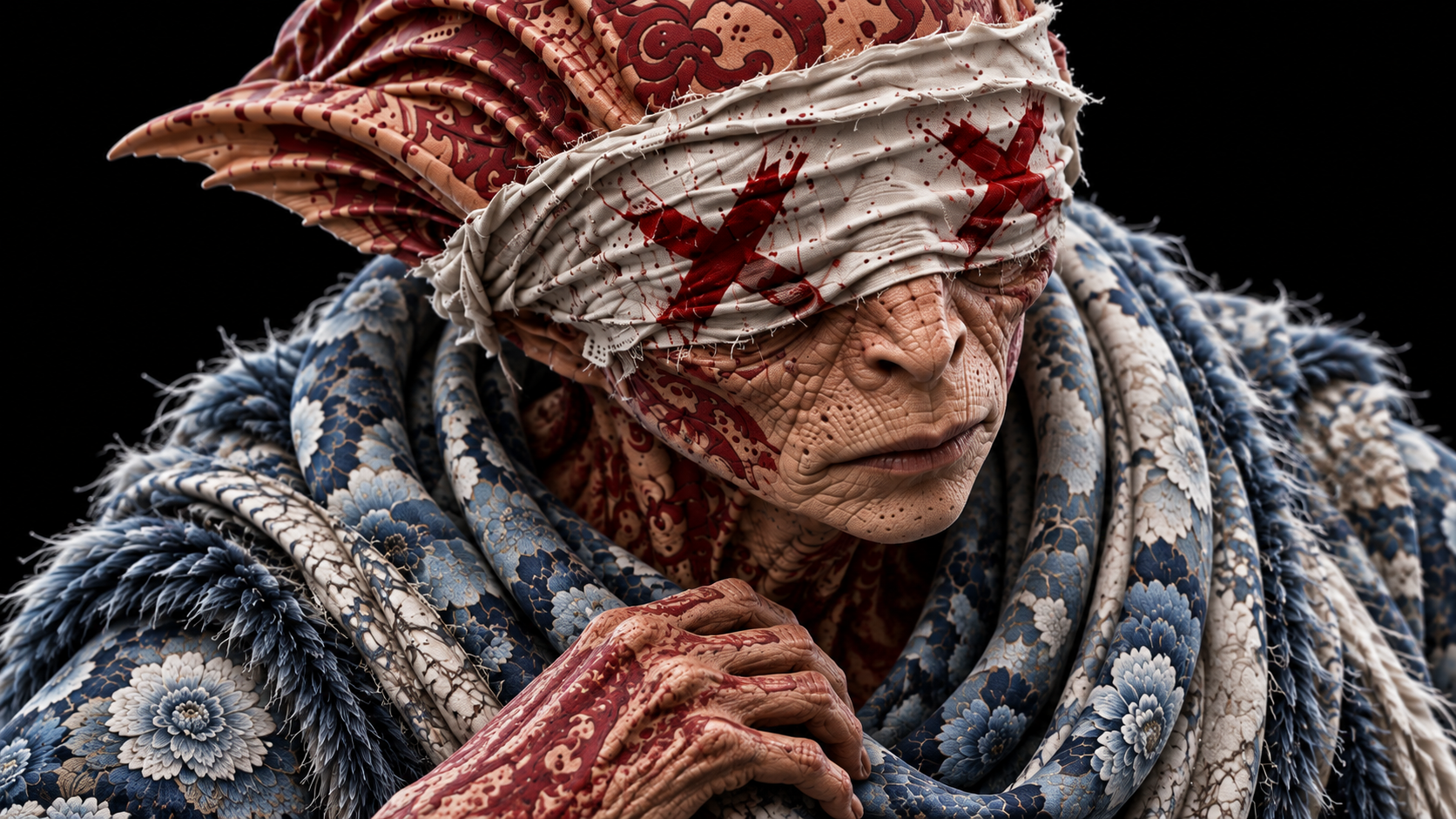
Alvak's eyes are white. Rakers work all day in the glare off the Bone, and many go blind slowly. His went in his early forties. By the time he inherited his mother's dots, he could no longer read them in the brine. He counted them by touch, as the Weneth read cloth, with salt grit under his fingernails.
He has said that losing his sight was the beginning of it. He could feel the dots, but he could not see them. He began to wonder what they were for, if the only person who could see them was everyone else.
The Night of the Beetles
In the autumn of 2033, Alvak fell asleep on the rakes. He had worked past dark and lay down in the salt to rest. He did not mean to stay.
The pans have their own small life. The most common creature on them is a brown beetle about the length of a thumbnail. It lives on salt and nothing else. The Kharrin call it the dot-beetle. It is the only animal they consider unlucky. On cold nights, when the camps sleep in the open, the beetles come out of the crust and eat the salt-paste off sleeping faces. A careful Kharrin sleeps under cloth. Children are told that a beetle on your face in the morning means you have been robbed.
Alvak slept uncovered. When he woke at dawn, the left side of his face felt strange. He put his hand to it in the dark of his blindness and felt skin. The beetles had eaten nearly half his dots in the night. Under his fingers there was only red, smooth and clean, as it had been when he was born.
He sat in the salt and laughed. It was the first time anyone on the rakes had heard him laugh in twelve years. Rakers came out of the camp to see what was wrong.
What he did next
The camp counters came with fresh paste, as custom required. A debt eaten by a beetle is still a debt. They would lay the lost dots again from their tallies.
Alvak would not sit for it. He took a stick of raw salt, the kind used to mark the edges of the pans, and drew on his own face by feel. He did not rub his dots away. He crossed them out, one by one. On the side the beetles had cleared, he drew crosses where he remembered the dots had been.
He drew them as crosses, not lines. That was the scandal. A Kharrin line through a dot means settled. A cross is not a Kharrin mark at all. It is the southern mark of the Ulmaeth, and it means I saw this. It records a deed witnessed. It does not record a debt paid.
When the counters asked him what he thought he was doing, he told them.
"I have seen them," he said. "Every one. I have counted them every morning for twelve years. They have been witnessed. That is all a debt can ask."
Before the Reckoner
The camp counters could not lay new dots on a face that refused them. They could not rub crosses off either. A Kharrin's face is his own. So they took him up the Ember Road to the Reckoner.
In 2034 the Reckoner was Darra Val-Tal, Darrak's mother. She had held the office for a hundred years. She had witnessed the Salt Compact at Wennar in 1951. She had asked the Ilvenne three times whether the salt caused the Shedding. She had been told no three times, and she had believed them. She was old and very careful.
The hearing
She heard the case in her tent over three days. The counters argued that a debt is paid or it is not, and nothing else. A cross is an outsider's mark. It has no meaning on a Kharrin face. If one raker could cross out his debts, every raker would, and the whole count of the east would fall apart in a season.
Alvak did not argue. When she asked him to speak, he counted his face aloud for her, all three hundred and twelve, by touch. It took most of an afternoon. When he finished, he said: "You have heard them. Now there are two of us."
What she ruled
Darra did not rule. It is the only case in the record of the Reckoners that was heard and not decided.
She said there was no mark for what he had done. A debt can be paid. It can be forgiven by the one it is owed to. It can be carried. Alvak had done none of these things. He had looked at his debts so long and so honestly that he had stopped being afraid of them. She did not know what that was. She would not call it theft, and she would not call it payment.
So she did the one thing her office allowed. She laid a dot on her own face for the case, ringed in red: a debt witnessed, not yet claimed. It meant that someone was owed something here, and no one yet knew who.
The camps cast Alvak out the same week. A man who will not be counted cannot sleep among people who count. He has walked the road alone ever since.
The dot Darrak carries
When Darra died in 2050, her dots were copied onto her son, as all Kharrin dots are. Darrak took on the Salt Compact dot low on his left cheek. He took on six hundred others. Among them, near his right ear, is a small white dot ringed in red. It is Alvak's.
Darrak has never spoken about it. On the night the pressed flower came up from Tesh-Amarun, during the twelfth day of the Reckoning, he sat until morning and did not know where on his face it belonged. The compiler of this archive thinks he was thinking of his mother's tent, and the case that was never decided.
The Ember Road
The Ember Road runs from the red mountains of the Kharrah, west to the Kiln-Scarp of the Ulmaeth, north to Sael-Qor and round to the Fleece Downs of the Weneth. It is the only road that touches every people. Alvak has walked it for fifty-three years.
What he does
He does one thing. When someone asks, he crosses out their debts.
He carries a stick of raw salt. The person sits. He finds their dots by touch and draws a cross through each one, slowly, counting aloud as he goes. He laughs when he finishes. He always laughs. People who have watched him say it is not a cruel laugh. It sounds like someone setting down something heavy.
He does it for Kharrin, mostly. But the road is full of people who owe, and he has crossed out Weneth tolls, Ulmaeth kiln-debts and once, by her own request, the bride-price on an Ilvenne girl's Coil. He asks for nothing. He will not take payment, because payment would make it a trade.
Whether it works
Alvak's cross has no standing in any law. A creditor is free to ignore it. Many do.
But many do not. It has become a thing on the road. A debtor shows up with crosses through their dots, and the person they owe looks at them for a long time. Some lay the dots again. Some say nothing and let it stand. The Kharrin call this letting the beetle eat. It is spoken with contempt in the camps and with something softer at the road-houses. No one keeps a count of how many debts have been let go this way. That would rather miss the point.
The cloth
Alvak wears what people have given him. He did not ask for any of it.
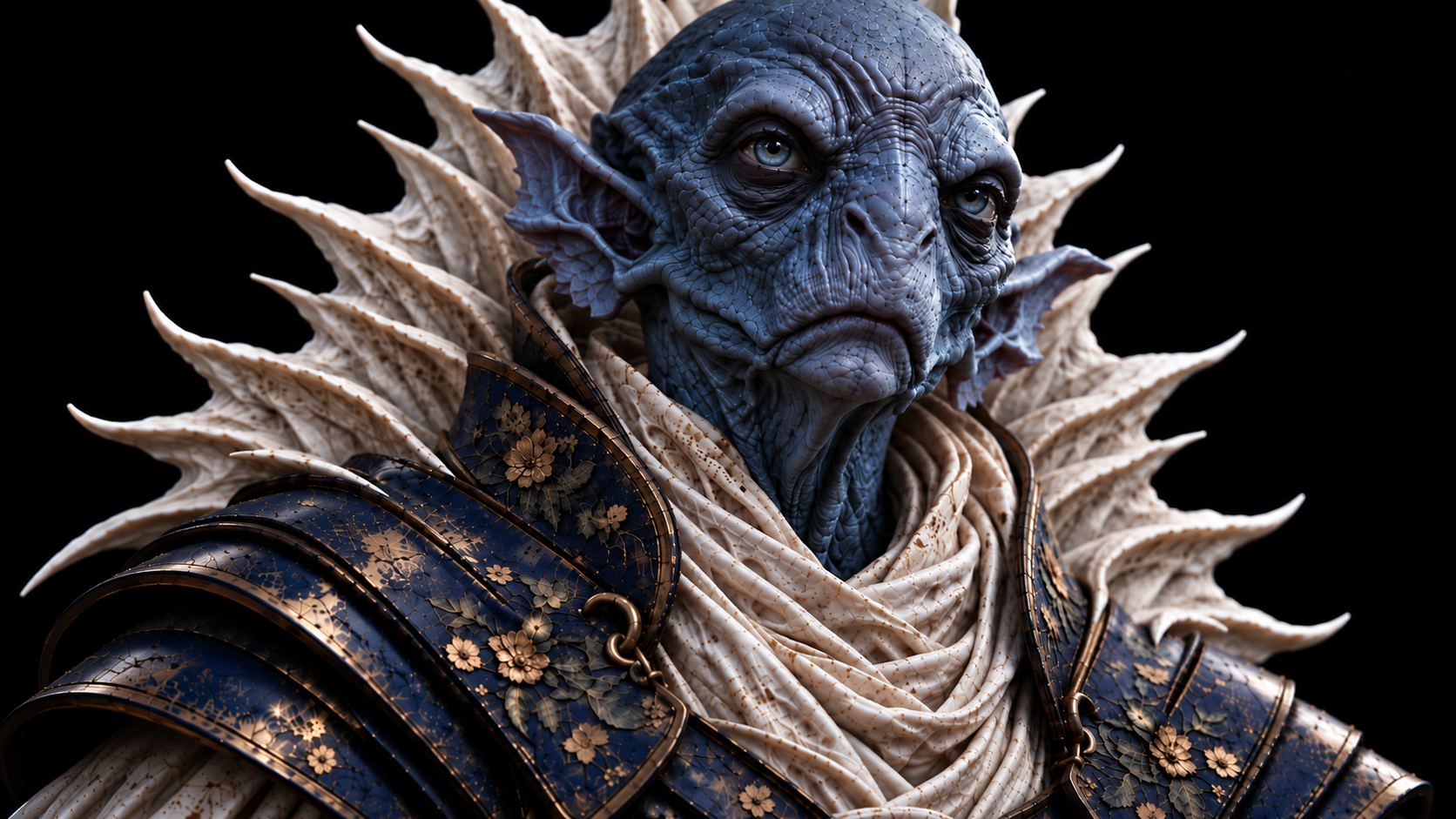
The blue and gold is Weneth cloth, dyed with cobalt from the salt years and patterned in gold. In 2044 the Weneth salt caravans stopped for good. The drivers were left owing road-tolls to every Kharrin camp between the Salt Fold and the Ember Road. They had no salt to pay with and no work. Alvak crossed out their tolls, all of them, one long winter on the road. When the drivers went home, they cut their caravan cloaks into lengths and gave them to him. They had nothing else.
The rope is raker's rope, the coarse cream line used to drag salt baskets across the pans. It comes from the rakes where he was born. It is coiled round his shoulders and neck in heavy loops. In Kharric, a line of inherited debts is called nesh-ven, a rope of salt. Alvak wears the rope instead of the debts.
The bronze toggles are camp tallies, small cast discs used by Kharrin counters to keep a running total. Counters from three different camps have pressed them into his hands over the years. They did it secretly and without a word, and none of them has ever explained why.
The drivers tied a Weneth knot into the hem of every length they gave him, one for each toll he crossed out. Alvak cannot read them. Neshwen, who led the last caravan, told him what they were. He has never untied one.
The Beetle on His Tongue
Alvak carries a dot-beetle on his tongue. He has done so since the night on the rakes. It is not the same beetle. They live about a year. When one dies, he walks out onto the nearest pan, kneels and waits with his mouth open until another climbs on.
Why he carries it
He gives a different answer every time he is asked. The road has collected them.
"So I cannot say what anyone owes."
"It robbed me once. I am returning the favour."
"It is the only creature that ever forgave me anything."
"It keeps my mouth salt."
"I am teaching it to count."
The first is closest to true. Every Kharrin meeting begins with counting the other person's dots aloud. With a beetle on his tongue, Alvak cannot count. He hums instead. Kharrin who meet him on the road find this almost unbearable. They count him anyway, out of habit, all the crosses, and he hums the whole time.
What it means to the Kharrin
The dot-beetle is the only animal the Kharrin consider unlucky. It eats debts in the night. It is a thief by nature. To carry one on purpose, in the mouth, where counting is done, is an insult so precise that most Kharrin assume it must be deliberate.
It is. He calls the beetle the Reckoner. He has done this in front of Darrak.
What it means to everyone else
Outside the camps the beetle has become something else. Children on the road catch dot-beetles and put them on their parents' faces while they sleep. Old women at the Salt Fold keep them in jars. In the Blue Hollow, where nobody keeps dots at all, the beetle is carved on the lintels of the shelters for the flaked.
Alvak did not mean any of this. He has said the beetle was just hungry. He happened to be lying in its way.
His Names
Alvak was not born Alvak.
Neshak
His birth name was Neshak. It comes from Kharric nesh, "salt," with -ak, "one who." It means "one who salts." It is a common raker's name, given to children born on the pans. It is also, in Kharric, the word for whoever lays a debt-dot, since the dots are salt. A raker's child is named for the substance of other people's debts before it owes anything at all.
Alvak
When the camps cast him out in 2034, they renamed him. Kharrin do not name outcasts for what they were. They name them for what they did.
Alvak comes from Kharric alv, "dust," with the same -ak. It means "one who turns things to dust." It is what you call a man who takes a debt, the most solid thing a Kharrin owns, and makes it into nothing. The camps meant it as a curse.
But alv is also the root of his mother's name. Alva means "dust" too, the ordinary dust of the red mountains. It is a common Kharrin name, with no curse in it. To the counters who chose it, Alvak meant "the dust-maker." To Alvak it has always sounded like "Alva's one."
He kept it.
The roots
Alv is one of the oldest words in the world. It comes from the Brine Speech ulv, the Floor, the ground everyone stands on. Each people kept it in its own colour. The Weneth say ulv, ground. The Ulmaeth say ulm, ochre. The Ilvenne say ilv, white clay. The Kharrin say alv, red dust.
Kharric changes sounds more than the other tongues, because traders talk to everyone. The old u became a. The old breathy kh stayed hard. A final r doubled, so the Brine root khar, "to bind," became Kharric kharr, a debt. To a Kharrin, binding and owing are the same word.
The Dern Kala
The road gave him his other name. The Dern Kala is Ember Road cant, the trade-talk spoken at the road-houses. Nobody owns it, and its words come from every people. Dern means "clean." Kala means "face." Together they mean "the clean face."
To a Kharrin, a clean face is the highest honour there is. It is given only to the dead who die owing nothing. To call a living man the Dern Kala is a joke, a blasphemy and a blessing at once. The road-houses say it all three ways. Alvak answers to it every time.
At the Lid-Stone
Nobody summoned Alvak to the Reckoning of the Shedding. He is not a party to any of its debts. He came anyway, in the first week, walking in off the Bone from the east with a beetle on his tongue.
He has no camp. The four peoples sit in a circle around the stone: the Ulmaeth, the Ilvenne, the Weneth and the Hollow. The Kharrin sit nowhere, because their Reckoner is the judge. Alvak sleeps out by the salt-rakes, on the uncovered crust, the way he did the night his life changed.
Every morning, after Amarwen recites the Law, Darrak counts the six hundred and four debts on his own face aloud. Every morning, from the edge of the circle, Alvak hums.
On the third day he offered to cross out Darrak's dots, all of them. He said it would save everyone a great deal of time. Darrak has not answered. He has not told him to stop humming either.
The People Around Him
Amarwen. The Weneth reader of the Law. Alvak follows her between the camps. He is the only person at the Reckoning who walks beside her rather than a step behind. He keeps asking her to read his face and tell him which of his debts are real. She has not yet found the words. In the portrait 3 Up: Alvak, Amarwen & Tallas he stands at her right hand, reaching out, mid-laugh.
Tallas. A fired Ilvenne of the ninth tower who cracked almost completely in the Breaking of 2044. He was mended in Kharrin gold, sent by Darra Val-Tal. So the Reckoner who could not decide Alvak's case also paid to make Tallas whole. Alvak was forgiven by no one and mended himself. Tallas was mended by someone else's payment. They stand on either side of Amarwen like the two answers to one question.
Darrak. The Reckoner, who carries Alvak's undecided case as a red-ringed dot near his right ear. Alvak calls his beetle the Reckoner. Darrak has heard him. The two of them have never spoken directly. Everyone at the Lid-Stone is waiting to see which of them speaks first.
Neshval. The rake-master of the eastern pans, who now lives on the Bone measuring the breath that seeps up through its cracks. Neshval was a young raker on the same pans when Alvak's mother died. He is the only Kharrin from the rakes who still speaks to him. He has never asked Alvak to cross anything out. Alvak has never offered.
Neshwen. The caravan-mistress of the Salt Fold, who led the last Weneth caravan in 2044. Her drivers were the ones whose tolls he crossed out that winter, and whose cloaks he wears. She told him what the knots in the hems mean. She is the only person he lets touch the cloth.
Khoralv. The six-armed ember-digger of the Kharrah. His debt-dots have melted together in the heat of the pits until no one can count them. Khoralv cannot be counted because of where he works. Alvak cannot be counted because he chose not to be. When they met on the Ember Road in 2061, Khoralv asked him whether it was easier. Alvak said no. Only lighter.
Kelak. The Kharrin physician, who offered in 2079 to treat Alvak's eyes. He thought the salt-white could be lifted. Alvak declined. He said he can see everything he needs to.
Namar. The blindfolded stair-warden of the Tessan, who lets the ashed pass by choosing not to witness them. Alvak's kindness is the opposite. He witnesses everything, every dot, and then lets it go. They have not met. When they do, one of them will have to decide which of the two is harder.
Orune. The pearl-coated stranger from the far coast, whose people cover every grief layer by layer until it shines and cannot be seen. She has already noticed Alvak. She thinks they want the same thing. They do not. Orune hides a wound until it gleams. Alvak leaves every debt on his face, crossed through but still visible, so anyone can count it.
What Is Still Unsettled
Is it forgiveness or theft? A debt is owed to someone. When Alvak crosses it out, the debtor walks free and the creditor loses what they were owed. Forgiveness belongs to the one who is owed. Alvak forgives on behalf of people he has never met. The counters say that is not mercy. It is spending someone else's money.
Can a debt be witnessed instead of paid? This is the question Darra could not answer. Alvak's crosses say I saw this. They do not say this is settled. He believes that a debt fully seen, counted every day for years without looking away, has been honoured in the only way that matters. No law of any people agrees with him.
Does he threaten the Reckoning? The Reckoning of the Shedding exists to count what the Ilvenne owe the Ulmaeth for a lost history. If debts can simply be crossed out, the whole sitting could end tomorrow. Some at the Lid-Stone think this is why Darrak lets him stay. Others think it is why Darrak never looks at him.
Is he mad? The camps say yes. The road says it does not matter. Alvak says he was mad before, when he counted his face in a pan of brine every morning for twelve years. He says this is what it looks like when that stops.
The Beetle at Night
In the evenings at the Lid-Stone, Alvak sits by the salt-rakes and takes the beetle off his tongue. He sets it on the back of his hand. It walks up his wrist, onto his face and across the crosses, slowly, the way it would cross a sleeping Kharrin's cheek.
There is nothing left for it to eat. The paste is long gone. It walks over every cross anyway, one by one, as if it were counting.
When it reaches his brow, he lifts it down and puts it back on his tongue. Then he gets up and walks into the circle of camps to find someone who is still awake and still counting.