Qaresse, The Ninth Reader
Qaresse is a fired Ilvenne of Sael-Qor and the Ninth Reader, the first scholar the towers sent out in two hundred years. As a young scribe of the ninth tower she kept the tallies of the salt cut from the floor of the world. In 1961 she wrote one line: The rim is quiet. Cutting continues. That summer the whole south shed its skins and lost its history.
Seventy-nine years later she went south to see what she had counted. She swore an oath not to copy the marks of the southern dead, and broke it the same night. What she copied turned out to be the warning against everything she had done. It also turned out to be the reason the world finally changed.
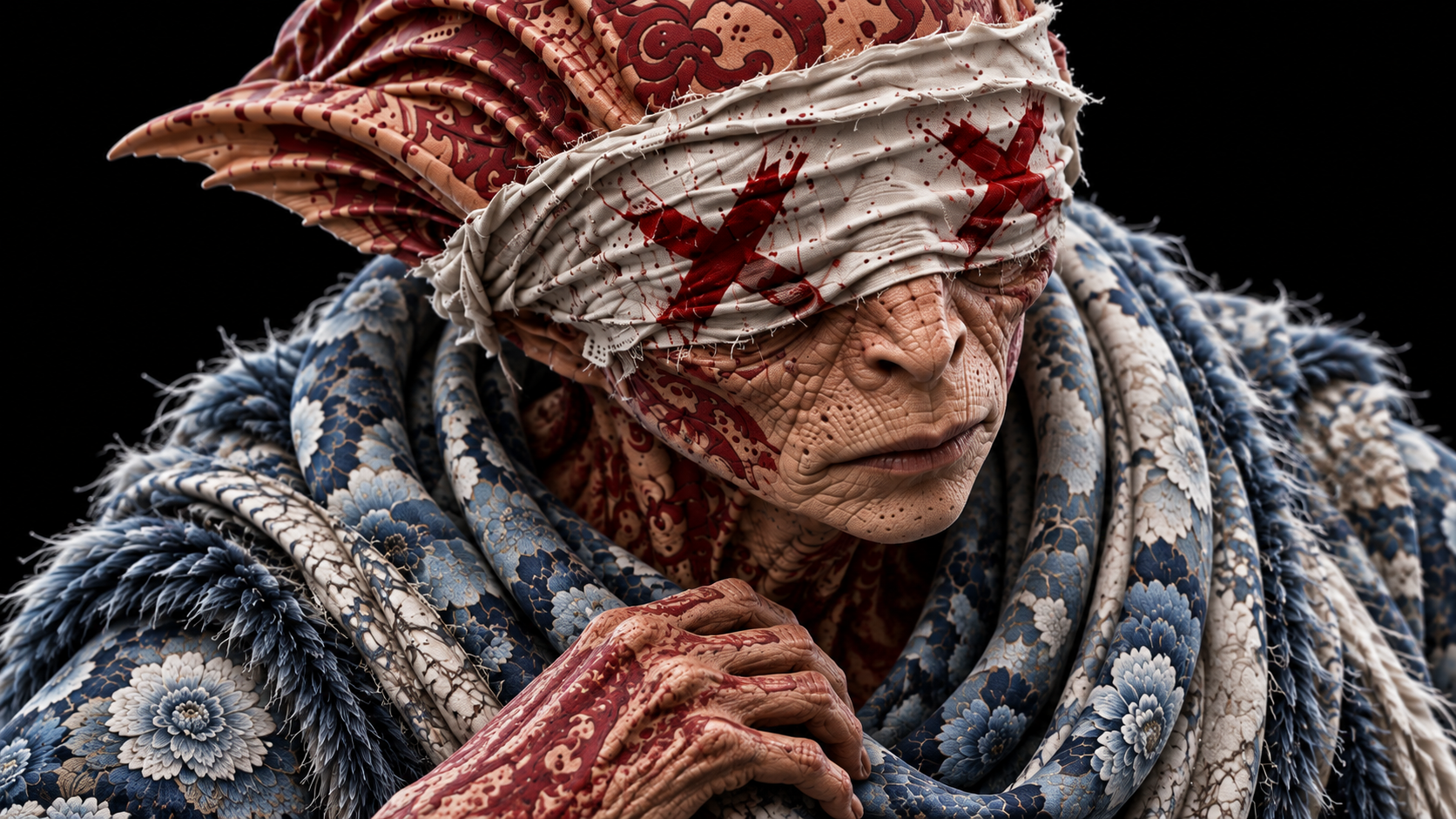
She is witness and accused at the Reckoning. Every noon she walks to the top of the southern stair and asks to come down. The warden says she sees no one. Qaresse will not go down unseen.
- Name
- Qaresse Vel-Sael
- Called
- The Ninth Reader
- People
- Ilvenne, of the first tower of Sael-Qor
- Born
- 1924 F.K. (1312 A.P.)
- Fired
- 1940 F.K., by her uncle Ilvas Qor-Ennu
- Age at the Reckoning
- 163
- Office
- Scribe of the ninth tower. Later the Ninth Reader.
- Known for
- The salt-tallies. Copying the Law of the Floor. Breaking her oath.
- Kin
- Cousin of Khaerith. Niece of Sael-Ennu. Foster-cousin of Qorran.
- At her brow
- A southern cross, fired under a Reader's orchid
- Seen in
- Qaresse of the White Kilns. 3 Up: Darrak, Qaresse & Neshval. Chapter One: The Twelfth Day.
The Fired, and the Readers
The Ilvenne live in nine towers in the white mountains north of the basin. Their city is Sael-Qor, blue fire. They left the southern basin fourteen and a half centuries ago, in the Parting, because their founder Ilvara wanted marks that could never be lost. The south struck all of them with ash for it.
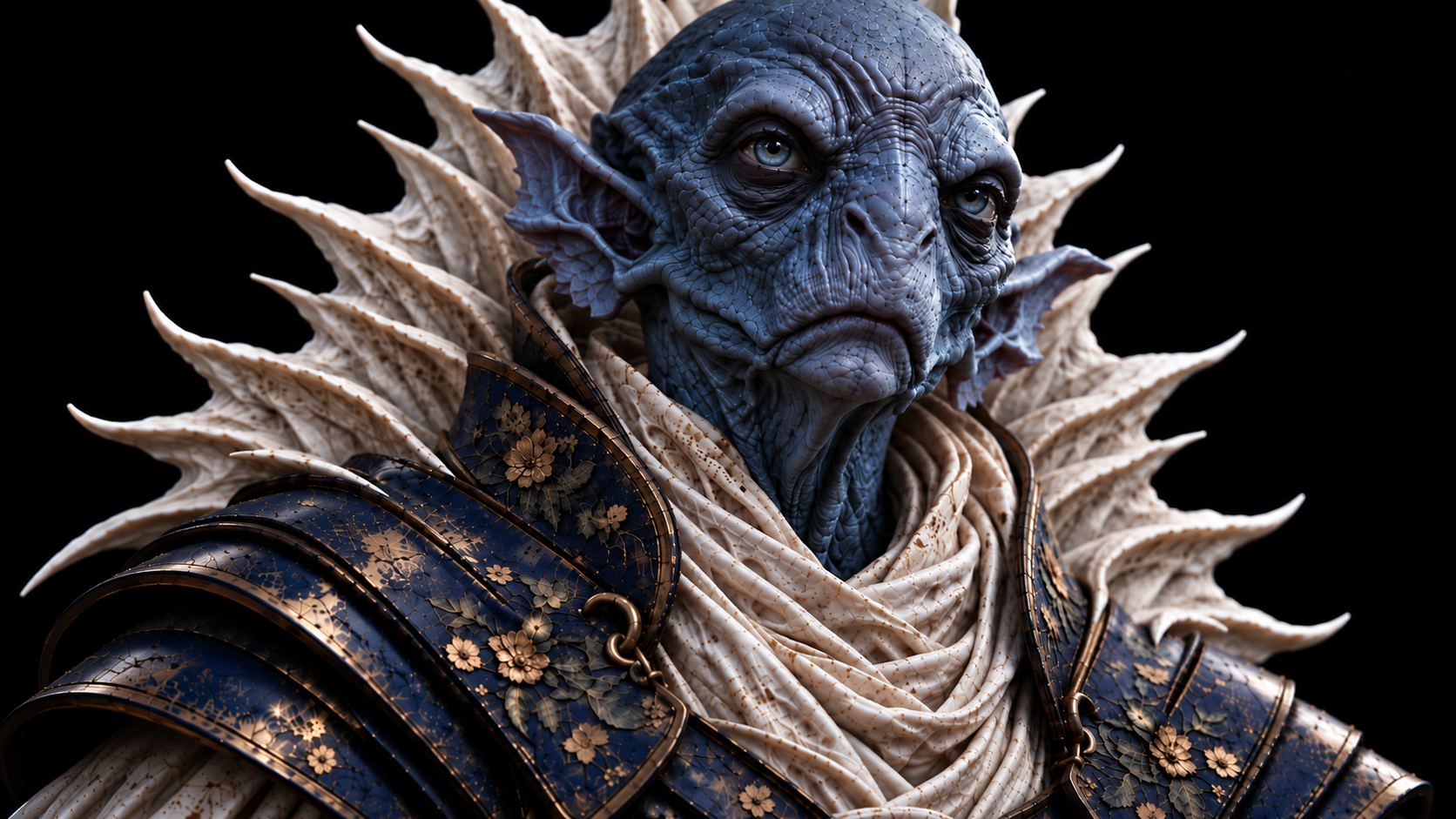
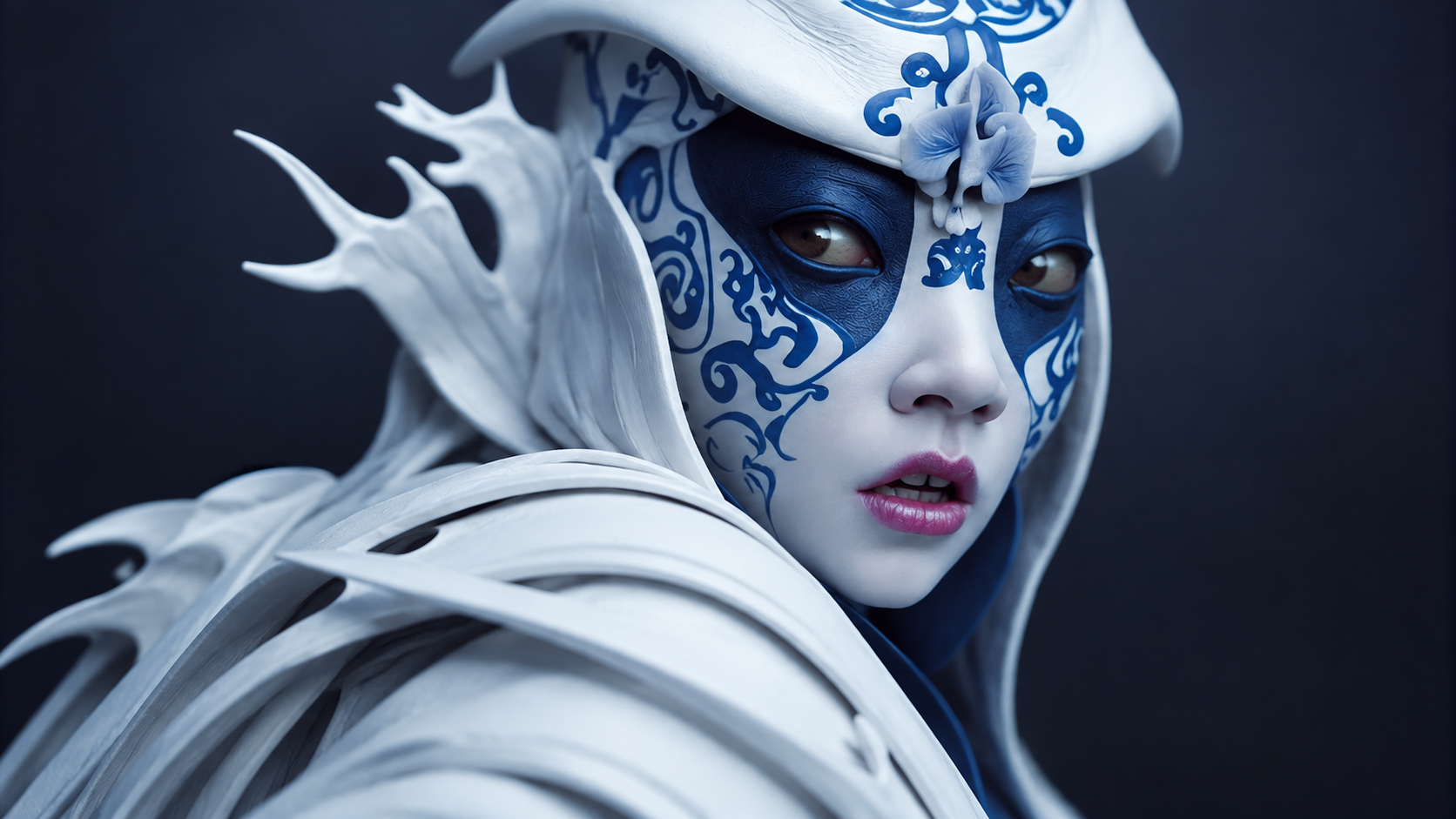
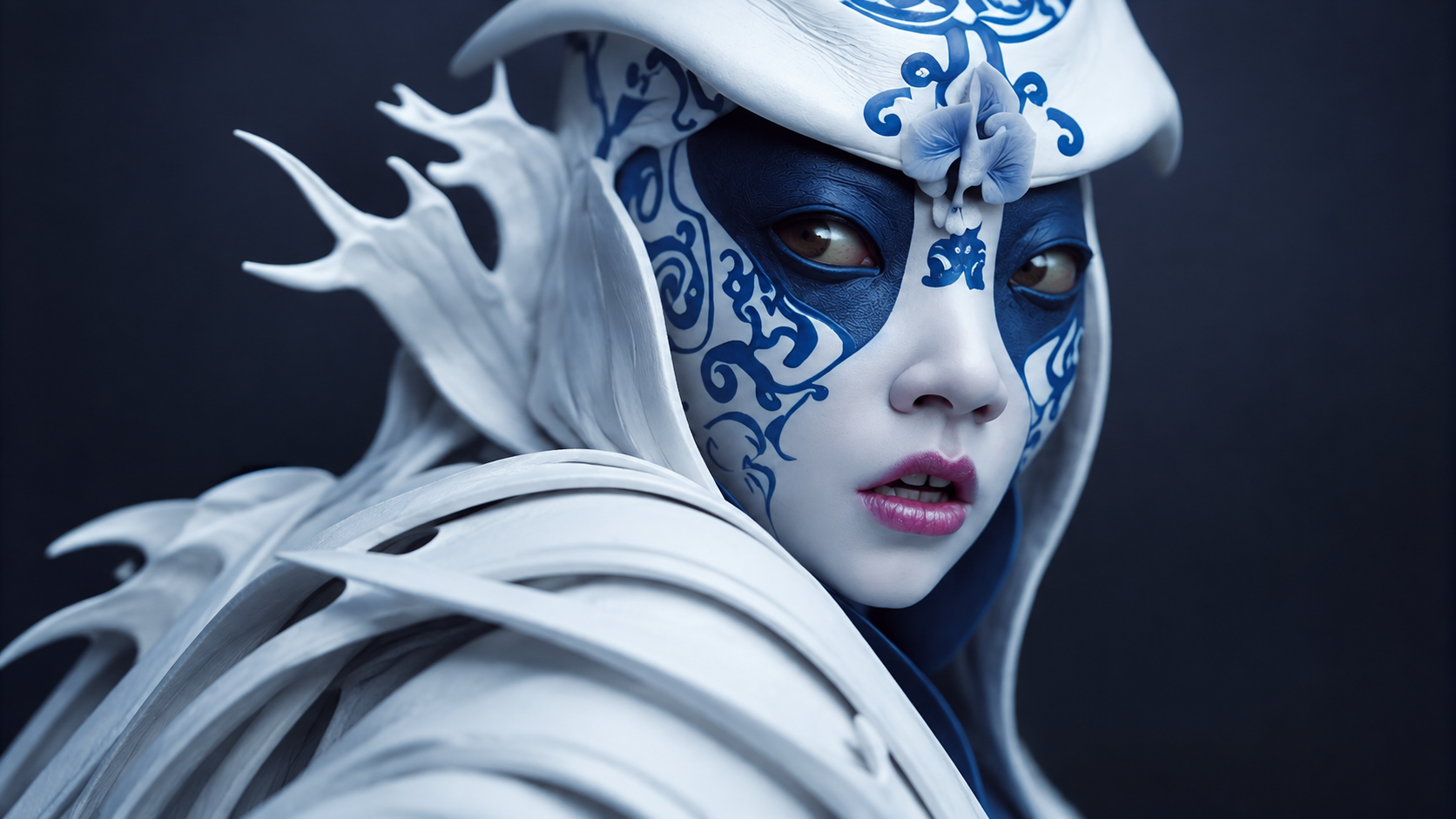
Every Ilvenne child is born soft and deep blue. At sixteen they are laid in white slip, painted with a Coil in cobalt and fired in the great kilns. They come out white and hard as porcelain, and they never change again.
The Coil
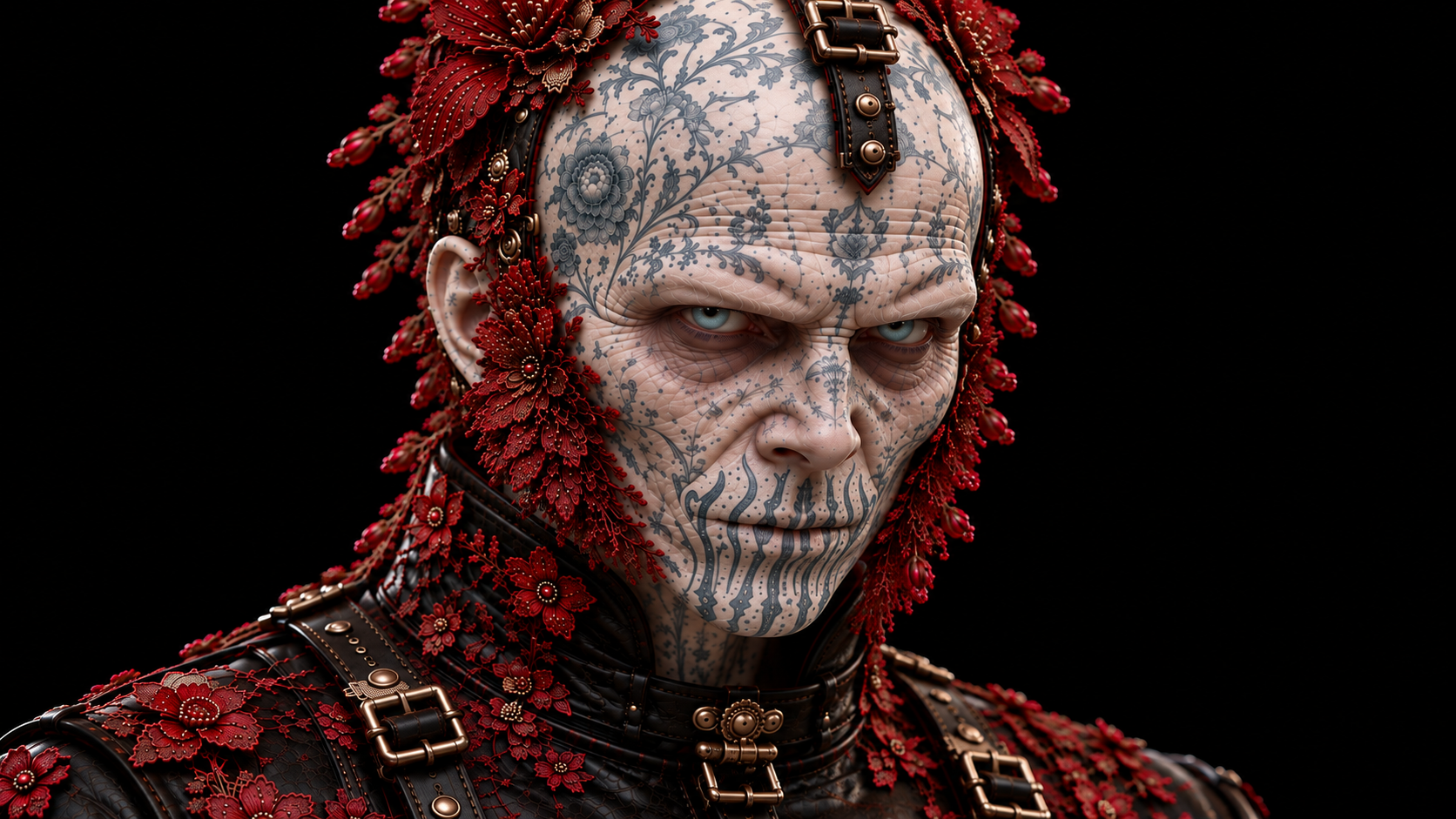
A Coil is a vow written in the future tense. The firing-master reads the child for a year and then writes what they will be. A spiral on the cheek is a craft. A hook at the temple is a debt the life will pay. The figure at the brow is what the master is least sure of. A life is judged by how closely it comes to match its Coil. The dead are buried with a tile saying matched or unmatched.
Two parts of the body are left unglazed. The fields around the eyes stay soft, so the fired can weep. They are painted cobalt-dark, so that grief cannot be read in them. The lips stay soft too, so the fired can speak and eat. They are painted with red earth bought from the south. It is the only southern red that will hold on an Ilvenne.
The Tally-Walls
The Ilvenne do not change, so they cannot add to their own bodies. Deeds are fired onto tiles instead and stacked in the Tally-Walls of Sael-Qor. Nothing on a tile can be altered. Errors stand, with the truth fired beside them. The oldest course, at the base of the first tower's wall, is written in a script no living Ilvenne can read.
The Readers
Once in a long while the towers send someone out. A Reader goes alone to another people, lives among them and writes what they find. Readers wear a porcelain orchid at the brow. Their books are sealed with cobalt wax and opened only if someone from the people described comes to Sael-Qor in peace and asks.
There have been nine. The eighth went east in 1840 and never came back. After him the towers sent no one for two hundred years. The ninth was Qaresse.
Born Blue
Qaresse was born in 1924 F.K. in the first tower of Sael-Qor. Like every Ilvenne child she was born deep blue, scaled and soft, with fins at her ears.
A family on both sides of the kiln
Her grandmother was Qaresse the Elder, a cobalt-reader, who judged ore at the Azure Seam by its colour. Qaresse is named for her.
The Elder had three sons.
Ilvas Qor-Ennu, the eldest of the twins, went into the kiln at sixteen and became a firing-master. He was the one who read children and wrote their vows.
Sael-Ennu, the other twin, stood at the kiln-mouth in his slip and walked away. He was a refuser, sent to the mines. In 1903 he walked south across the Bone and spent a winter in the city of the Ulmaeth. He came back the next year and never spoke of it, except once, to his twin.
Ennas, the youngest, was fired and became a cobalt-reader like his mother. He was Qaresse's father.
So Qaresse grew up with one uncle in the kilns and one in the mines. The family did not talk about the second one. She met Sael-Ennu twice as a child, at the edge of the Blue Hollow, when her father took cobalt samples there. He was blue and finned and old. He gave her flowers. She did not know then that she had a cousin in the south, or that the cousin had been named for the same grandmother.
Childhood
She was quick and watchful and liked numbers. Her father taught her to read cobalt by colour. Her uncle Ilvas taught her to read tiles. By twelve she could read the Tally-Walls of the first tower back four hundred years. She could not read the bottom course. Nobody could. Ilvas told her it was decoration from the founding.
She asked him once why the founders would decorate the foundations of a city where no one could see them. He did not answer.
The Firing
In 1940 Qaresse was sixteen. Her uncle Ilvas read her for a year, as masters read children, and then fired her.
Her Coil
Most of it was plain.
On the cheeks, the scribe's mark: twin hooks facing, qaru-imar, the vow to witness and set down. It was her craft.
Beneath the eyes, opening spirals, qaru-vel, the vow of a life of going out: travel, embassy, reading. Ilvas wrote her as a traveller before she had ever left the tower.
At the temples, a hook turned back on itself, qaru-hesk, the vow to return to a wrong and answer it. Her family took it for a small shame. She took it, much later, for an instruction.
The figure at the brow
At the brow, where the master writes what he is least sure of, Ilvas fired a figure no one in Sael-Qor could name. It was not a spiral or a hook. It was two strokes crossing at right angles, with a second bar laid across the upright.
The other masters asked him what it meant. He said: It is what she will undo. He would not say more. He set a Reader's orchid socket over it, though she was not a Reader and nobody expected her to become one. The orchid hid the figure.
Ilvas died the following winter, in 1941. He took the meaning with him.
It was a southern mark. It is the kharu-tal, the double-barred cross of the Ulmaeth, which means an oath kept to its end. No Ilvenne could read it, because the Ilvenne had struck all southern words from their lives at the Parting. Ilvas could read it because his twin brother had drawn it for him, once, describing a winter in the south. That was when Sael-Ennu told him he had a daughter there.
Qaresse would not learn any of this for a hundred and three years.
The Tallies
After her firing Qaresse went to the scribes' room of the ninth tower. It was the newest and smallest of the nine, and the least honoured. It suited her. It was quiet.
The salt
In 1952 the master of the ninth tower, Vessan Qor-Tal, began glazing with salt. He had found that a handful of salt from the Bone, thrown into a kiln at full heat, gave a glaze harder and brighter than anything the towers had ever made. He had made a compact with the Weneth of the west to carry it north on their wool-beasts. He had married a Weneth girl named Ishwen to seal it. She was fourteen.
Someone had to keep the tallies. How many cartloads came up the Salt Road. From which plates of the Bone. Cut how deep. Qaresse was twenty-eight, a junior scribe, and good with numbers. She was given the tallies.
She kept them for nine years.
Ishwen
Ishwen came to the ninth tower unfired, the only bare-skinned person in Sael-Qor. The children called her the unpainted. In 1954 Vessan fired her with salt. It nearly killed her.
She was given a seat in the scribes' room because there was nowhere else to put her. Qaresse was fourteen years older. She was the only person in the tower who spoke to Ishwen as an equal. They sat together through the long afternoons while the tallies were fired. Ishwen watched Qaresse write the numbers. Qaresse watched the cutting go deeper every year.
The line
In the ninth summer of the tallies, 1961, word came up the Salt Road that something had happened in the south. The plates at the southern edge of the Bone had cracked, and the basin smelled of brine.
The caravans kept coming. The cartloads kept arriving. Qaresse wrote the tally for that summer the way she had written every other. The tile for 1961 has one line on it, in her hand:
The rim is quiet. Cutting continues.
That summer every living Ulmaeth shed their skin at once and lost every mark they carried. The history of a people came off them like paper in the rain. Qaresse did not know that yet. She wrote what she was told to count.
Ishwen watched her write it.
The Seventy-Nine Years
After 1961 another scribe took over the tallies. Qaresse moved to the archive. The salt-glazing went on for eighty-three more years. She was in Sael-Qor for most of them.
What she knew, and when, is the question the Reckoning keeps returning to.
What she says
She says she did not know. Word of the Shedding came north slowly and in pieces. The Ilvenne elders asked the Weneth whether the salt was to blame, and the Weneth asked the Kharrin. The elders told everyone no. She believed them, as everyone did.
She also says that from 1961 onward she could not stop thinking about the line. She took the tile for that summer out of the ninth tower's wall more times than she can count. She read it. She put it back. She never wrote anything beside it.
What the others say
Her defenders say she went south in 2040 to find out what she had done. Her accusers say she went to see what could be hidden. The Tally-Walls show that she kept the count. They do not show that she understood it.
Ishwen, who was beside her that summer, says only this. Qaresse wrote the line slowly, and then sat for a long time looking at it.
The request
In 2040, at the age of a hundred and sixteen, Qaresse went to the elders and asked to be made a Reader. There had been no Reader for two hundred years. She asked to go south, to the Ulmaeth. The towers had sent three Readers south in their whole history, and none since the 1600s.
The elders agreed. It is not clear why. Some say they were curious. Some say they wanted to know what the south knew. Qaresse says they did not care where she went, as long as she stopped taking the 1961 tile out of the wall.
They fitted a Reader's orchid into the socket her uncle had made a century before. It fit exactly.
South
She crossed the Bone in the spring of 2041. She was the first Ilvenne to cross it since her uncle Sael-Ennu, and he had gone as a refuser. She went as a Reader, with an orchid at her brow and a book with nothing in it.
The stair
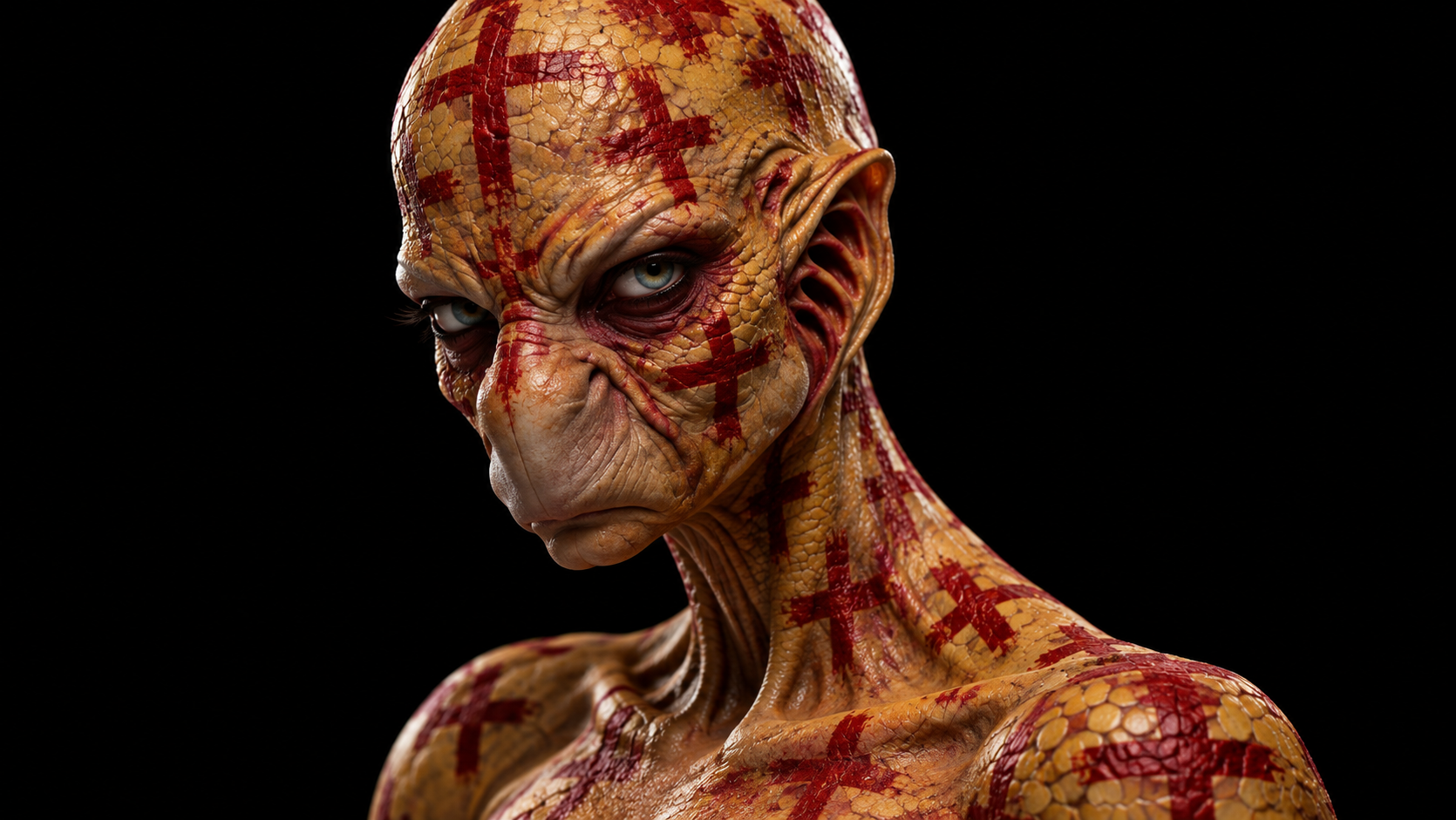
The city of the Ulmaeth climbs out of the basin on a single stair cut into the cliff. The red crosses of their history were once painted on every step. After the Shedding the steps were the only record left. The skins had come off. The stone had not.
She was stopped at the foot of the stair for eleven days. Nobody would speak to her. On the twelfth day an old painter came down and asked her, in Brine Speech, what she was. She told him. He asked her what was under the orchid. She said she did not know.
He lifted it out of the socket with two fingers, looked, and set it back. Then he took her up the stair.
The oath
The figure at her brow was a kharu-tal, an oath kept to its end. The Ulmaeth do not paint it on anyone who has not sworn one. The painter told her she was wearing a promise she had not made. In the south that is a debt.
She asked what the oath was. He said that was for her to find.
She stayed. She learned Ulmaeth speech from the children, who laughed at her vowels. She learned to read the crosses on the stair. On the four hundred and eighty-first step she found her uncle's name, painted in 1903, in a hand that was not his: the blue one who walked out of the fire.
The copying
The Ulmaeth had lost their past in one summer. The Ilvenne had kept the tallies of what took it. Qaresse understood, on the stair, that her towers held the only written account of the years before the Shedding that anyone had kept. Every cartload of salt was a date. Every plate of the Bone was a place.
She wrote north and asked for copies of the Tally-Walls. The elders refused. She asked again. They refused again. In 2049 she went back to Sael-Qor herself and copied them by hand, nine towers, eighty-three years, in the scribes' room of the ninth tower, where she had written them the first time. It took her four years.
She carried the copies south in 2053 and gave them to the painters. They used the dates to rebuild their calendar. They used the places to remember which families had lived on which plates. They did not thank her. She had not expected them to.
The tile for 1961 she did not copy. She carried the tile itself.
The name
In 2061 the Ulmaeth painted a name on the stair for her. It is the only Ilvenne name on the stair besides her uncle's. They wrote her as Vel-Sael, the one who went out and came back, which is also the vow beneath her eyes. She has used it ever since.
In the same year she met Khaerith, a painter of the stair, who was Sael-Ennu's daughter. Neither of them had known the other existed. They were named for the same grandmother. They sat on the four hundred and eighty-first step and read their uncle's and father's name together.
West and North
Wennar
In 2068 she went west to Wennar, where the Weneth keep the Great Cloth. The Weneth weave only what all parties agree happened. She wanted the summer of 1961 woven in. She brought the tile.
The weavers would not weave it. The Kharrin had not agreed. The ninth tower had not agreed. Qaresse was one scribe, and a line on a tile was one account.
She stayed a year anyway. She found the place in the Cloth where 1961 should be. It is a hand's width of plain undyed wool. The Weneth call it the quiet, after her line, though few of them know that.
It was in Wennar that she learned what had become of Ishwen. Ishwen had left Sael-Qor in 1962, the year after the line, and walked home. Her salt-fired skin had never healed. She had never been rewoven into her own people's Cloth either. Qaresse went to find her and was turned away at the door.
The Hollow
In 2072 she went north to the Blue Hollow, where the ilv-hesk plant what is mourned. Her uncle Sael-Ennu was there, as he had been for most of his life. He was very old. He knew who she was before she reached him.
She told him about the stair, and about Khaerith. He listened. Then he told her about the winter of 1903, and the drawing he had made for his twin, and why Ilvas had fired a southern oath on a child of the towers.
He wanted someone in the family to owe the south something, Sael-Ennu said. He thought it would make you go.
The flower
The ilv-hesk plant a tal-flower for each grief they agree to carry. Qaresse asked them to plant one for the Shedding. They told her the Hollow already held one, planted in 1962 by an unpainted woman from the west who had come north and would not give her name.
It was Ishwen.
Qaresse planted a second flower beside it. She did not ask anyone's leave. It grew. The ilv-hesk say that a flower planted by the one who caused the grief will not take. Hers did. They have argued about it ever since.
Her Book
Every Reader writes a book. When the Reader dies the book is sealed in the archive of the ninth tower, unread, for as long as the towers stand. Eight are sealed there now.
Qaresse's is the ninth. It is not sealed. She has been writing it for forty-six years.
It has three parts.
The first is the tallies, 1952 to 1961, written out again in full in her own hand, with every number she set down and what she now knows each one cost.
The second is the stair. It is a copy of every cross on it, step by step, so that if the stone goes the way the skins went, there will be one more account.
The third is blank. She says it is for what she will undo. She has not started it.
She has read parts of the second aloud in the south. She has never read the first aloud to anyone. Khaerith has asked. Ishwen has not.
At the Reckoning
In the autumn of 2087 the five peoples met at the Lid-Stone to reckon the salt years. Qaresse came as a Reader of the towers and as a witness for the south. She is the only person at the Reckoning who has stood on both.
She is also accused.
The Kharrin, who wear the owed, have counted her among those who carry the debt. The ninth tower has counted her among those who should not speak for it. The Ulmaeth have said nothing, which in the south is a kind of judgment. Namar, who speaks for the stair, sits beside her each day and has not said which way he will go.
The tile
On the fourth day she laid the 1961 tile on the Lid-Stone. The rim is quiet. Cutting continues. She read it aloud in Brine Speech so that every people could hear it in its own root. Then she sat down.
Nobody spoke for the rest of the day.
The twelfth night
On the twelfth night of the Reckoning she lifted the orchid out of its socket in front of all five peoples and laid it beside the tile. Under it was the cross.
She did not explain it. The Ulmaeth at the Lid-Stone could read it. So could Khaerith, who stood up. So could Vaelith, who carried the stair's ochre and had not looked at her once in twelve days, and who looked at her then.
She has not put the orchid back.
Her Body and What She Wears
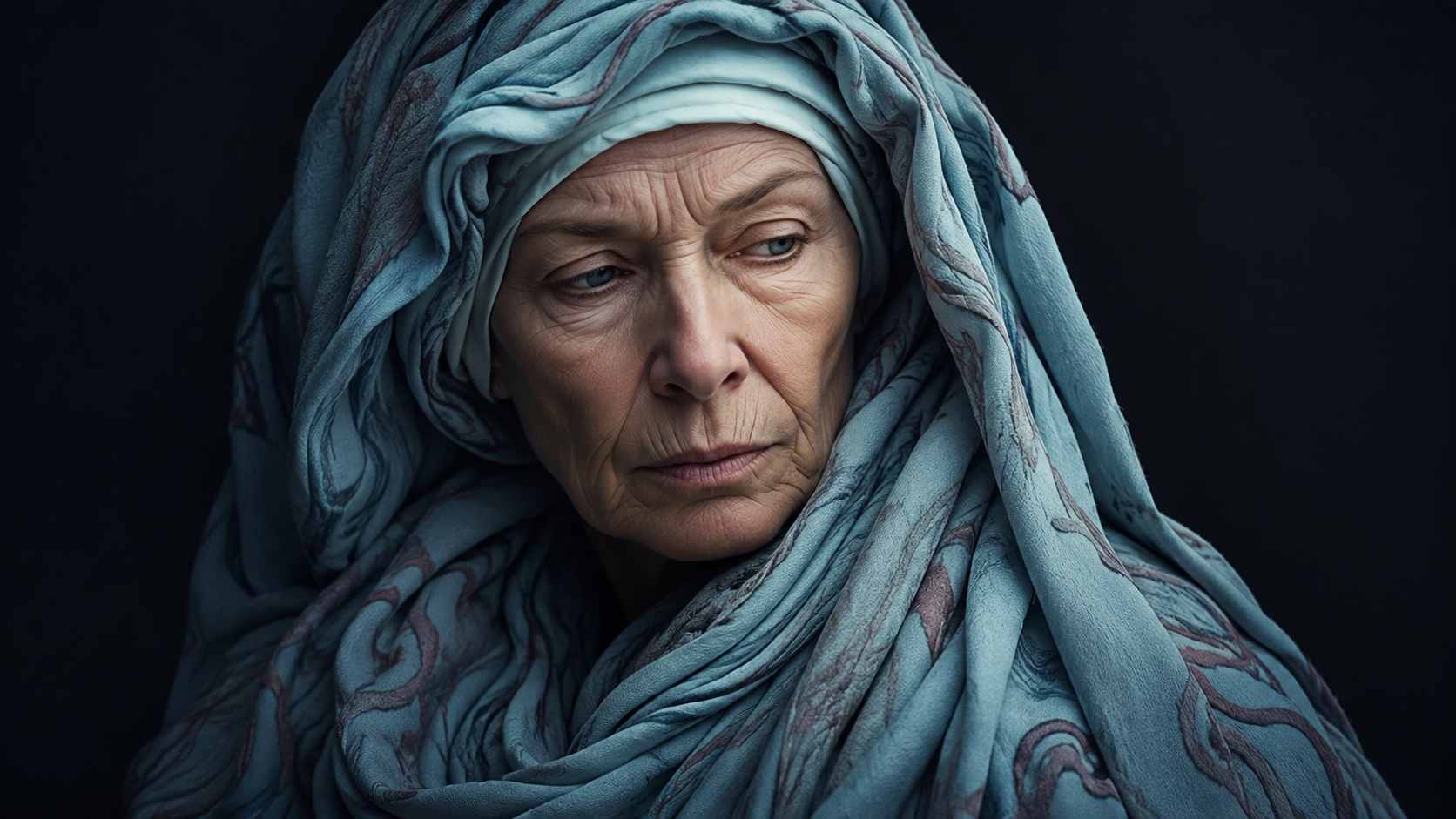
She is a hundred and sixty-three. For an Ilvenne that is old but not ancient. The porcelain of her face has gone the colour of milk, as fired skin does with age. The cobalt has not faded. Cobalt does not.
The Coil runs as it was fired: the scribe's hooks on the cheeks, the opening spirals under the eyes, the turned hook at the temples. The lines at the corners of her mouth are not glaze. They are her own.
The socket at her brow is a small round well in the glaze, a little deeper than a thumbprint, with the southern cross at the bottom of it. Without the orchid it looks like an empty eye.
The orchid is white, with a blue throat. It is a living flower, grown in the Readers' house in the first tower and replaced each spring. The one she lifted out on the twelfth night was the forty-seventh. She keeps it, dried, inside the back cover of her book.
She wears the plain undyed robe of the scribes' room. She has worn it in the south, in Wennar and at the Hollow. The Ulmaeth painted one red cross on the hem in 2061. It has not been washed out.
Her Names
Qaresse. Her birth name, after her grandmother. In Ilvenne the root qar- is the Brine Speech kher-, to count or to keep. The -esse ending is a grandchild's form. The one who keeps, after her.
Vel-Sael. Her Ulmaeth name, painted on the stair in 2061. Vel is going out. Sael is the towers. It means the one who went out from the towers and came back. Her uncle Ilvas wrote the same thing under her eyes in 1940, in a script the Ulmaeth could not read.
The Tally-Hand. What the Kharrin call her. It is not a compliment.
The Quiet. What a few Weneth weavers call the bare hand's width in the Cloth. Some of them use it for her as well.
Cousin. What Khaerith calls her. It is the only name she answers to without pausing.
The People Around Her
Ilvas Qor-Ennu (died 1941), her uncle, the firing-master. He fired a southern oath on her brow and hid it under a flower. She has forgiven him. She is not sure he needed it.
Sael-Ennu, her uncle, the refuser of the Blue Hollow. He told her why. She visits him every few years and he gives her flowers, as he did when she was small.
Ennas, her father, a cobalt-reader. He died in 2019. He never asked her about the south.
Khaerith, her cousin, Sael-Ennu's daughter, a painter of the stair. They found each other on the stair in 2061, when both were already old. Khaerith is the one who stood up on the twelfth night.
Qorran, her foster-cousin, raised in the towers. He thinks she should have kept the orchid in.
Ishwen, who sat beside her in the scribes' room and watched her write the line. They have not spoken since 1961. Two flowers grow side by side in the Hollow.
Vessan Qor-Tal (died 2044), master of the ninth tower, who began the salt and gave her the tallies.
Namar, who speaks for the stair at the Reckoning and sits beside her at noon.
Vaelith, who carries the ochre, and who looked at her.
Open Questions
What she knew in 1961. The tile says she counted. Ishwen says she sat a long time. Neither says she understood.
What the oath is. Ilvas wrote it. Sael-Ennu explained it. Nobody has told her what, exactly, she has sworn to finish. The third part of her book is waiting for it.
Why her flower took. The ilv-hesk are still arguing.
Whether Ishwen will speak to her. Ishwen is at the Reckoning. She sits with the Weneth, three places down.
Since the twelfth night Qaresse has gone to the top of the stair at noon each day. She stands there without her orchid. Her brow is bare. She waits to be seen.