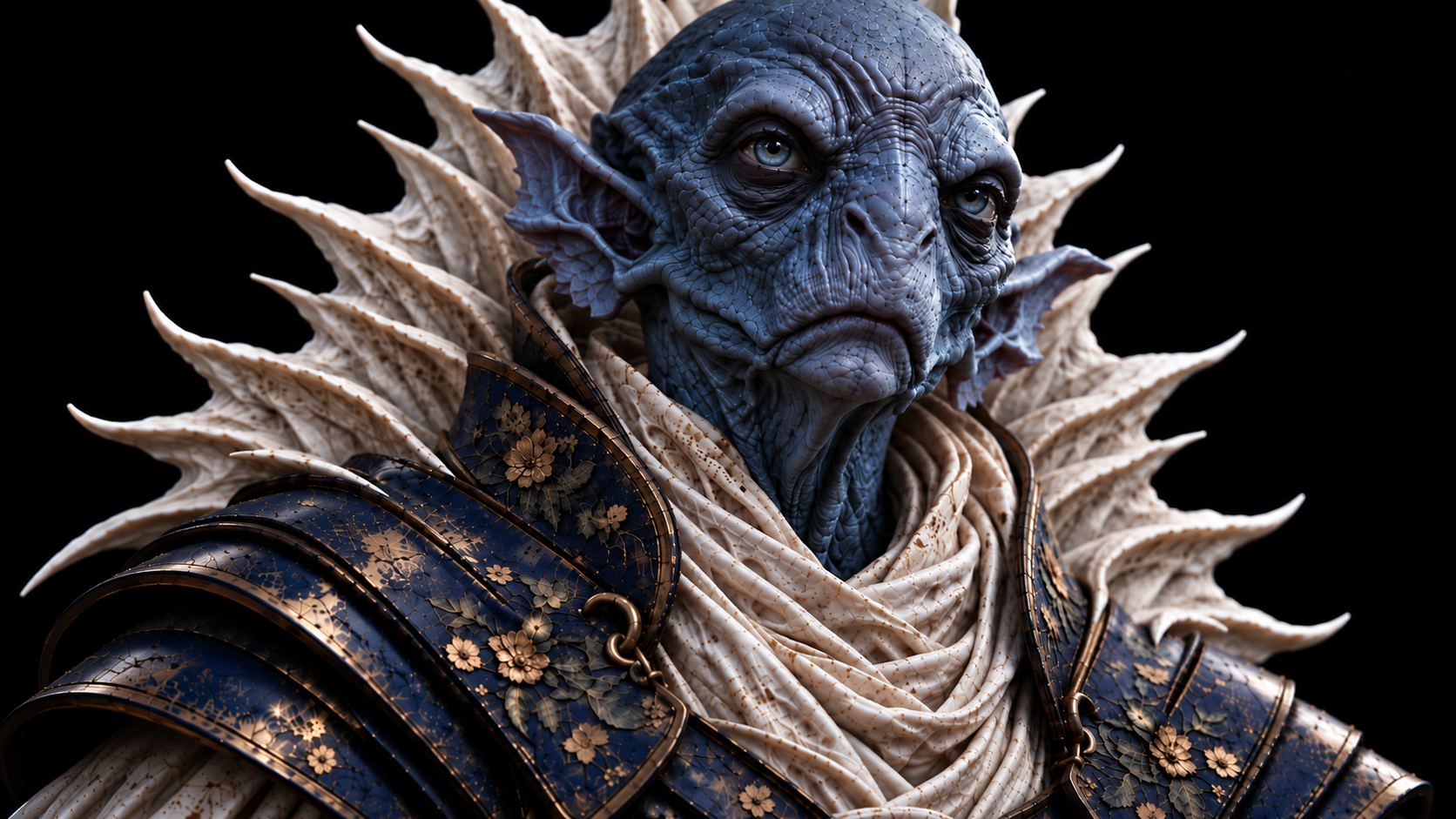
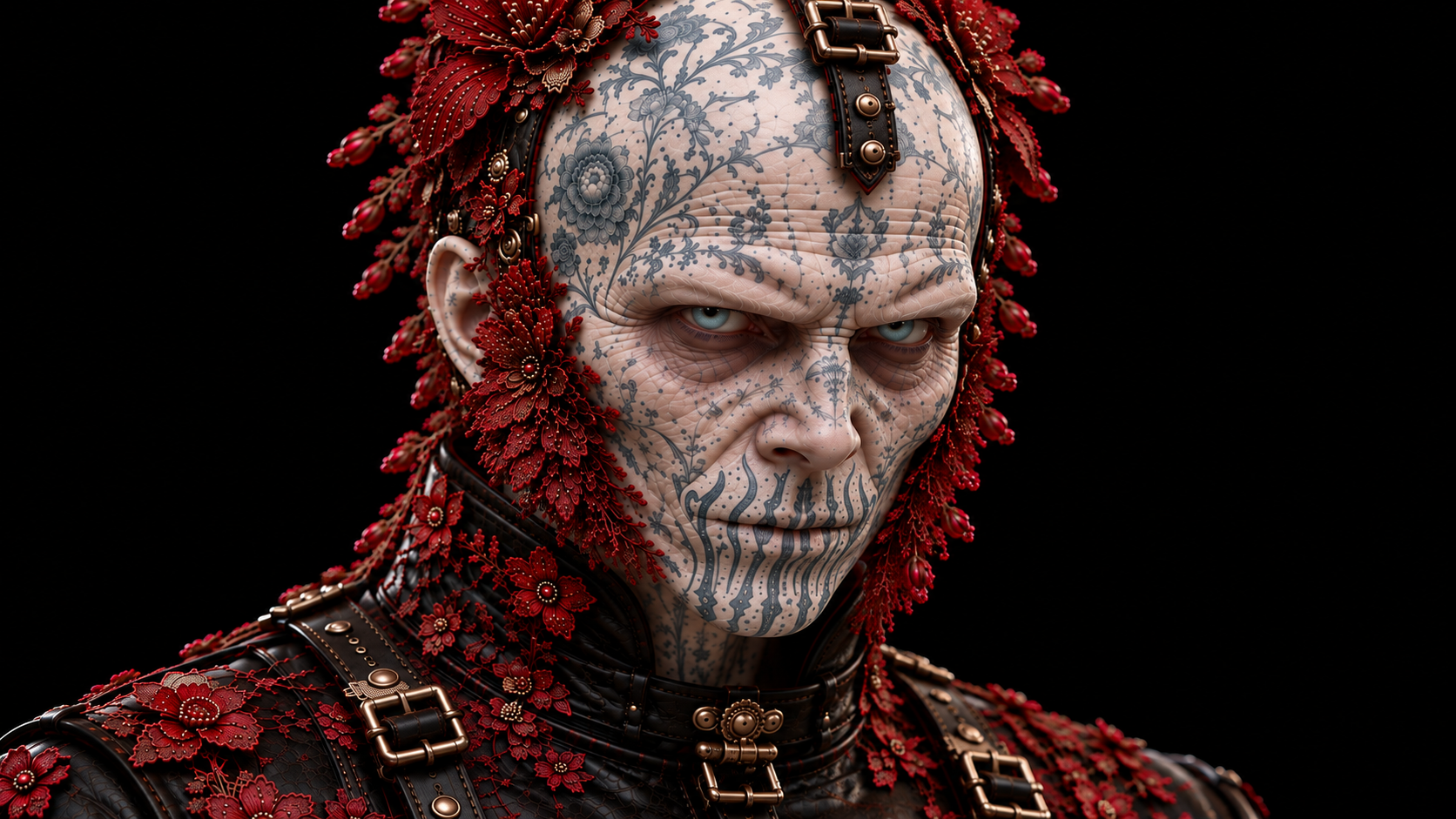
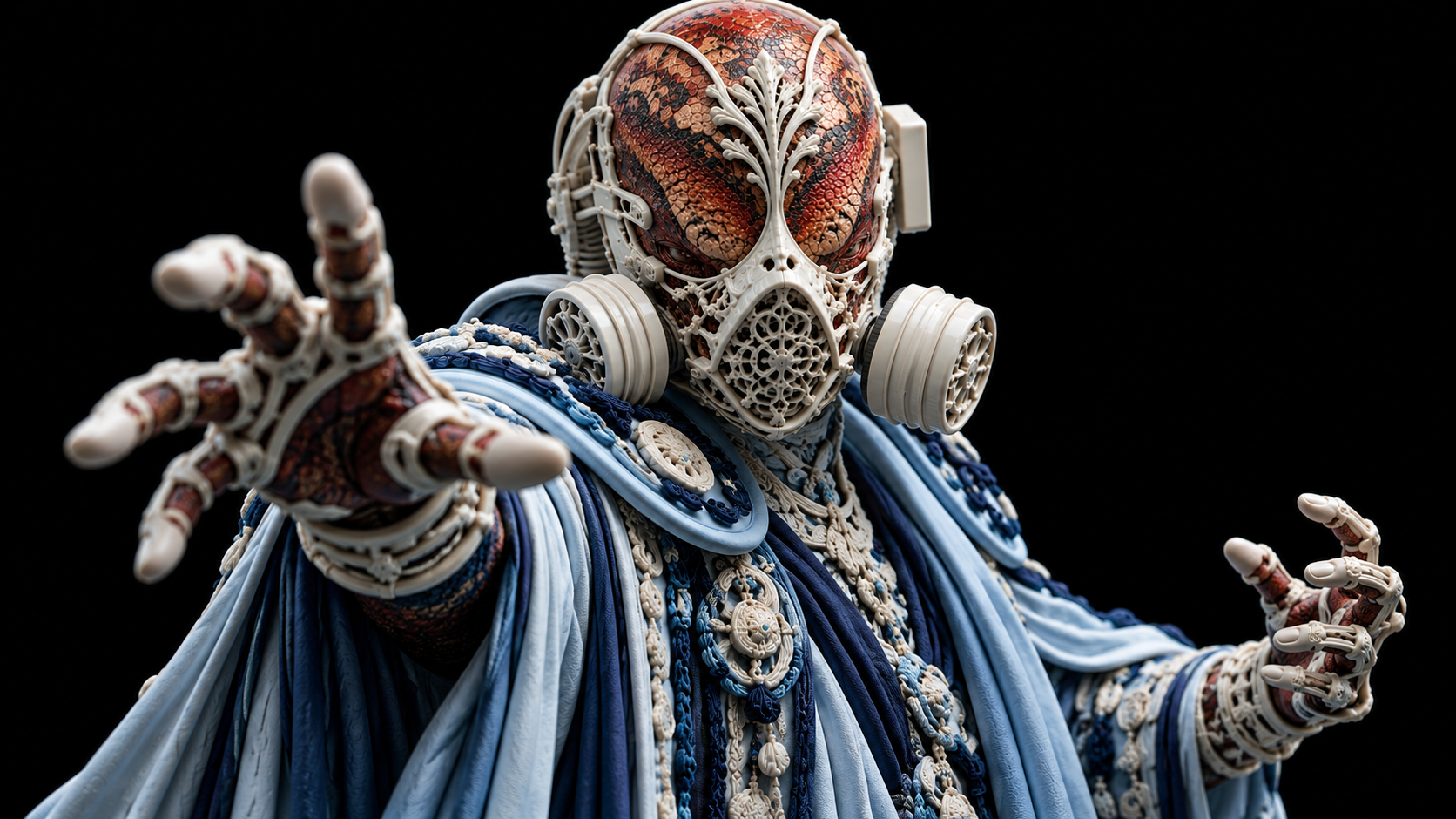
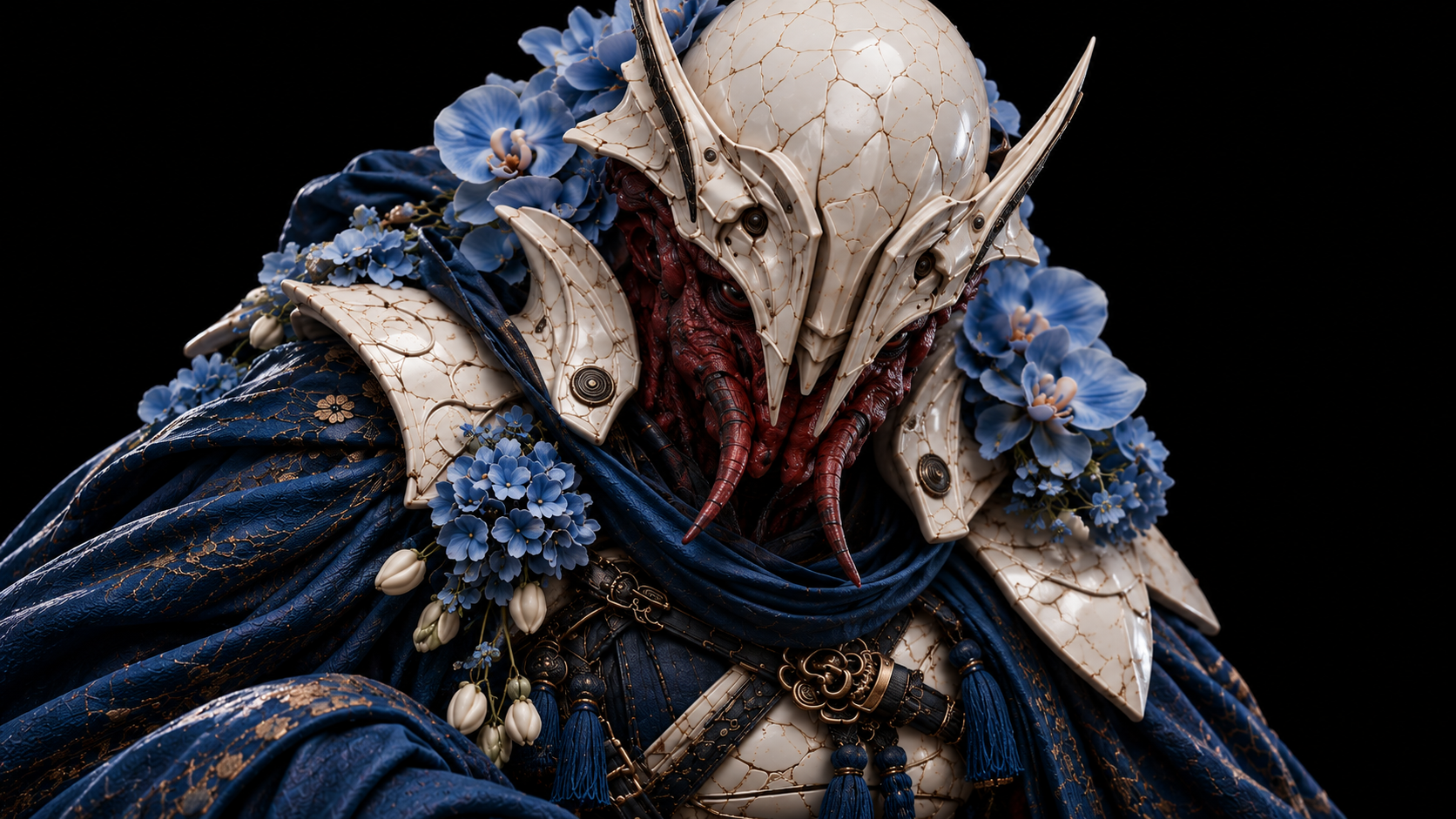
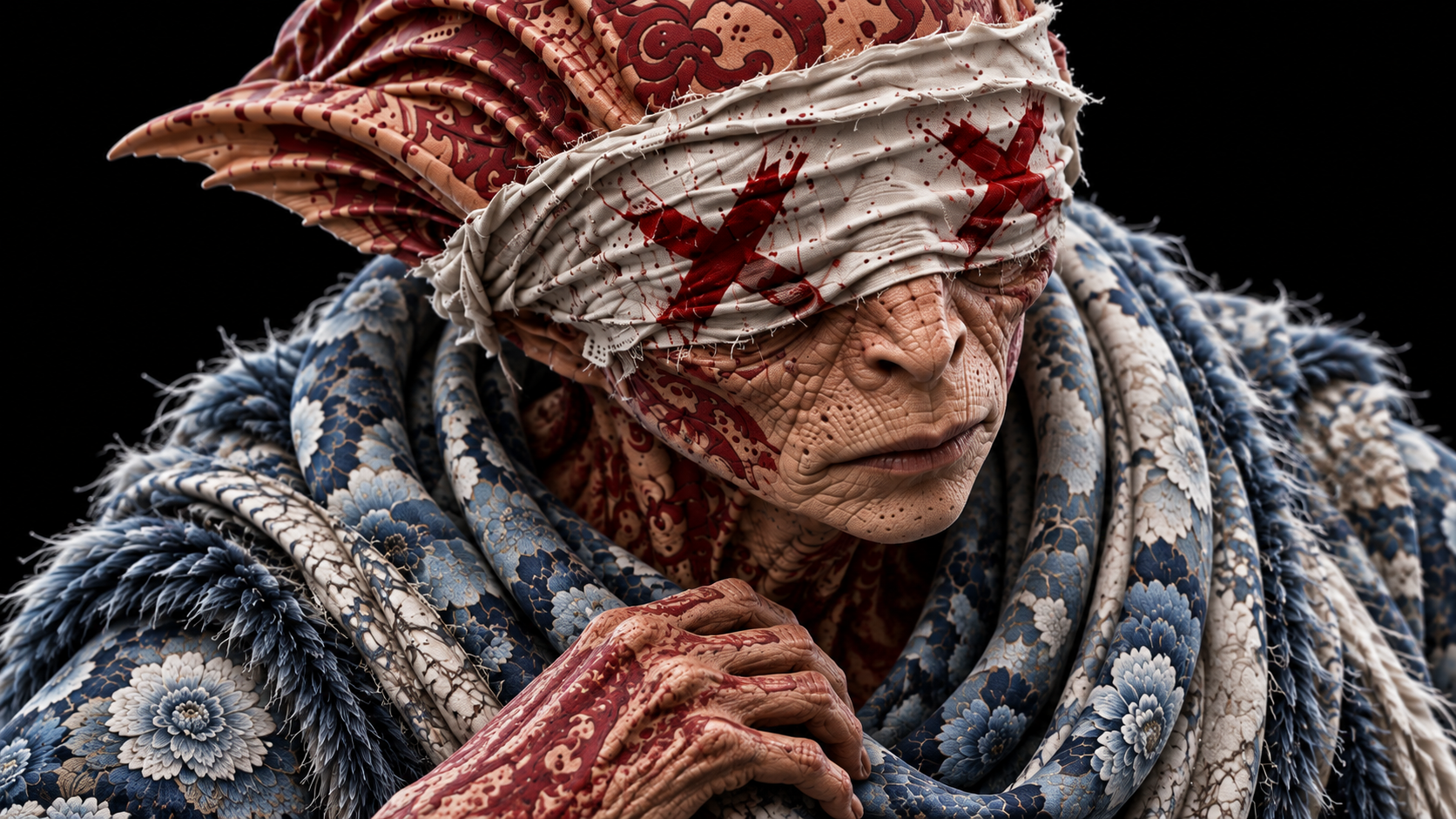
Kelak, Olsen Olsen
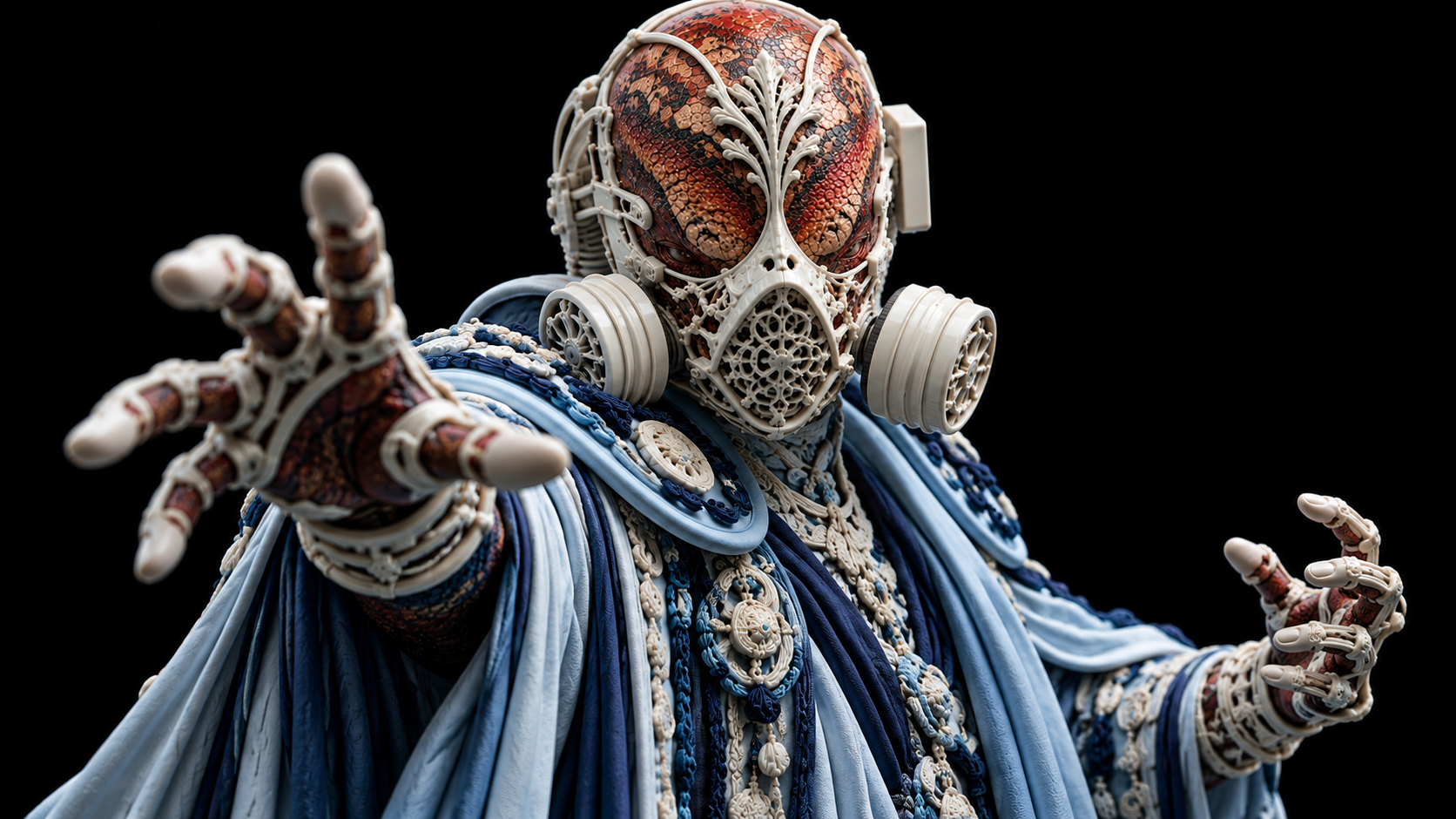
Kelak is a Kharrin physician, and the first Kharrin ever trained among the menders of Sael-Qor. He treats the two great sicknesses of the age. In the south, the Ulmaeth shed their skins too early. In the north, the glaze lifts off the Ilvenne. He treats both because he believes they are the same sickness: a sickness of skin.
He came north at nineteen carrying the gold that mended a broken man. He stayed to learn how the fired are put back together. He has been mending people ever since, in a mask of fired lace that lets him breathe the air of the Bone. He will not take payment. In a people who keep only what is owed, that makes him very strange. In a book about grief, it makes him kindness as a trade.
- Name
- Kelak, born Vallak
- Called
- Olsen Olsen, by the children of the Hollow
- People
- Kharrin, of the Ember Road
- Born
- 2026 F.K., in a goldsmiths' camp
- Age at the Reckoning
- 61
- Craft
- Physician of the skin. Mender. Lace-firer.
- Trained
- Among the menders of Sael-Qor, the first Kharrin to do so
- Known for
- Mending Tallas in gold. Lace splints for failing glaze.
- Wears
- A breathing mask of fired lace. Lace sheaths on every finger.
- Takes
- No payment, and lays no dots
- Seen in
- Kelak, Olsen Olsen. 3 Up: Ulvas, Kelak & Saelesse.
The Kharrin, and What a Healer Is Owed
The Kharrin are the red people of the east. They live along the Ember Road, the only road that touches every people, and they trade with everyone. They keep no history of their own. They keep accounts.
Every debt a Kharrin takes on is painted on their face as a white dot of salt-paste. Each debt paid is rubbed away. When a Kharrin dies, their dots are copied onto their heir. A clean face is the highest honour there is, and almost nobody has one.
Healing is a debt
To the Kharrin, everything given is owed. That includes care. A Kharrin physician who sets a bone or closes a wound lays a dot on the patient's face before they leave. It is not cruelty. It is the only way the Kharrin know to say that something happened between two people and mattered.
Kharrin physicians are rare and grow rich. Their own faces are usually clean, because everyone owes them and they owe almost no one.
Kelak has never laid a dot on anyone. When the camps ask why, he gives the same answer every time.
"A sickness of the skin," he says, "cannot be paid for in marks on the skin."
Skin, everywhere
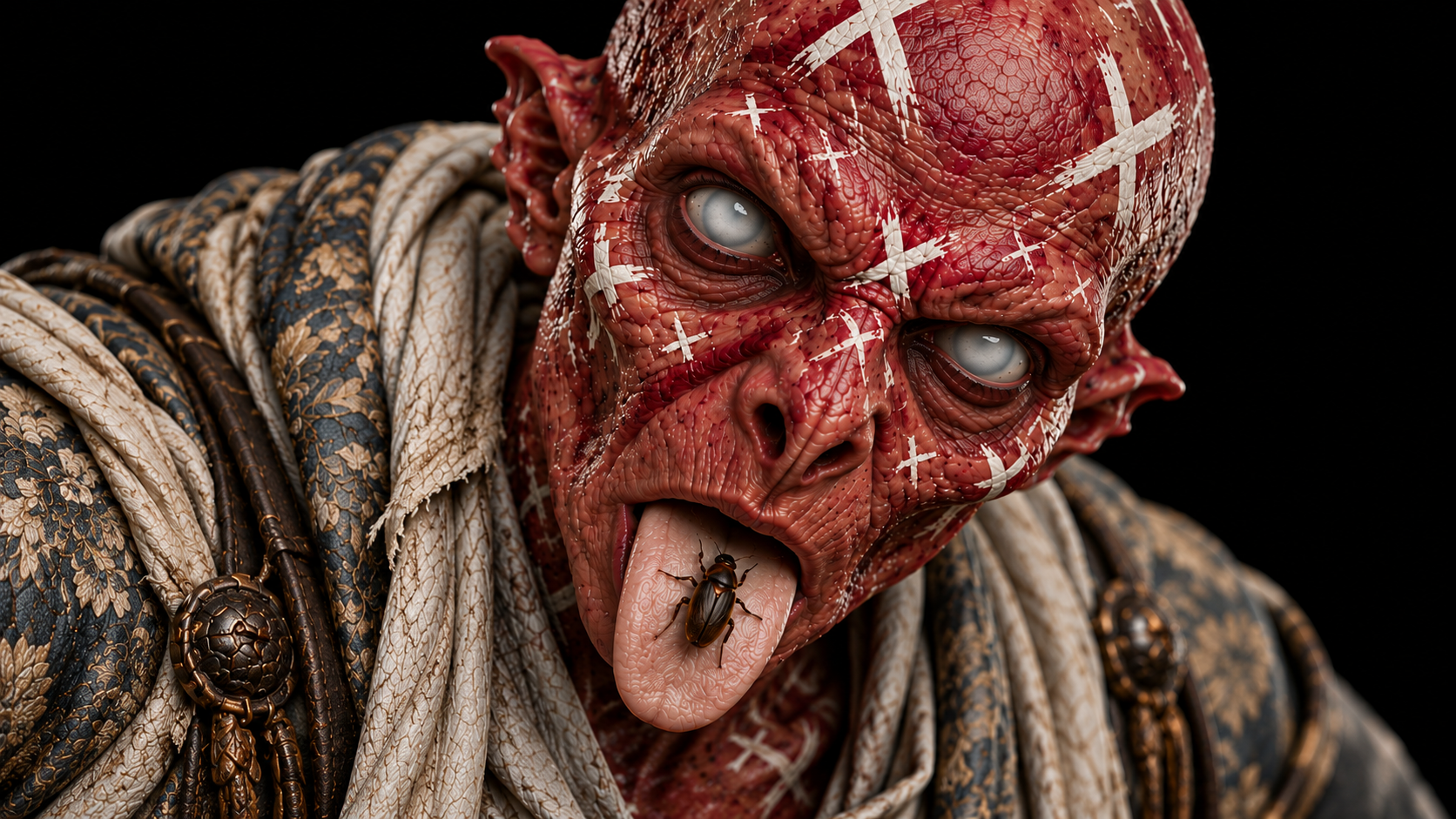
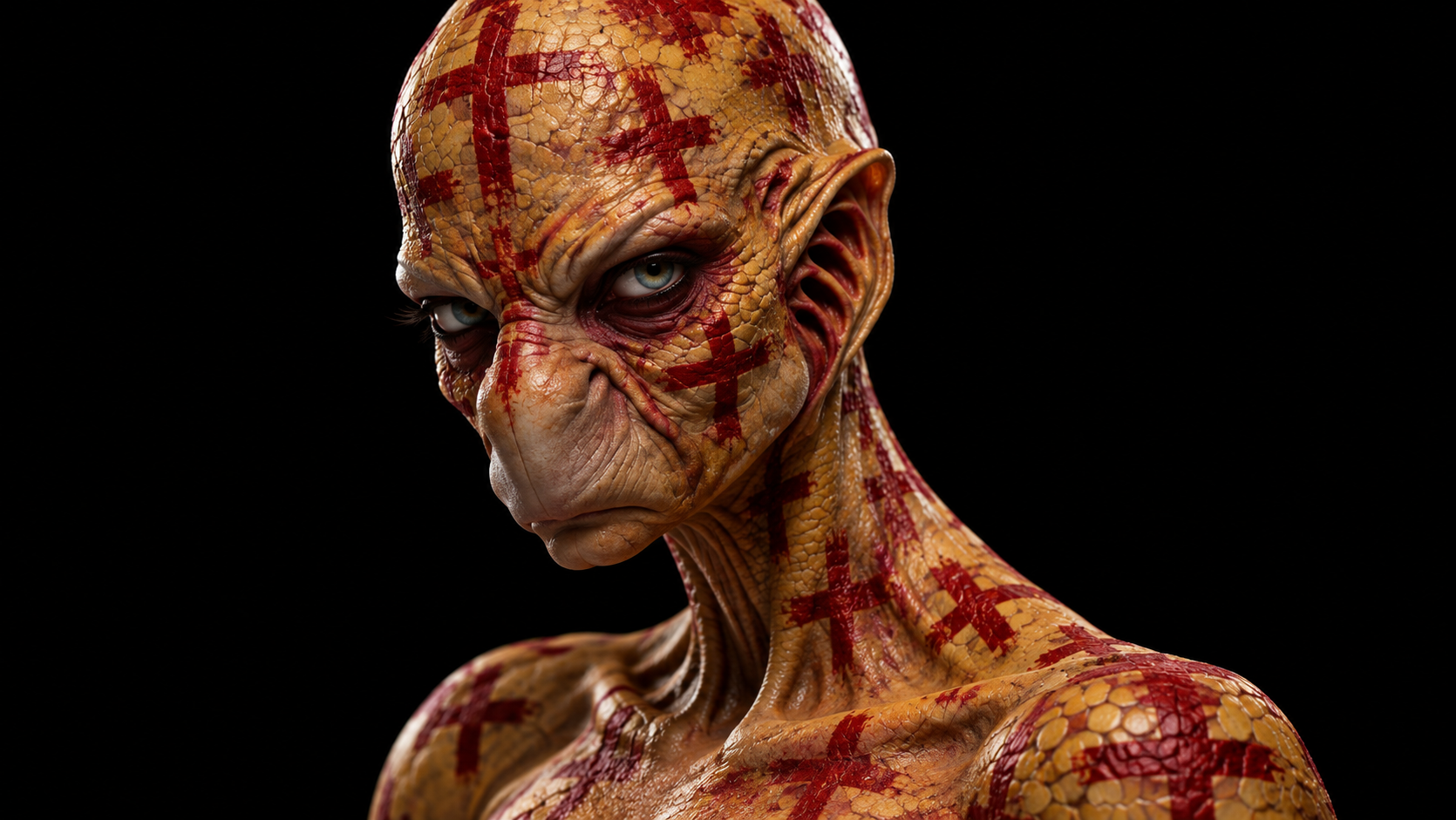
The Kelborn are the peoples born from the foam of Kel, the Skin, in the oldest story. Every one of them keeps its past on skin, or on something that stands for skin. The Ulmaeth paint crosses on scale. The Ilvenne fire vows into glaze. The Weneth weave cloth, which they call a second skin. The Kharrin wear salt on their faces.
So when skin fails, history fails with it. Kelak has said this is why he became a physician of the skin and not of anything else. Every record in the world sits on the thing he treats.
Vallak of the Ember Road
He was born in 2026 F.K. in a goldsmiths' camp on the Ember Road. His birth name was Vallak. It comes from Kharric val, "witness," with -ak, "one who." It means "one who witnesses." It is an ordinary name.
The Kharrin keep gold for one purpose. They use it to mend what has broken between peoples, and never what has broken between Kharrin. A goldsmiths' camp moves along the road behind the Reckoner, in case it is needed. Vallak grew up among small furnaces, crucibles and very fine tools. He was apprenticed at ten. By sixteen he could lay a gold seam thinner than a hair into a cracked cup so that it held water.
He was a quiet apprentice. He liked the work for the patience of it. He did not much like the cups.
The Gold
In the spring of 2044 the ninth tower of Sael-Qor broke. Refusers from the Blue Hollow poured brine into its salt-kilns at full heat, and the firing-chamber cracked from floor to crown. Thirteen people died.
One did not die who should have. He was a kiln-worker named Tallas. He had been standing beside the main kiln, and he cracked almost to pieces. He lived, which no fired Ilvenne had ever done with that much of their glaze gone.
Too little to mend
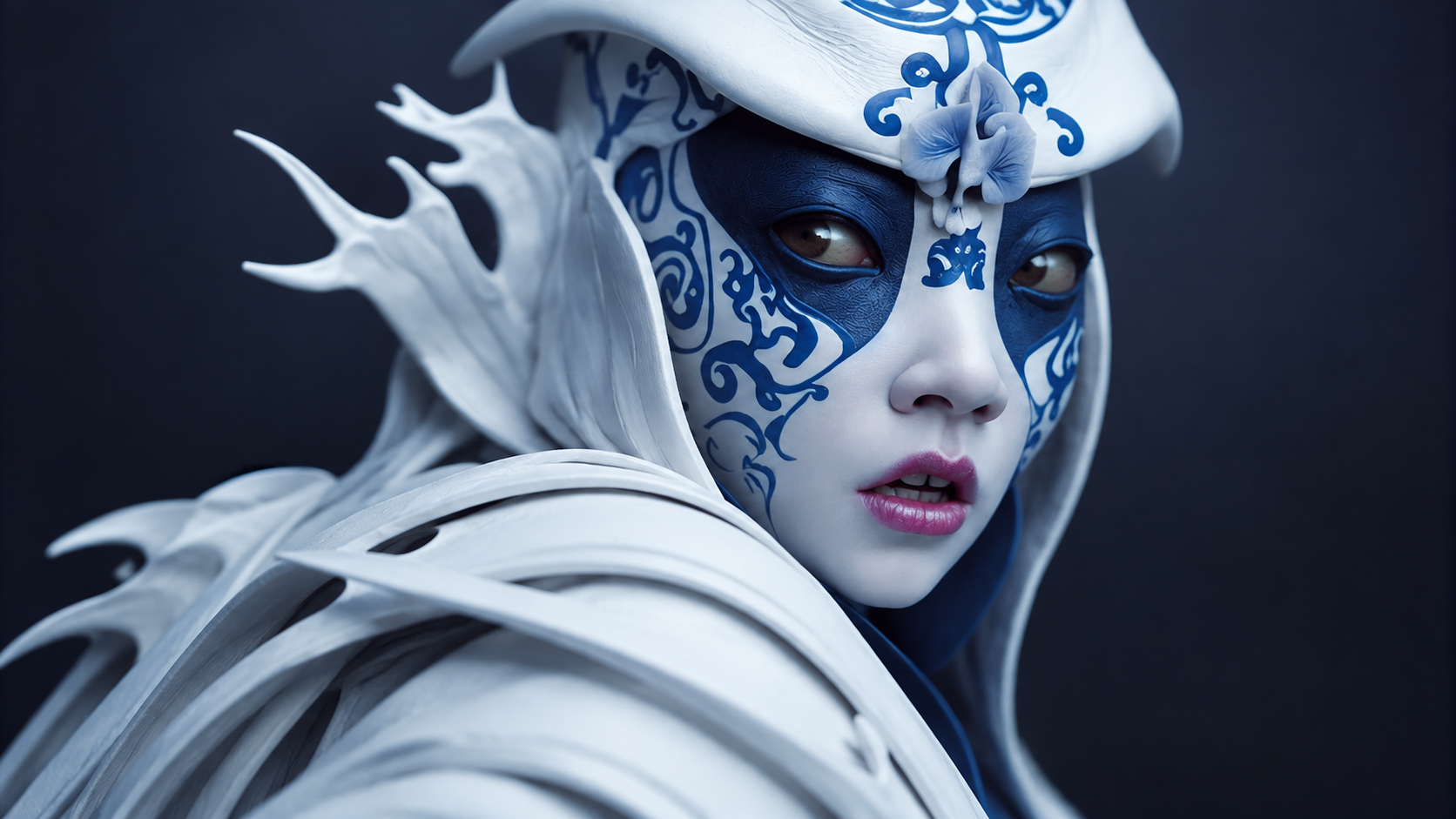
The Ilvenne mend their cracks in cobalt. They lay a blue seam into the break and fire it, and they call it the second line. The very old are laced with blue seams and honoured for each one.
Tallas had too many cracks and too little glaze between them. Cobalt needs something solid to hold on to. The menders of Sael-Qor looked at him and said there was nothing they could do.
Word reached the Kharrin Reckoner, Darra Val-Tal, on the Ember Road. She had witnessed the Salt Compact ninety-four years before. She had laid a dot on her own face for it. She had asked the Ilvenne three times whether the salt caused the Shedding, and believed them when they said no. She said she would not let one more person break because of salt she had not counted.
She sent gold north. With the gold she sent the youngest goldsmith on the road who could lay a seam fine enough. That was Vallak. He was nineteen.
Tallas
It took him most of a year. He worked in a cold room at the foot of the eighth tower with Tallas lying on a table in front of him. He had never mended anything alive.
He laid gold into every crack. Where the glaze had gone entirely, he laid a lattice of gold across the gap, fine as a web, and fired it in a slow kiln so that it bonded to the glaze on either side. When he was finished, more of Tallas was gold than glaze. He could stand. He could walk. He could not be fired again, ever, and he will never be anything but mended.
The same year Vallak laid gold into the cracked tally tiles that the war-leader Qorran wears as armour. Darra had sent enough for both. She sent a message with it: a debt mended in a different colour is still a debt.
The Menders of Sael-Qor
When Tallas could walk, the elders of Sael-Qor did something they had never done. They asked a Kharrin to stay.
Vallak stayed. He trained with the menders of the eighth tower for twelve years. He was the first Kharrin ever to learn the Ilvenne craft. The master of the menders was Hessal Qor-Ven of the ninth tower, who had survived the Breaking with three blue seams across his jaw. Hessal did not like Kharrin. He taught Vallak anyway, because Vallak had done something none of his menders could.
The lesson of the Breaking
The Breaking taught Vallak the most important thing he knows. A hot kiln cracks when cold water hits it. So does a cold body when something hot touches it.
The fired Ilvenne are cool to the touch. The Kharrin are warm-blooded, the warmest of the five peoples. When Vallak first laid his bare hand on a cracked Ilvenne, the glaze under his palm crazed in a ring. The patient did not die, but Vallak never touched a fired body with bare skin again.
He fired himself a set of sheaths in white lace porcelain, one for every finger and a band for each palm. They keep his warmth off the glaze. He has worn them for forty years. He eats in them. He sleeps in them. The children of the Hollow think his hands are made of lace.
Lace splints
From the sheaths came his real invention. The menders of Sael-Qor had only ever had one answer to a crack: a cobalt seam. A crack that kept spreading was a death sentence.
Vallak began to fire lace. It is pierced porcelain, light as cloth and stronger than it looks. He fits it around a cracking limb like a splint, so the lace takes the strain and the glaze underneath does not. It holds the body together without sealing it. The patient can still move. The crack can still be watched.
The Ilvenne call these splints kel-lace. Hundreds of fired people wear them now, in Sael-Qor and in the Hollow. Some of them would otherwise be dead.
The new name
The menders of Sael-Qor have an old word for their work on the body. It is kel, from the oldest speech, meaning skin. It survives almost nowhere else.
When Vallak finished his training in 2057, Hessal gave him a mender's name. He took the menders' word and added the Kharric ending: kel with -ak. Kelak, "one who tends the skin." It is half Ilvenne and half Kharrin. Hessal said it was the only fair way to name him.
Kelak has used no other name since.
The Flaking
In the 2060s the glaze began to lift from everyone who had been fired with Bone-salt. The brine in the salt worked its way back out through the glaze over the decades, as it had once worked up through the Bone. The glaze came away in scales, and the Coil went with it. Underneath was skin the glaze had held back for years. It aged suddenly.
The Ilvenne call it the Flaking. Kelak was the first mender to say it was not a crack. Cracks are mended. This was something else. The glaze was not breaking. It was letting go.
What lace can do
Kel-lace cannot stop the Flaking. Kelak tried for ten years. A splint can hold a cracking limb together. It cannot hold glaze onto skin that no longer wants it.
What lace can do is slow it. A lace sleeve fitted close over a flaking arm keeps the scales in place for a season or two longer. Some of the flaked want that. They want a little more time inside the vow they were given at sixteen. Kelak fits the sleeves for anyone who asks.
Ennesse
In the Blue Hollow there is a woman named Ennesse, salt-fired, whose tears crazed her own glaze in black lines after the Breaking. She has a different answer. When the flaked ask, she lifts their failing glaze away with a thin knife, all at once, so they do not have to wait years for it to fall.
Kelak and Ennesse have argued about this for twenty years. He says she takes from people the last of the time they have in their vow. She says he makes them wait inside something that is already leaving them. They work in the same shelters. They share the same patients. Sometimes a patient tries Kelak's lace first and goes to Ennesse's knife later. Sometimes the other way round.
Neither of them has ever told a patient the other one is wrong. Kelak has said this is the only part of the argument he is sure about.
Qarukh
In 2085 a young kiln-worker of the ninth tower came to Kelak with his face flaking. His name was Qarukh. He was Hessal's apprentice. Kelak fitted a lace mask over the worst of it, to hold the Coil a little longer.
Three months later Qarukh came back and asked him to take it off. He had decided to let the Coil go. Kelak took the mask off with his lace fingers and let the last of the glaze fall into his palm. Afterwards Qarukh went to a Hollow painter and had southern crosses laid on his bare face. He is the first fired Ilvenne to do it.
Kelak keeps the last plate of Qarukh's glaze in a pocket of his robe.
Ishwen
In 2078 Kelak went to the ninth tower to see Ishwen, the Weneth bride fired with salt in 1954. Her legs had split. She could not stand. He fitted lace to her knees and her hands. He told her the journey west would crack her further. She went anyway.
In 2087, when she asked to be carried to the Lid-Stone, the Weneth sent to ask him whether she would survive it. He said probably not. He also said she knew that, and that it was hers to decide.
The Rim
Since 2079 Kelak has spent part of every year in the south, on the eastern rim of the Bone.
Why he went
The Ilvenne were not the only ones whose skin was failing. In the south the Ulmaeth shed once in a long life, usually between seventy and ninety. Since 1961 almost no one had shed out of season. That was the summer the whole people shed at once. But in the 2070s, among the families who live nearest the rim, it began again. Children of forty shed. A woman shed twice in ten years. Each time the marks of a life came away.
The Ulmaeth asked the Kharrin for a physician of the skin. There was only one.
Neshval
On the rim Kelak met Neshval, the rake-master of the eastern pans. Neshval lives alone on the crust, measuring the breath of brine that seeps up through hairline cracks in the Bone. He draws it through tubes and reads it with a brass lens.
Neshval showed him the numbers. The floor had breathed a little every year since the Shedding. Kelak showed him the sheddings. They laid the two counts side by side. Where the breath rose, the sheddings followed.
They have worked together ever since. Neshval measures the floor. Kelak measures the skin. Neither of them is sure what they are measuring towards.
The scars
The air near the cracks is thick with brine. It burns. Kelak's scales were the plain deep red of every Kharrin when he first went south. The brine marked them. Dark mottling now runs across his scalp and down his face, like the burn a wave leaves on rock. It is not a pattern anyone painted. It is a record nobody asked to keep.
It is also why he wears the mask.
The Reckoning
In the autumn of 2087 the Reckoning of the Shedding opened at the Lid-Stone. Kelak came in from the rim with Neshval. He has no seat. The Kharrin sit nowhere, because their Reckoner is the judge.
Twice Neshval has stood up to tell the Reckoning that the floor is breathing more than it was. Twice Darrak has told him the Reckoning is counting the last cutting. Kelak has not stood up yet. He has a list of names in the pocket where he keeps Qarukh's glaze. They are the Ulmaeth who have shed out of season this year.
The list is longer than last year's.
What He Wears
The mask is fired lace, white porcelain pierced so finely that the brine air passes through it in a fine mist and leaves its salt behind on the lace. Two round lace filters sit at the jaw. A frame of lace runs over his scalp to hold it. He fires a new set every month on the rim. The old ones go grey with salt. Through the lace you can see his face: deep Kharrin red, mottled dark with brine scars.
He made a half-mask in the same lace for the Hollow scholar Imaresse. She wears it over the blank side of her face, the side she is keeping for routes no one has walked.
The finger sheaths are white lace, one for every finger, with bands across each palm. They keep his warmth off cool glaze. He has worn them since his first year as a mender. Under the lace, his hands are red and scarred like his face.
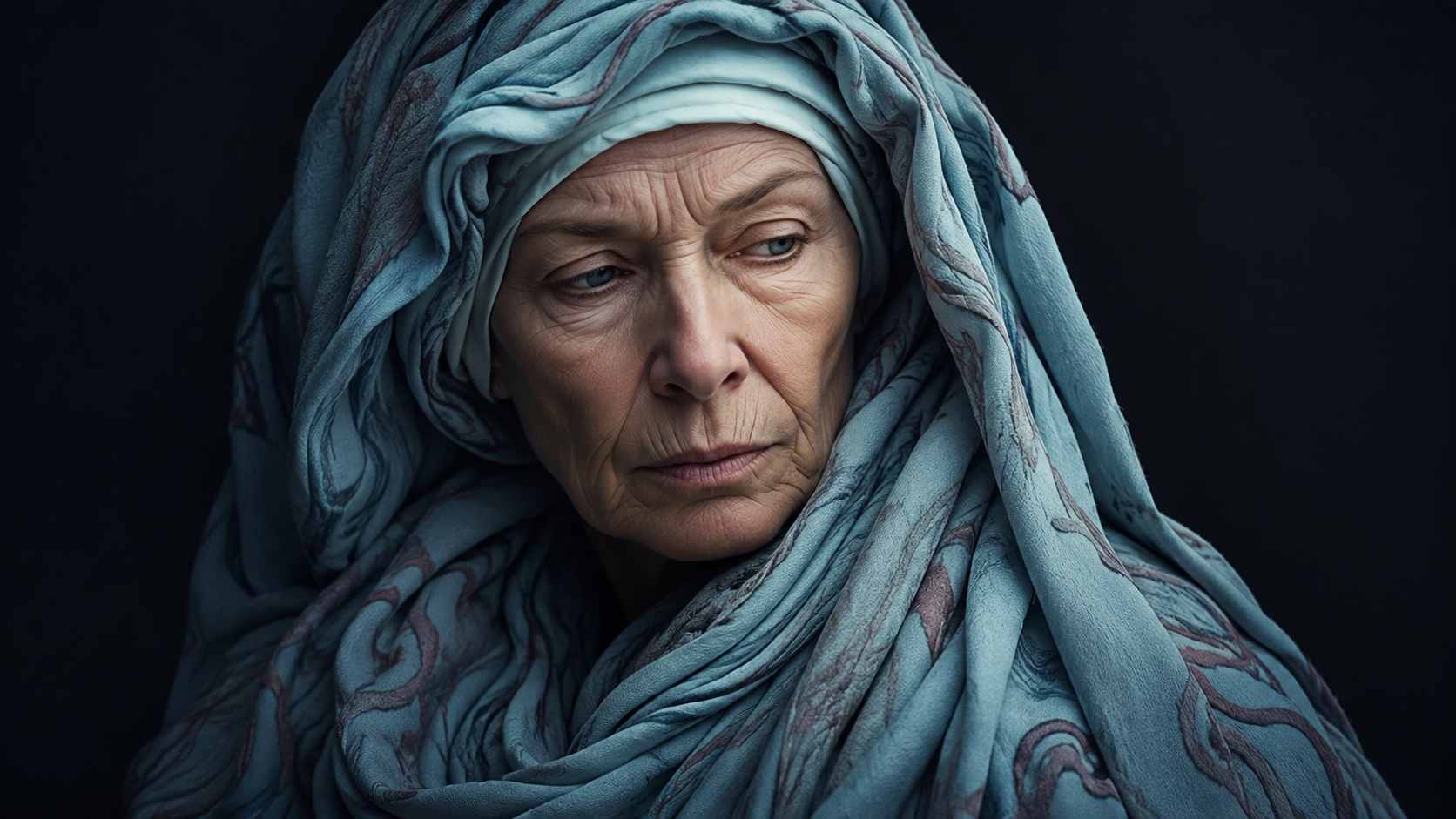
The robes are Ilvenne mender's robes, white over cobalt, given to him by the menders of the eighth tower when he finished his training. They are heavy with lace medallions on chains.
The medallions are his patients. Each one is a small disc of fired lace, pierced in a pattern of its own and hung from his robe. He fires one for every person he has fitted with kel-lace. There are several hundred. They click when he walks, like glaze.
The Kharrin lay a dot on a patient's face. Kelak hangs a disc on his own robe instead. The record of the care stays with the one who gave it. Nobody owes him anything.
His Names
Vallak
His birth name comes from Kharric val, "witness," with -ak, "one who." Val comes from the oldest speech, the Brine root vael, to watch without sleeping. The same root became the southern vael, the carrier's vigil, and the northern vel, a guard. In the east it narrowed to watching debts be made.
His mother hoped he would be a counter. He became a goldsmith instead.
Kelak
His mender's name was given by Hessal in 2057. It joins the menders' word kel, skin, with the Kharric -ak. It means "one who tends the skin."
Kel is very old. It is the root of the oldest story of all, about Kel, the Skin, who rose from the foam where the first hook touched the floor. Every record is laid on her. All the peoples who keep records are her children, the Kelborn. The word itself survives almost nowhere: in a Weneth word for the lining of a garment, and in the menders' talk of Sael-Qor. Kelak's name is one of the few places it is still said every day.
Olsen Olsen
The children of the Blue Hollow call him Olsen Olsen. Nobody is sure where it comes from. It is not Ilvennic, Kharric or Venethic. The children say it is the sound his medallions make when he walks.
He answers to it. He has said it is the only name anyone has given him for free.
The People Around Him
Tallas. The first person he ever mended, and the reason he went north. Tallas is more gold than glaze now. He stands at the Reckoning most days near Amarwen. Kelak checks his seams every week. Tallas still calls him the goldsmith, never by either of his names.
Darra and Darrak. Darra Val-Tal sent the gold, and sent Kelak with it. She died in 2050. Her son Darrak is now the Reckoner, and has refused twice to hear what the rim is saying. Kelak does not blame him. He thinks Darrak is counting as fast as he can.
Hessal Qor-Ven. The master who trained him and named him. Hessal mends his own cracks in cobalt, by lamplight, and will not let Kelak near them.
Qarukh. Hessal's apprentice, whose last plate of Coil Kelak keeps in his pocket.
Ennesse. The woman with the knife. They have argued for twenty years and never once in front of a patient.
Neshval. The rake-master of the rim, who measures the floor while Kelak measures the skin. They are the two people at the Reckoning who think it is not over.
Alvak. The Kharrin holy fool who crosses out debts. In 2079 Kelak offered to treat his eyes, which had gone white from salt glare. Alvak said he could see everything he needed to. The two of them are the only Kharrin who take nothing. Alvak gives up what is owed to him. Kelak never claims it.
Imaresse. The Hollow scholar who carried the eight Readers' books out of the ninth tower. She is writing their routes onto her skin. Kelak made her half-mask.
Ulvas and Saelesse. In the portrait 3 Up: Ulvas, Kelak & Saelesse he stands between the Hollow's floor-guard captain and its Coil-reader. They are the three people who came after the Breaking to build things instead of judging them. Ulvas guards the floor. Saelesse writes vows that can be changed. Kelak keeps the skin alive long enough for either to matter.
Ishwen. The Salt Bride, whom he fitted with lace in 2078 and told not to travel. She travelled. She has asked to travel again.
What Is Still Unsettled
Is care a debt? Every Kharrin custom says yes. Kelak says a sickness of the skin cannot be paid for in marks on the skin. The camps have never decided whether he is generous or simply refusing to be counted.
Lace or knife? He holds the glaze on. Ennesse lifts it off. Both say they are being kind. Both are.
What is the rim saying? Neshval's breath-count is rising. Kelak's list of early sheddings is rising with it. If the floor is opening again, the Reckoning is counting the wrong cutting.
Will he stand up? He has the list. He has not read it aloud at the Lid-Stone. He says he is waiting until it is long enough that no one can tell him to sit down. He is afraid of how long that will be.
The Medallions
On the rim, in the evenings, Kelak sits outside Neshval's hut with a small kiln and fires lace.
Every medallion on his robe is a person he has fitted. Since he came south he has begun firing a second kind. These are smaller and plain, with no pattern. Each one is an Ulmaeth who has shed out of season. He cannot fit them with lace. Lace holds glaze. It cannot hold a skin that has already let go. He fires the disc anyway, and hangs it with the others.
This autumn he has had to fire them faster.