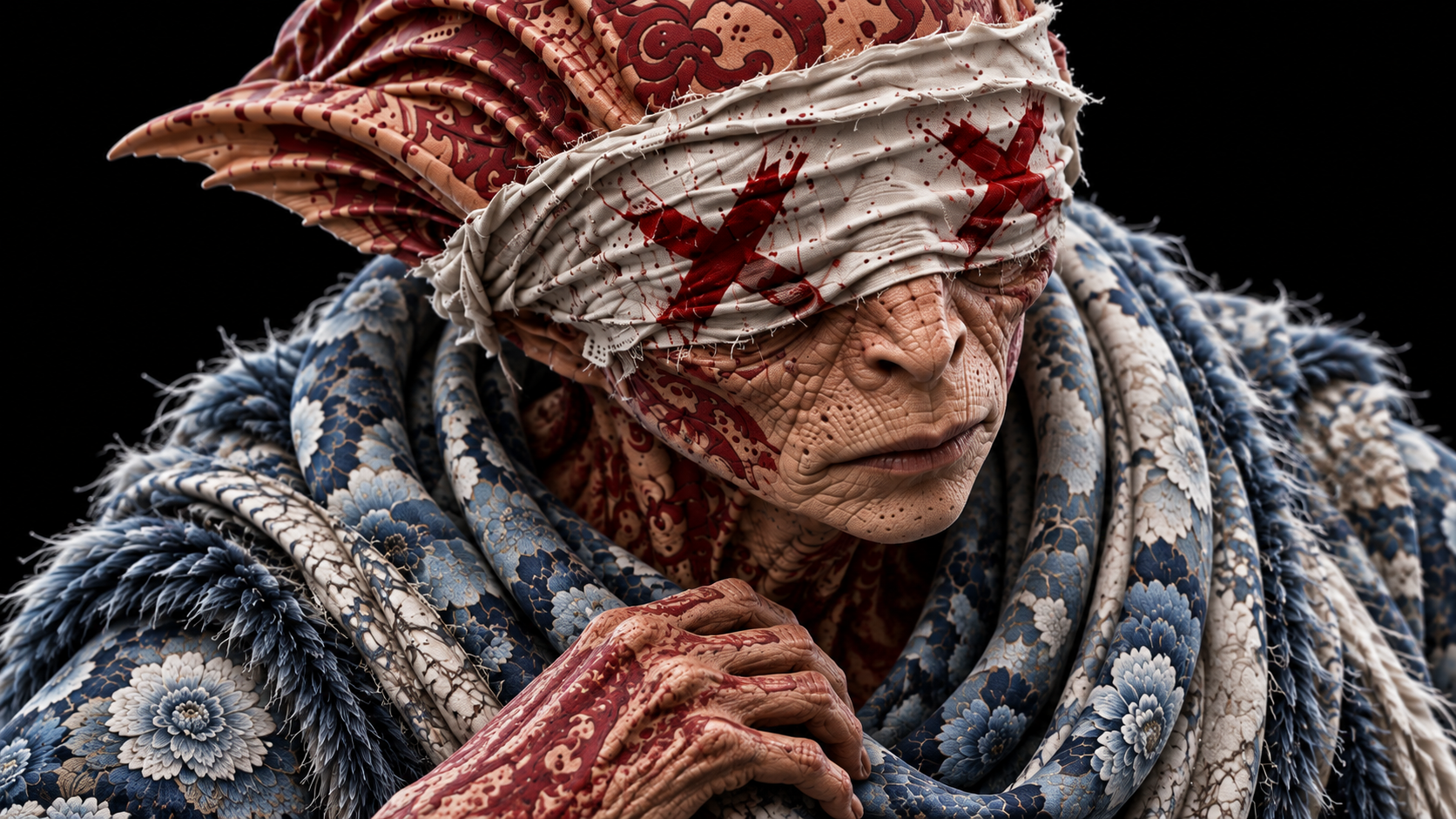
Irunas, The Eighth Reader
In 1840 F.K. a fired Ilvenne scholar walked east past the red mountains and did not come back. He was the Eighth Reader of Sael-Qor. For two hundred and forty years his book sat sealed in an archive, and nobody opened it.
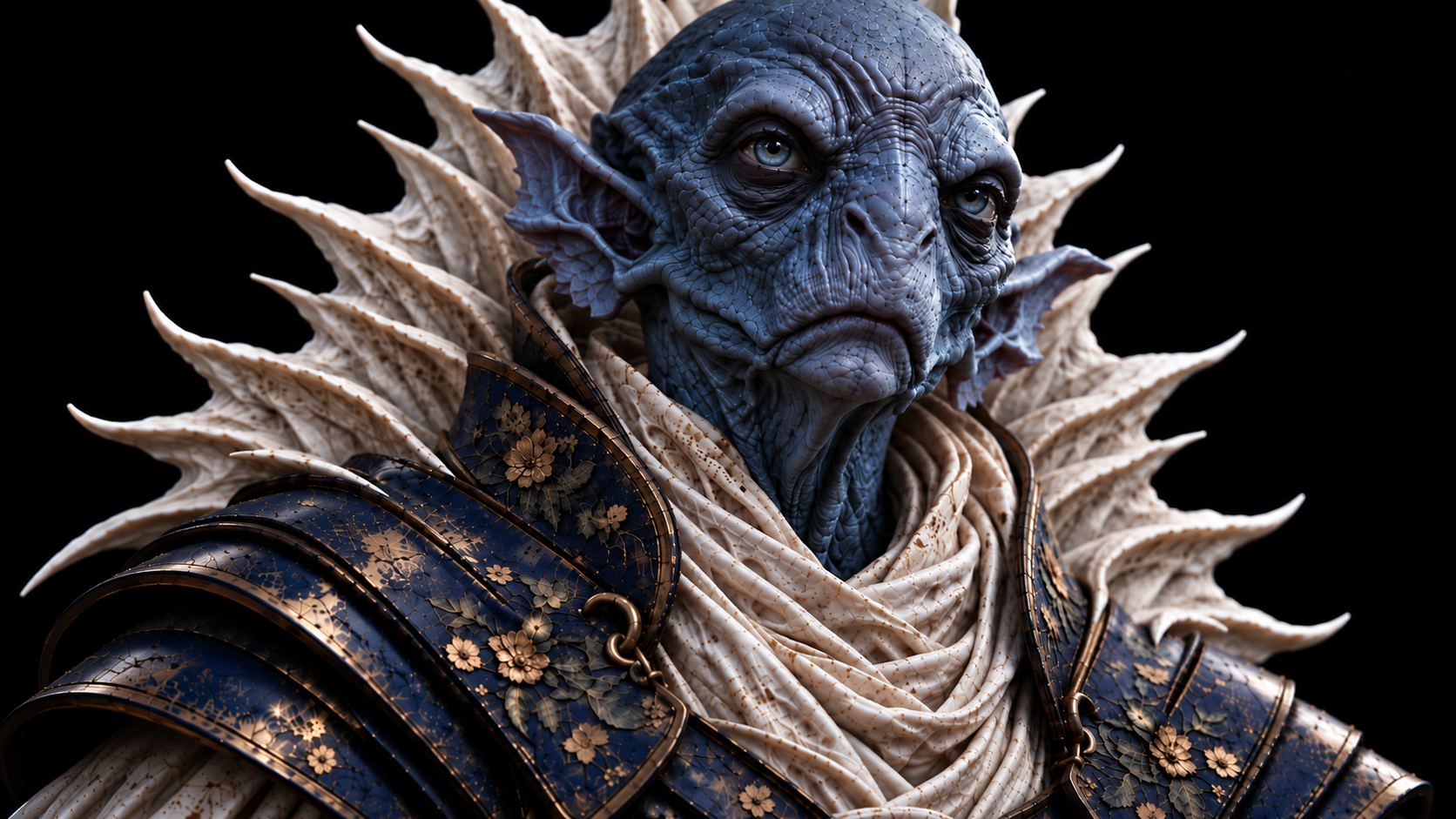
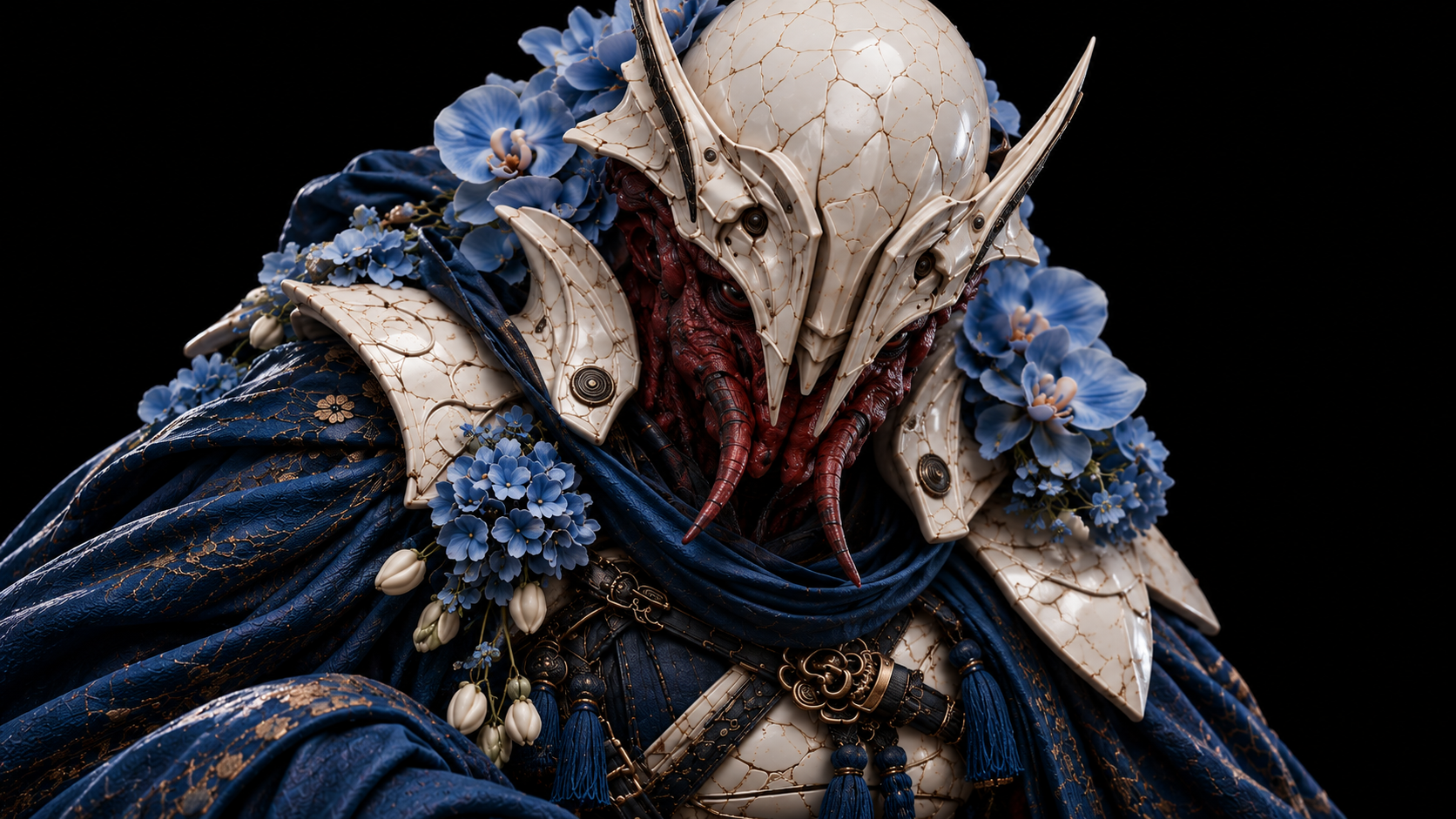
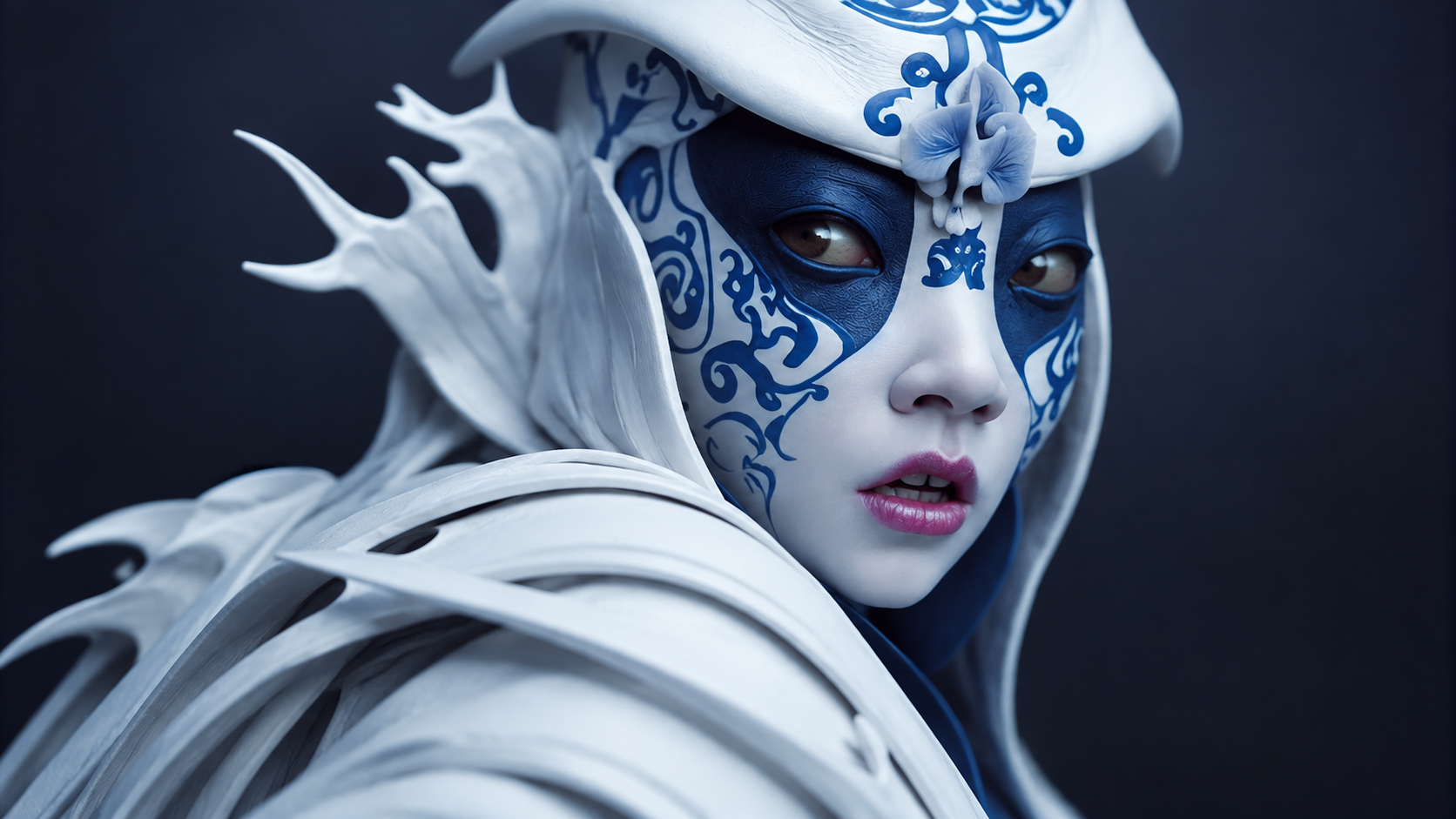
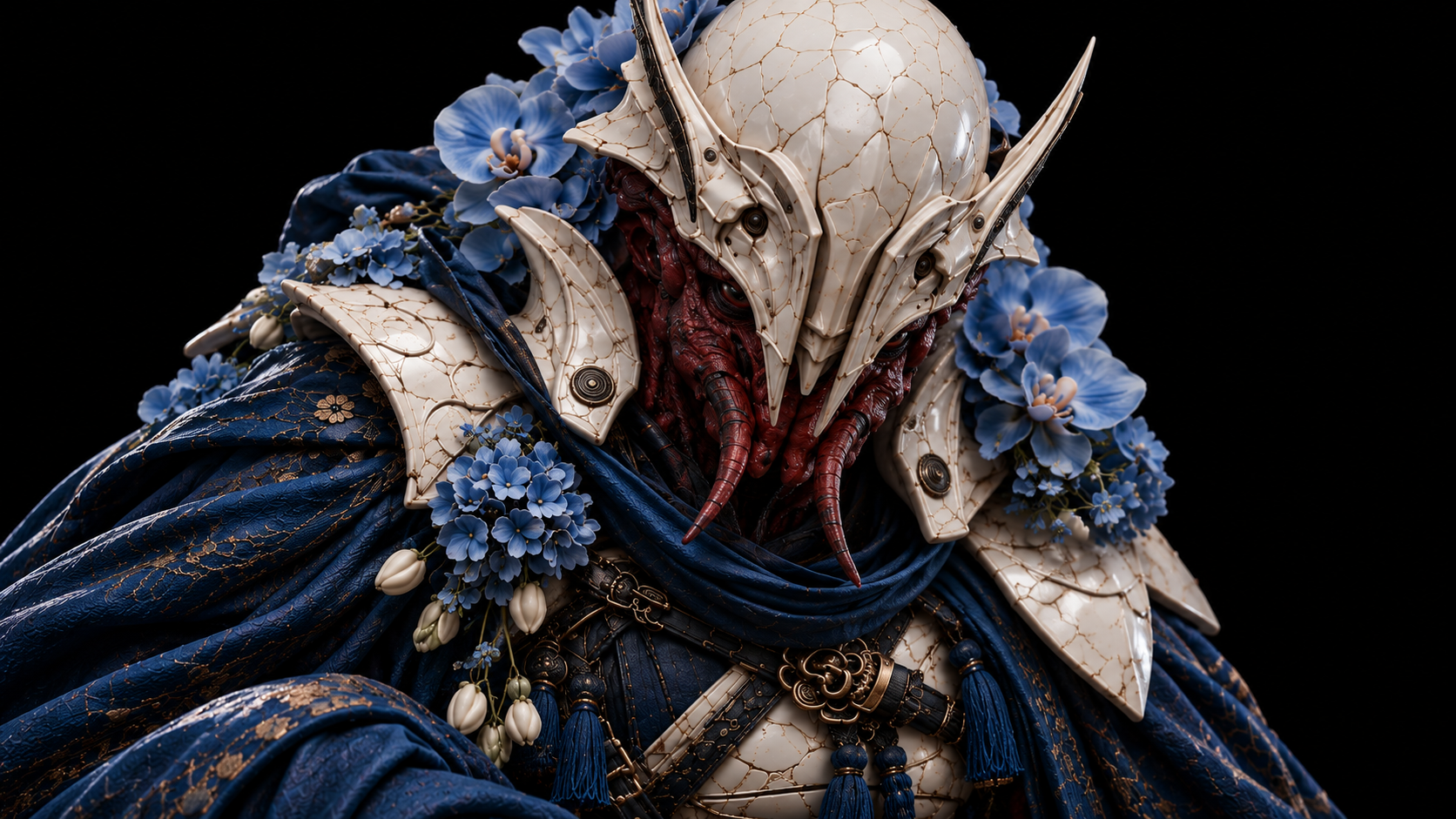
This autumn, something came up out of the sea beyond the mountains wearing his glaze. It is a porcelain shell crazed all over, with gold run into the cracks and orchids growing from the seams. Inside it is something red and wet that grew there in the country he found. It calls itself Irunas. It says it has come back to read his book aloud.
Nobody at the Lid-Stone is sure whether he is a man who has changed, or something that has taken a man's shape. He has not said which. He may not know.
- Name
- Irunas
- Called
- The Eighth Reader
- People
- Ilvenne, of Sael-Qor. Once.
- Born
- 1790 F.K., in the fourth tower
- Went east
- 1840 F.K., and was not heard from after 1846
- Came back
- Autumn 2087, out of the eastern sea
- Age
- 297, if he is who he says
- Body
- His fired shell, crazed and mended in gold. Something else inside.
- Wears
- Reader's orchids, one for every land he read
- Followed by
- Orune, of the Drowned Floor
- Seen in
- Irunas, The Eighth Reader. 3 Up: Qorran, Irunas & Vaelith.
The Readers of Sael-Qor
The Ilvenne live in nine towers in the white mountains north of the basin. They are fired at sixteen. They are porcelain, with a vow painted on them in cobalt that says what they will be. They are proud of a permanence they are also afraid of, and they do not travel much.
Once in a long while, they send someone out.
What a Reader is
A Reader is a scholar sent by the towers to study another people and write down what they find. A Reader goes alone. They live among the people they study for as long as it takes. Then they write a book.
Readers are marked at the brow with a porcelain orchid, fired onto the glaze. It is the only ornament the Ilvenne allow on a fired body. The orchid means this one has looked at something other than us.
There have been nine. Their books are fired on tiles, as all Ilvenne records are, and bound in cobalt-dyed leather. They were kept in the archive of the ninth tower, the newest of the nine, which had the most room.
A Reader's book is sealed with cobalt wax as soon as it is finished. By custom it may be opened only when someone from the people it describes comes to Sael-Qor in peace, and asks. In fourteen centuries nobody ever did. The Ilvenne wrote down everything they learned about their neighbours and then never read it.
The nine
The first three Readers went south, to the Ulmaeth. The fourth and fifth went west to the Weneth. The sixth and seventh went east to the Kharrin, along the Ember Road. All seven came home and wrote their books.
The eighth went east too, and kept going.
After him the towers sent no one for two hundred years. When they did, it was the Ninth Reader, Qaresse, who went south in 2040. She came back with a copy of marks no one could read, and the history of the world turned over.
The archive
The nine books sat in the ninth tower's archive until the spring of 2044. That was the night refusers from the Blue Hollow broke the tower's salt-kilns and the lower third of the tower split.
In the confusion, a young refuser named Imaresse went into the archive and carried the books out. Eight of them, that is, sealed with cobalt wax and never opened. The ninth, Qaresse's, was already in the hands of the elders. Sael-Qor believes the eight are still in the ruined archive, under rubble. Nobody has gone to look.
The Eighth Reader
He was born in 1790 F.K. in the fourth tower of Sael-Qor. He was fired at sixteen with a Coil his master read as qaru-vel, an opening spiral: a life of going out. His family were tile-scribes. He grew up copying records he was not allowed to read.
The towers made him a Reader in 1838. He was forty-eight, which is young for the office. He asked to go east, past the Kharrin.
The sixth and seventh Readers had already written about the Kharrin. They had walked the Ember Road from the red mountains to the Kiln-Scarp and back. Their books were sealed, but both of them had come home talking about the same thing. Beyond the Kharrah, the iron mountains of the east, the road ends at a shore. Past the shore there is water that does not end. The Kharrin trade with no one across it. They do not sail. They say the water there is still, and they do not like still water.
The Eighth Reader wanted to see it.
Going
He left in the spring of 1840 with a Reader's orchid on his brow and a cloak of cobalt wool. He walked the Ember Road east. The Kharrin camps logged his passing, as they log everyone, by counting him aloud. The last camp to count him was at the eastern foot of the Kharrah, in the autumn of 1841.
After that there is one more record.
The book comes home
In 1846 a Kharrin trader came up the Salt Road to Sael-Qor with a parcel. It was a stack of fired tiles, bound in cobalt-dyed leather and sealed with cobalt wax. The trader said a man in a cracked glaze had given it to her on the eastern shore, with a message: Seal it. I will come back and read it to you.
The tiles were in the Eighth Reader's hand. The towers sealed the book and put it in the archive with the other seven. They waited for him. After fifty years they wrote him into the Tally-Walls as matched, meaning that his life had come to fit his vow of going out. It was a polite way of saying they thought he was dead.
After that, the towers sent no Reader anywhere for two hundred years.
The Book
Imaresse is an unfired refuser of the Blue Hollow, a scholar who never had the right to be a Reader. She carried the eight sealed books out of the ruined archive in 2044. She has been reading them ever since, in the Hollow, by lamplight. She writes their routes onto her own skin: compass roses, distances and coastlines. Half her face is still blank.
She broke the wax on the Eighth Reader's book last. She was afraid of it.
What it says
The book is two hundred and twelve tiles long. The first hundred are an ordinary Reader's account. There is the Ember Road, and the Kharrin camps and their counting. There is the Kharrah, the iron mountains, where the red earth is dug. Then the road comes down to the eastern shore, where the Kharrin will not go, and water that does not end.
The next eighty tiles describe the crossing, and the country on the other side. The Eighth Reader calls it the Drowned Floor. Its contents are set out below.
The last thirty-two tiles are not in the Ilvenne hand. They are in Old Coil, the oldest script in the world, which no one alive can read fluently. Imaresse cannot read them. The Weneth reader Amarwen probably could. They have not yet met.
The hand
Imaresse has noticed one more thing about the book, and she has only told Qaresse. The hand changes over the course of it. The first tiles are a tile-scribe's hand, neat and upright, in the cobalt of Sael-Qor. By the middle of the book the strokes are looser. By the last of the Ilvenne tiles they curve in a way no Ilvenne hand does, as if the fingers had grown longer, or there were more of them.
The last tile in Ilvenne says: I am staying until I understand them. I am not sure I will be the one who leaves.
The Drowned Floor
This is what the Eighth Reader's book says about the country across the eastern water, as far as Imaresse can read it.
A floor that was cut
In the oldest story of the Kelborn, the floor of the world was laid over still water like a lid on a cistern. The first floor was cut with a hook, in the Dry Dawn, and the Brine-children climbed out. Then the floor closed again and grew a crust of salt called the Bone. The water stayed below.
In the country across the eastern sea, the book says, the floor was also cut. It was long ago, longer than anyone there remembers. It did not close. The still water came up through the cut and stayed. There is no crust there. The floor is under the sea. The people live on what little ground stands above it, and on the water itself.
The Eighth Reader called it the Drowned Floor. In the book's oldest pages he gives its own name for itself as Ulv-ish, "floor-water." It is a word in a tongue very close to the Brine Speech.
The people
The people of the Drowned Floor are Kelborn too. Like every people descended from the Brine-children, they keep the past on skin. But their skin is wet always, and paint will not hold on it, and nothing they make can be fired. So they keep it another way.
They coat it. When something happens that must be remembered, they let a small hurt be made: a grain of salt, a splinter of shell, a cut. The body coats it slowly, layer by layer, the way an oyster coats a grain of sand. In time it becomes a pearl. A grief becomes something smooth and shining that can be worn, carried and handed down. And it cannot be seen any more.
The Eighth Reader admired this at first. His early tiles about it are almost envious. The fired Ilvenne cannot change, the painted Ulmaeth fade, and here was a people who turned their wounds into ornaments. Later tiles are less sure. He notes that nobody on the Drowned Floor ever speaks of a grief once it is coated. He notes that they do not seem to know what their own pearls are for.
The hooks
One line in the book has frightened everyone who has heard it. In the oldest story, Ulv made more than one hook. She gave the first to the eldest Brine-child, who cut the floor. The others she kept. The story says they are still straight, somewhere.
The Eighth Reader saw one. It was white stone, sharp along its inner curve, longer than a man. It stands upright in the water off the shore of the Drowned Floor, where the people take their dead. They do not touch it. They have coated it in pearl, all the way up, so that the edge cannot be seen.
Up Out of the Sea
In the late summer of 2087, Kharrin rakers on the eastern shore, beyond the Kharrah, saw something walk out of the water.
It was the shape of a fired Ilvenne, white and tall, in a rotted cobalt cloak. Its glaze was crazed all over like an old cup. There were flowers growing from it. Where a face should have been, under the shell of the brow, something red and wet moved.
The rakers did not run. The Kharrin count everyone, and so they counted it aloud. There were no dots. A clean face. They did not know what that meant on something like this.
It spoke to them in Ilvennic, slowly, in a voice like water moving in a pipe. It said its name was Irunas, and that it was the Eighth Reader of Sael-Qor. It asked where the Reckoning was.
Nobody on the shore had told it there was a Reckoning.
Gold
Its glaze was badly cracked. Some of the cracks went all the way through. The rakers took it to the nearest goldsmiths' camp on the Ember Road. The Kharrin use gold for one thing: to mend what has broken between peoples. The goldsmiths decided this qualified. They laid gold into every crack that would hold it.
It took nine days. The goldsmiths say Irunas did not move or speak the whole time. On the tenth day he stood up and walked west.
The Hollow
He did not go straight to the Lid-Stone. He went north first, up the Salt Road, to the Blue Hollow. He asked at the edge of the Spoil Garden for the person who had his book.
Nobody had told him that either.
Imaresse came out to meet him. She has said she knew him at once by the hand on the last tiles. The refusers of the Hollow tucked blue tal-flowers into the gold seams of his shoulders before he left, for luck, as they do for anyone who is going somewhere dangerous.
He came down onto the Bone in the autumn, a few days after the Reckoning opened. He has asked the Reckoner for leave to read his book aloud at the Lid-Stone. Darrak has not yet allowed it. He says the Reckoning is counting the last cutting.
What He Is
Nobody at the Reckoning agrees about this. Here is what is known.
The shell is his
Every fired Ilvenne's Coil is recorded on a tile in the Tally-Walls of Sael-Qor at the moment of their firing. The Eighth Reader's tile survives, in the fourth tower. Qaresse went north in the first week of the Reckoning and copied it. The Coil on the shell matches it stroke for stroke: the opening spiral of a life of going out, the tile-scribe's hooks, and the house pattern of the fourth tower.
The shell is the Eighth Reader's fired body. Nobody disputes that.
What is inside it is not glaze
The fired Ilvenne are porcelain all the way through. Irunas is not. Behind the face-plates of the shell, where the glaze has crazed and parted, there is red flesh, wet and folded, with long soft tendrils that move when he speaks. There are eyes in it. They are not where an Ilvenne's eyes would be.
Kelak, the Kharrin physician of the skin, examined him in the second week. He laid a lace finger into one of the cracks. He has told no one what he found except Neshval. Neshval has not told anyone either.
What he says
Asked whether he is the Eighth Reader, Irunas says yes.
Asked whether he is the same man who left in 1840, he says the question does not have the shape they think it has. He says that on the Drowned Floor, nothing that is kept stays the same. It is coated, and coated, and the coating becomes the thing. He went there to read a people. He stayed long enough to be read by them.
He remembers the fourth tower. He remembers the tile-scribes, and his master's voice reading his Coil aloud in 1806. He remembers the Kharrin camp that last counted him at the foot of the Kharrah. He remembers the name of the trader he gave the book to. The Kharrin have checked. It was right.
He does not remember, he says, when he stopped being able to leave.
What the Ilvenne think
To the Ilvenne, a fired body cannot change. That is the meaning of the Firing. A Coil is a vow written at sixteen, and a life is judged by how closely it comes to match. The Tally-Walls record the Eighth Reader as matched.
Irunas is proof that a fired body can change, completely, and still carry its vow on the outside. The elders of Sael-Qor have not come to the Lid-Stone to see him. They have sent word that they consider the matter closed.
What He Wears
The shell is his fired body, white porcelain, crazed over every surface like an old cup. The plates of the face have shifted. They have grown out into long curved points at the brow and temples, like the petals of a closing flower. Nobody knows whether that happened on the Drowned Floor or on the way back.
The gold runs through every crack. The goldsmiths of the eastern shore laid it in during the nine days. Kharrin gold is used only to mend what has broken between peoples. They decided he counted.
The orchids grow from the seams of his shoulders and head. A Reader wears one porcelain orchid at the brow, fired onto the glaze. Irunas's orchid is gone. Where it was, living orchids grow out of the cracks: pale blue, many of them, rooted somewhere inside. He says there is one for every land he read. Imaresse has counted. There are more of them than there are lands in his book.
The tal-flowers are the smaller blue flowers tucked into the gold at his shoulders. The refusers of the Blue Hollow put them there. They grow only on cobalt spoil, in the Spoil Garden. They are the Hollow's sign for an agreement between peoples, and for luck.
The white buds hang from his shoulders on fine stems among the flowers. They are smooth, pale and hard. They are not flowers. Kelak thinks they are pearls, just beginning. Something on the Drowned Floor has started to coat him.
The cloak is cobalt wool, worked over with a crackle of gold thread. It is the cloak he left Sael-Qor in, in 1840. It rotted in the sea. The goldsmiths on the eastern shore rewove what was left with gold thread. It hangs off him in heavy folds.
The tassels and buckles are a Reader's travelling harness, cobalt and bronze, the kind the Ilvenne use for carrying tiles. He still carries the book in it. Imaresse gave it back to him on the day they met.
Orune
Somebody came after him.
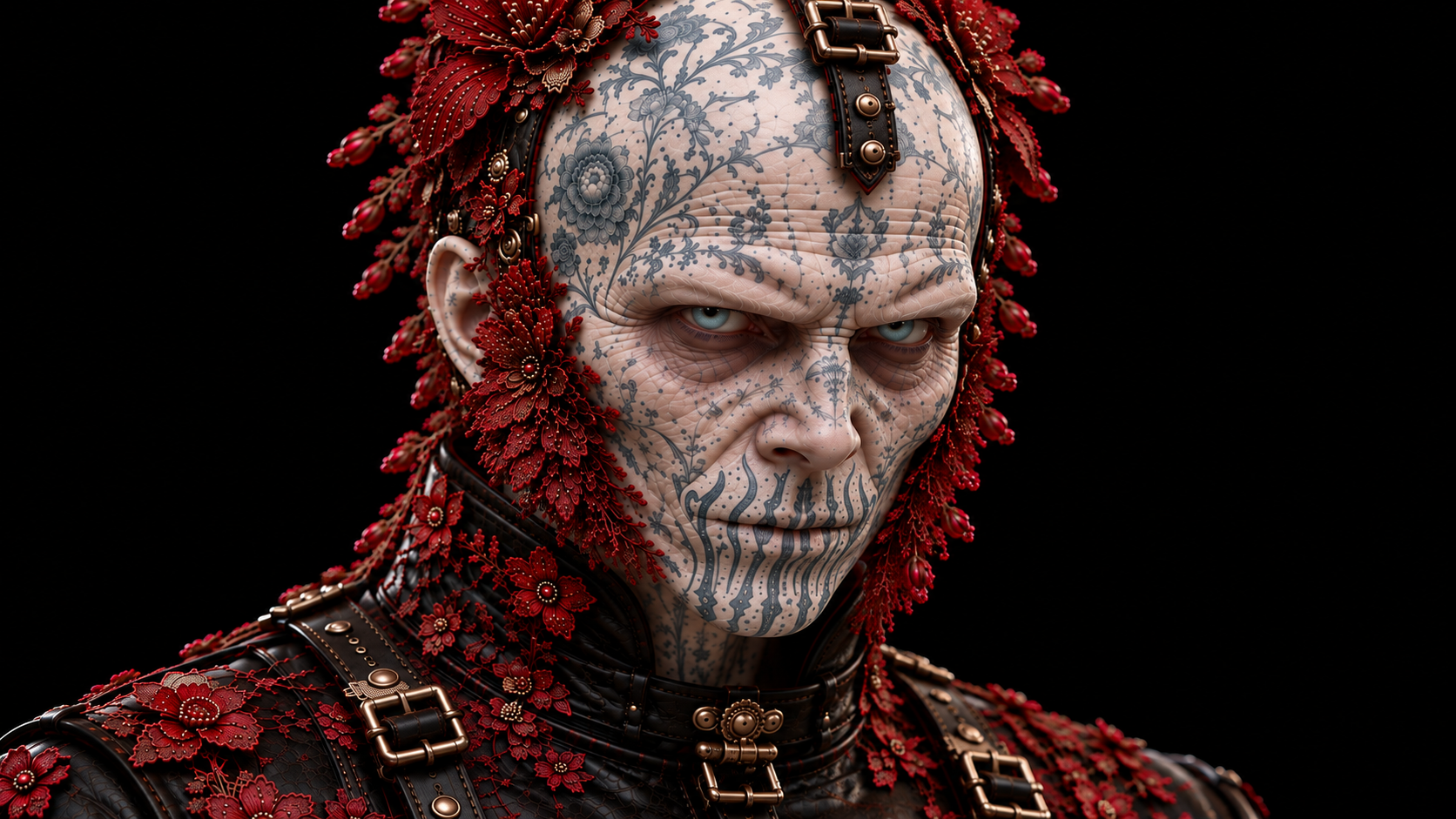
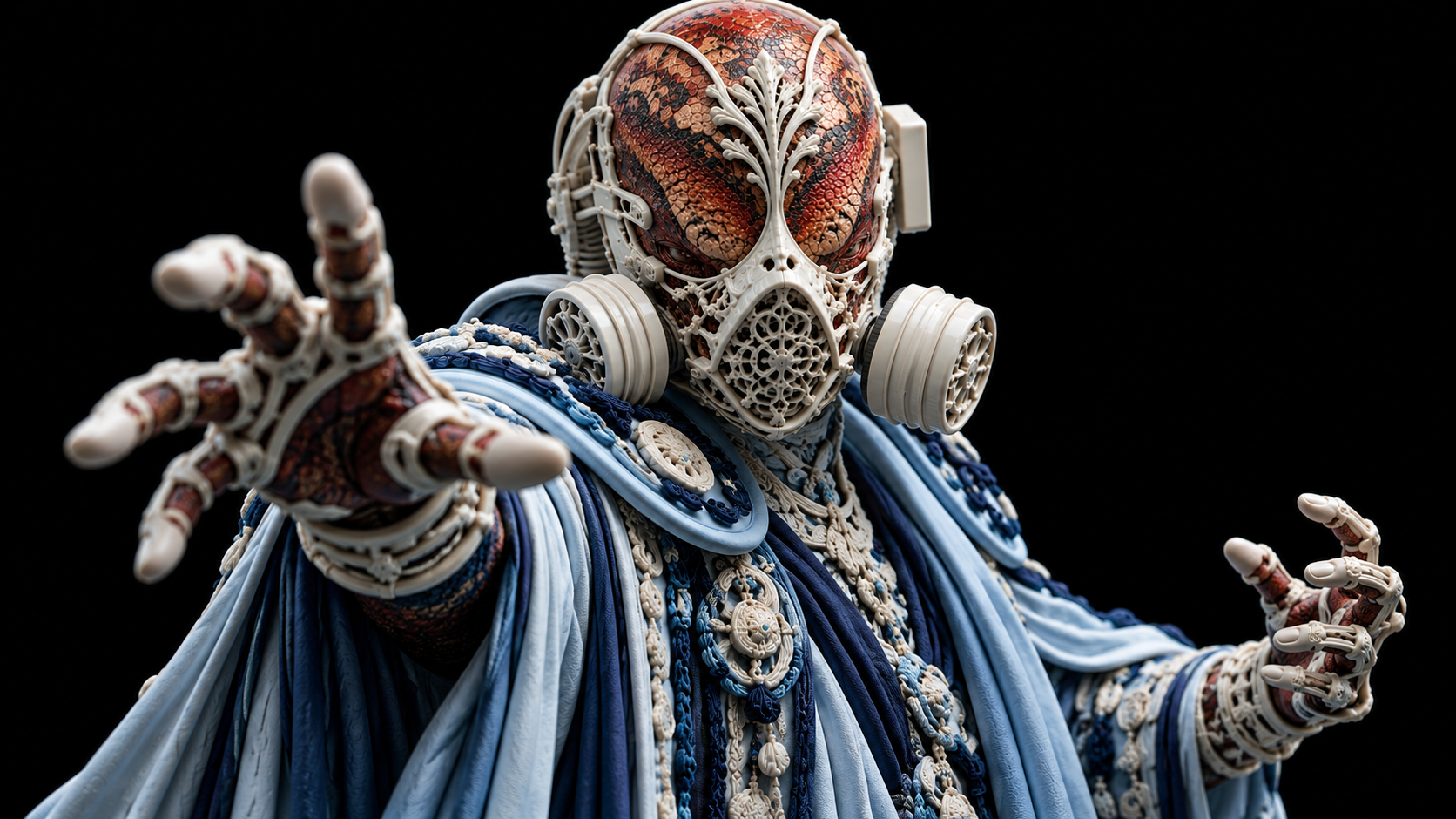
She came up out of the same eastern sea two weeks after he did. She walked the Ember Road and the Kharrin counted her too. She had no dots either. She wore a white hood stitched with gold and pearls, over a body armoured in pearl and dark cloth. A segmented tube runs from her throat into her robes. Her face is pale and freckled with red blooms, and her mouth is full of teeth.
Her name is Orune. It is the same word as his. Orun is the oldest name for the Deep: the one who sits at the bottom of everything and remembers. In the Ilvenne tongue it became Irun, and with the ending for a son, Irunas: son of the Deep. In the tongue of the Drowned Floor it stayed as it was. She does not say she is of the Deep. She says she is it.
What she wants
She has said plainly that she has come to take him back. He belongs to the Drowned Floor now. He has been coated. The white buds at his shoulders prove it. She means to finish the work.
She has also seen the Reckoning, and a whole people's grief laid out on the Bone in the open. The Shedding, the Flaking and the Breaking are argued over, day after day, in the cold. She has offered to coat it for them. She says her people can take any wound and make it shine. She says there is no need to carry it like this.
Some of the people at the Lid-Stone are listening to her. They are very tired.
Irunas and Orune
Irunas will not go with her. He will not say why. He will not speak to her directly. When she comes near, the tendrils behind his face-plates draw in.
He asked the Reckoner for leave to read his book aloud on the day after Orune arrived.
His Name
He was not born Irunas. His birth name, on his firing tile in the fourth tower, is Ennarel, a common tile-scribe's name. He has not answered to it since he came out of the sea.
Irunas is built from Orun, the Deep, one of the first names in the oldest story. The Ilvenne tongue changes an old initial u or o sound at the start of a word to i. So Orun becomes Irun. The ending -as means "son." Irunas means "son of the Deep."
It is a northern name for a southern thing. The Ilvenne have no stories about the Deep. They left those behind at the Parting. Nobody gave him the name. He says it is what the people of the Drowned Floor called him, translated into a language he still had.
The People Around Him
Imaresse. The refuser scholar who carried his book out of the ruined archive and has been writing its routes on her skin. She is the only person alive who has read his crossing. She sits with him most nights.
Qaresse. The Ninth Reader, two centuries after him. She went north and copied his firing tile to prove the shell was his. She has not decided what else it proves. Of everyone at the Reckoning, she is the one he most wanted to meet. They have spoken once, about the orchid. Hers is still porcelain.
Orune. The one who followed him out of the sea. She shares his name. She wants him back.
Kelak. The physician of the skin, who laid a lace finger into one of his cracks and has not said what he felt.
Neshval. The rake-master who measures the breath coming up through the Bone. Irunas walked up out of the sea in the same month that Neshval's count rose highest. Neshval does not believe that is a coincidence.
Kharrish. A young Kharrin whose hands raise water when he holds them over the brine-pans. He says the water is answering him. Irunas has watched him do it twice. Both times the tendrils behind his face-plates went very still.
Amarwen. The Weneth reader who can read Old Coil. The last thirty-two tiles of his book are in it. They have not met. She has asked Imaresse to bring her the tiles. Irunas has not said yes.
Darrak. The Reckoner, who has not yet let him read. Darrak has said the Reckoning must finish counting the last cutting before it hears about another.
Qorran and Vaelith. In the portrait 3 Up: Qorran, Irunas & Vaelith he stands between them. Qorran looks up and away, at the wrong he did. Vaelith looks back over her shoulder at the dead she carries. Irunas looks straight out. He is the only one of the three facing what is coming.
What Is Still Unsettled
Is he the Eighth Reader? The shell is his. The memories are his. What is inside is not anything the Ilvenne would call a man. He says the question does not have the shape they think it has.
What do the last thirty-two tiles say? They are in Old Coil. Only Amarwen could read them. He has not let her.
Why will he not go back? Orune says he belongs to the Drowned Floor. He does not deny it. He has walked across the world to get away from her.
Why now? He came out of the sea the summer the floor began to breathe harder. He asked where the Reckoning was before anyone told him there was one.
Reading to No One
Darrak has not given him leave. So every night, at the eastern edge of the Bone, Irunas reads his book aloud to no one.
He sits facing the sea he cannot see from there. He reads one tile at a time in a voice like water moving in a pipe. Imaresse sits beside him with her lamp and her brush. When he reads a route, she writes it on the blank side of her face.
She has filled a little more of it every night. He has not yet reached the tiles in Old Coil. She has noticed that he slows down as he gets closer.