Case Study: Some Articles Belong to One Site. These Belong to All of Them.
A Superconnector is an essay written to sit at an intersection. Opera meets product thinking. Walking meets AI. The archive meets the self. Each one exists because a map of my work showed that two things should have met and never had.
There are ten of them. They live across the constellation, carry their own badge wherever they appear, and are collected on autonomousmatt.com as a category of their own. None of them was chosen from the open field of things I might write. The map chose them.
A Map That Showed Its Own Gaps
The work spans thirty years and ten sites. Film criticism. Wagner and scored walking. Games. Generative image-making. Academic writing. AI products. The Firmament ties it together: a radial map of more than 1,225 pieces across 13 named constellations, with animated pathways drawn between works that share a theme.
Once every star was placed, the map started doing something unexpected. Some paths ran cleanly from one domain to another. Others stopped short. Two constellations would sit side by side with an obvious argument between them and nothing written to carry it.
That changed what the map was for. It stopped being a record of what exists and became a specification of what should. A missing connection was no longer a hole. It was a brief.
Ten Commissions In Two Waves
The first five commissions came straight from the map's broken paths. Each was drafted with an AI writing partner working from the full corpus, then edited and published in my voice on the site where its argument belonged.
Then something useful happened. Publishing the first five shifted the map. Each new essay created adjacencies that had not existed before, and each one ended somewhere the corpus could not yet follow. Those endings became the second wave. Writing toward a gap did not close the map. It extended it.
| Wave | Essay | The intersection it carries |
|---|---|---|
| 1 | The Attention Economy of One | Attention, walking and product design |
| 1 | Was Wagner the First Product Manager? | Wagner and product thinking |
| 1 | What the Archive Knows That I Don't | The archive and authorship |
| 1 | A City You Can Only Learn by Leaving | New York, England and immigration |
| 1 | The Threshold | Product thinking and the map itself |
| 2 | The Gesamtkunstwerk Was a Walk | Wagner and the scored walk |
| 2 | The Second Arrival | England, return and distance |
| 2 | Who Is Speaking? | AI, voice and authorship |
| 2 | The Map That Precedes the Territory | The Firmament as method |
| 2 | Attention as Ethics | Attention, memory and the news |
A Category Needs A Form
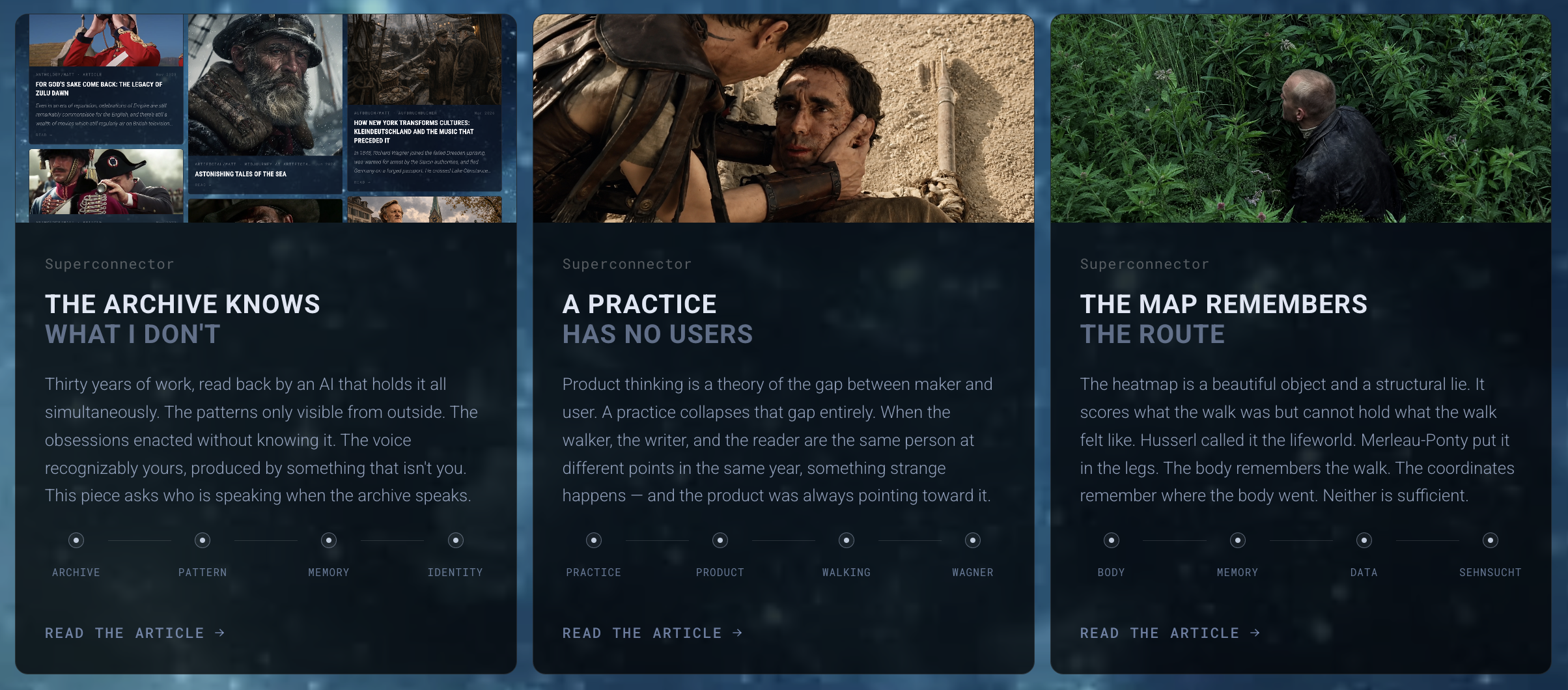
Ten essays scattered across several sites read as ten essays. The structural work they do stays invisible. So the category got a name, a mark and a card.
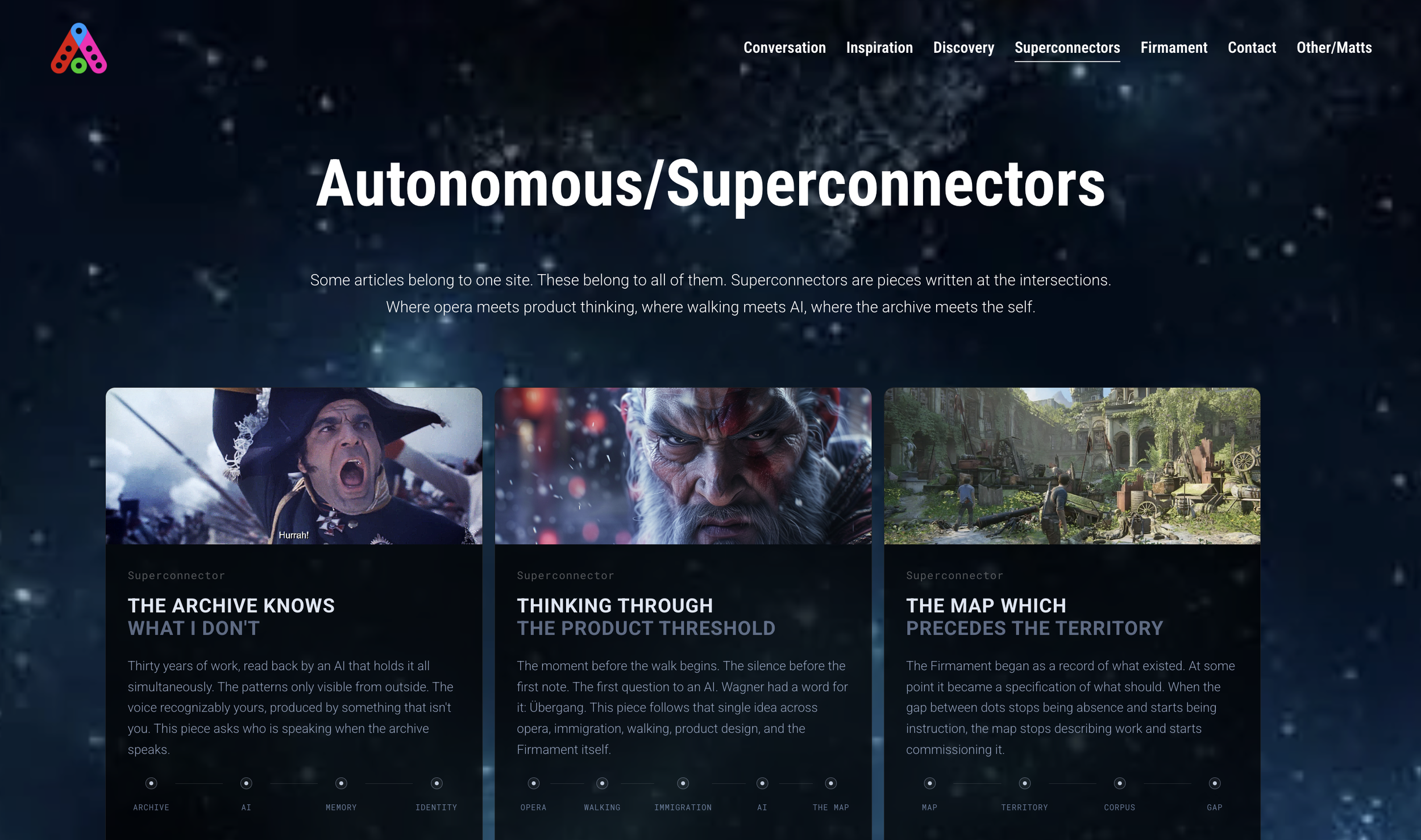
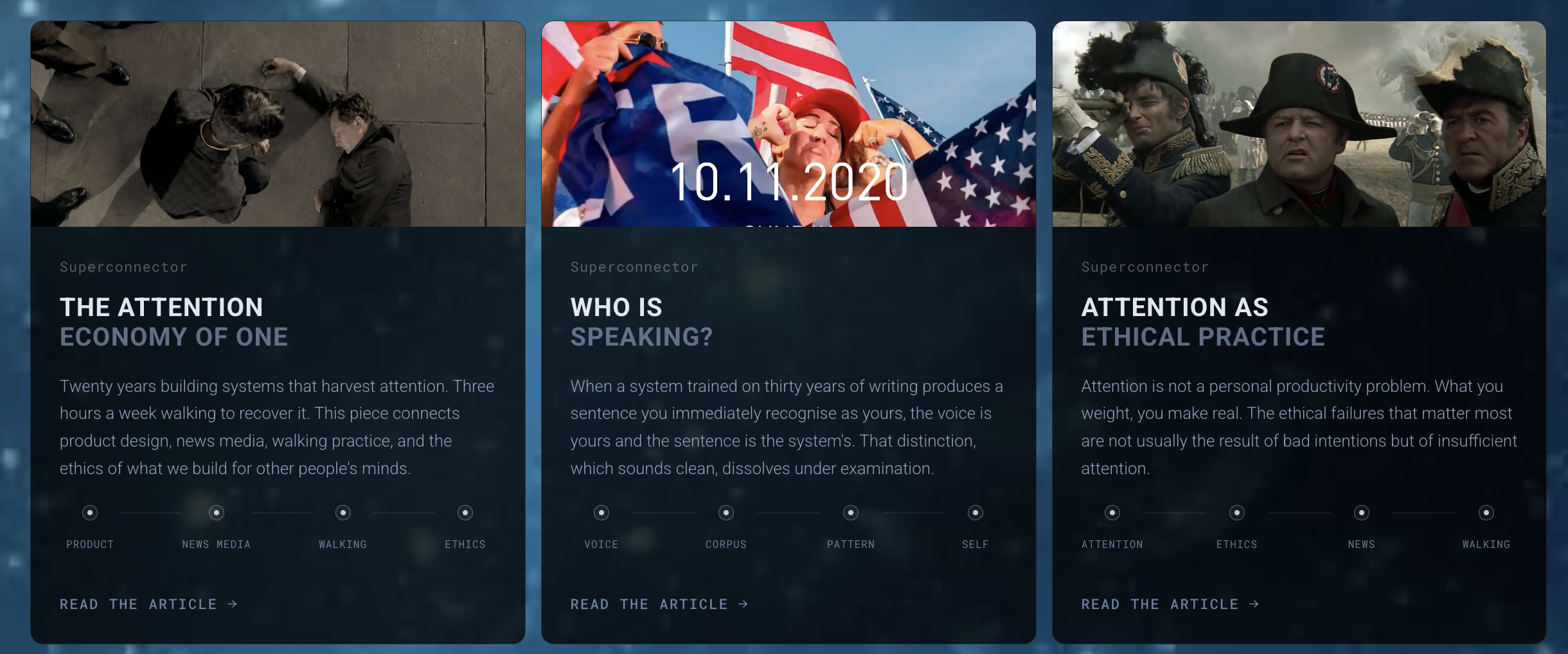
The name is functional. Superconnector describes what the pieces do, not how good they are. The mark is a red SUPERCONNECTOR badge on each thumbnail, so a reader browsing any site meets the piece as something distinct without needing the architecture explained.
The card carries the idea visually. It uses the same dark design language as the Autonomous/Matt products: a semi-transparent black ground, the article's header image, a bold uppercase two-line title with a muted second line, and a short line of copy. Beneath the copy runs a node thread, a small row of connected points naming the domains the essay passes through. Opera. Walking. Immigration. AI. The Map. It is the Firmament's pathway drawn at the scale of a single piece. The whole card is one link.
Each card is self-contained HTML and CSS with no framework, built to drop into a Squarespace code block anywhere in the constellation.
Where They Live And What They Feed
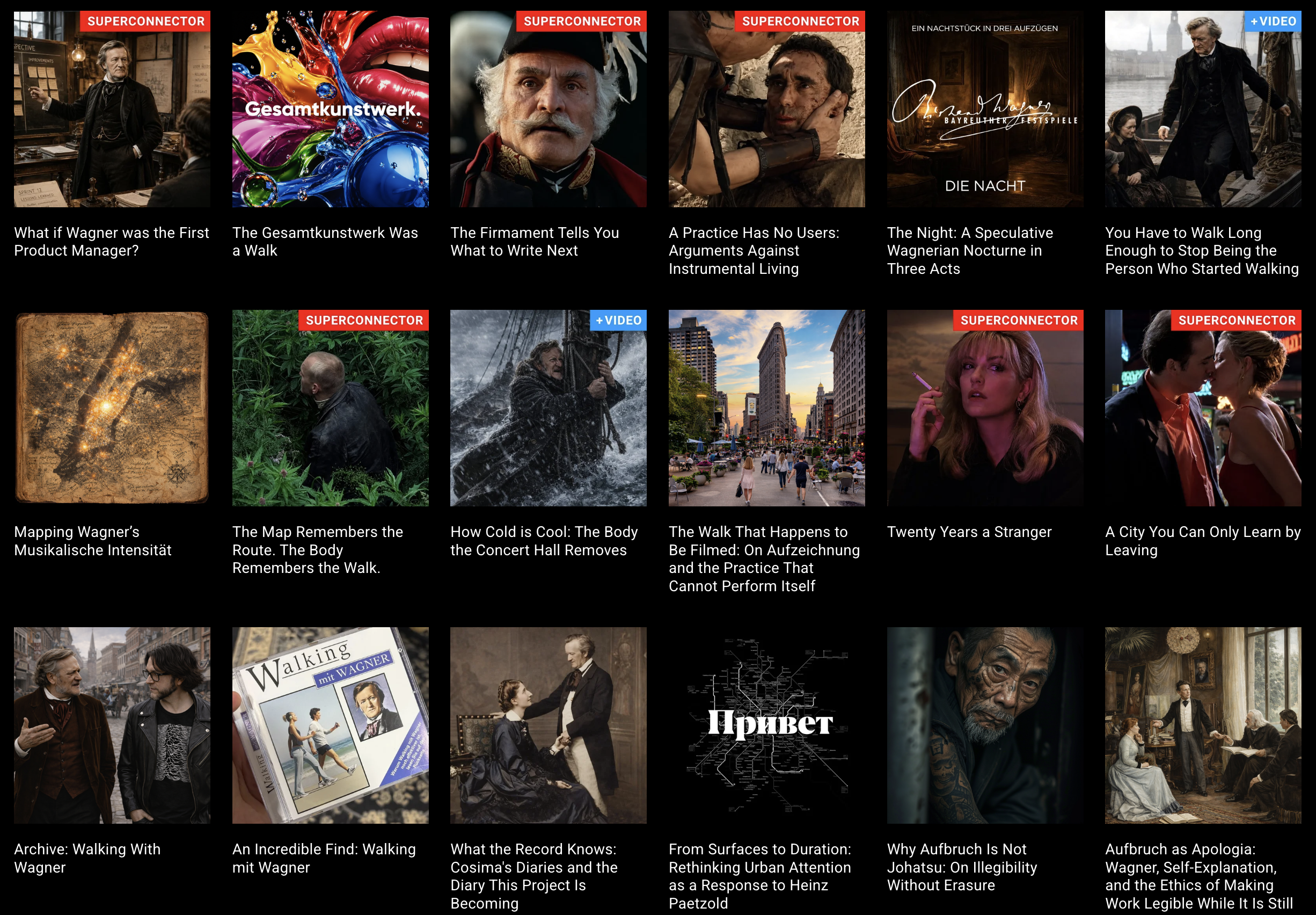
The Superconnectors are collected on autonomousmatt.com, beside the tools that read the corpus: Conversation, a chat grounded in the full text of the work; Inspiration, a visual search across the image archive; Discovery, a semantic search that crosses constellations; and the Firmament itself. The placement is deliberate. The essays came from the same idea as those tools. They are the editorial half of a discovery system.
They also feed it. Every essay goes into the corpus. The recirculation units embedded across hundreds of articles, each with a written sentence explaining why two pieces belong together, now have bridges to cross that did not exist before. Older pieces find new neighbours. Search and conversation can reach connections the archive could not previously make on its own.
The Map Is Always Slightly Ahead
The method is simple to state. Build a structure that shows how work connects. Read its gaps as an editorial calendar. Give the new work a form that makes its purpose visible. Put it back into the system and read the map again.
What changes is the question behind the next piece. It is no longer what I want to make. It is what the work needs next. The blank page gives way to a brief, and the brief comes from the body of work itself.
The Firmament will not be finished, and that is the design. Every essay written to close a gap opens two more. The territory is always slightly behind the map. That distance is where the next Superconnector is already waiting.