Prologue: Born from the Foam
1. Still Water
There is water under the Bone. No one in the Ulmorn has seen it. Most people have heard it. At noon, in the hour of silence, you can lie flat on the white crust and hear something move underneath. It is slow, like a tide in another room.
The singers say the water was there first. They call it Ish. It had no colour and no shore. It did not move, because there was nowhere for it to go.
Then came Ulv, the Floor. She lay over Ish the way a lid lies over a cistern. Between them was Khar, the Binding. Khar joins things. She is the reason anything stays where it is put.
Ish had a child called Orun, the Deep. He sits at the bottom of everything and remembers. Ulv had a child on her own, with no one's help. He was Khor, the Burning. She set him above her so he could see all of her. Every day he lay down on her and every night he rose. Wherever he had lain, she was warm.
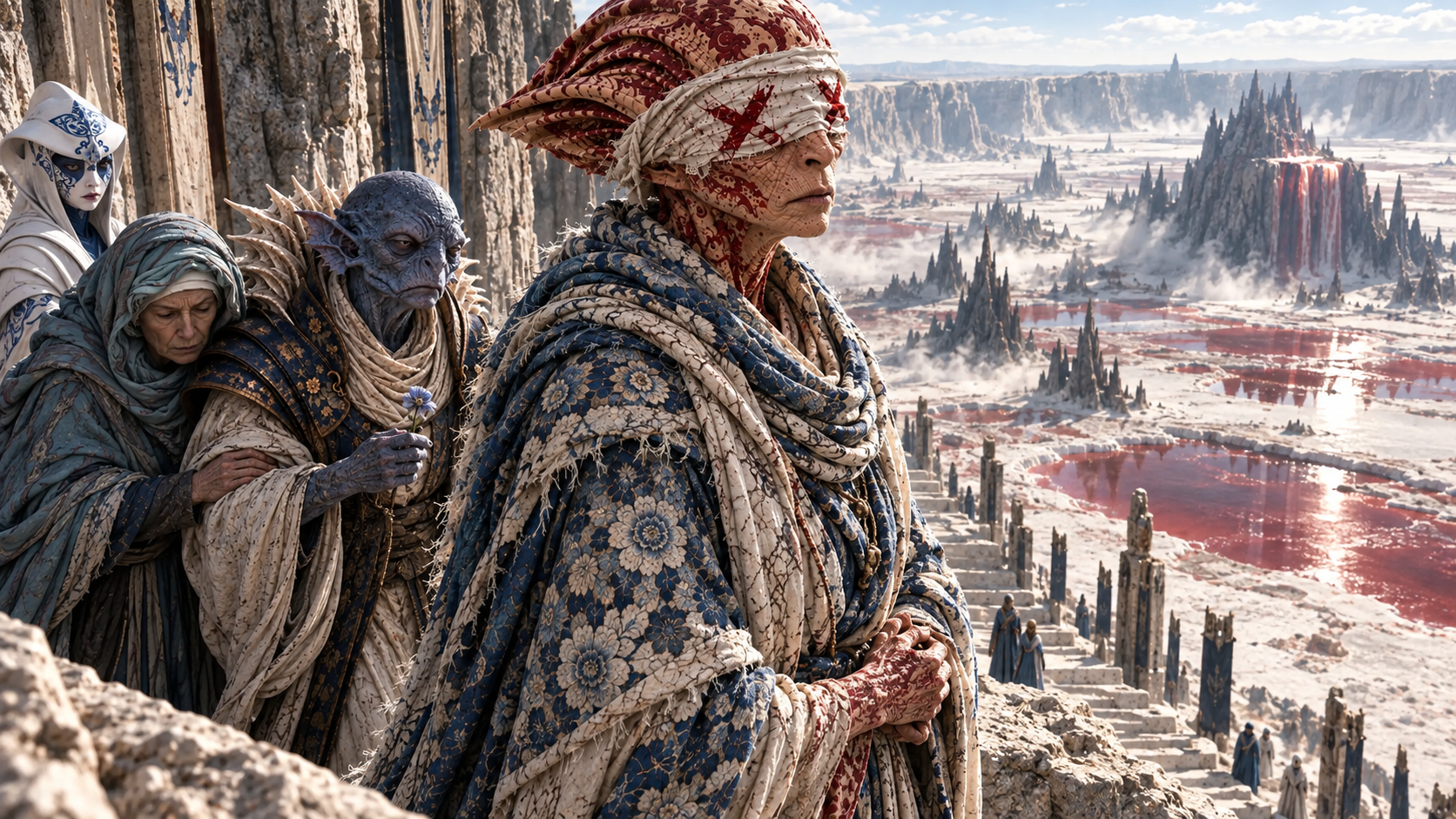
The singers learned this from the Daughters of Ish. The Daughters come up the Weeping Stair at noon, where brine runs down the red wall and never dries. They walk on the Bone and it does not break. Their footprints fill with water behind them.
They told the first singer one thing she never forgot. They know how to tie a knot that looks true and is not. They also know how to tie one that is. They did not say which kind this was.
2. The Hook
Ish had other children. The singers call them the Brine-children. They were soft and pale, and there were as many of them as there are grains of salt. They lived in caves between the Floor and the water.
Ish kept them cold. She kept them close. She gave them no colour. She was afraid that anything that went up into the light would not come back down.
The Brine-children were Ulv's too. They were made from her underside, and she could feel them pressing up against her. She grew tired of the weight.
So she made a hook. It was white stone, sharp on the inside of the curve. She gave it to the eldest child, the boldest one, and told her to cut.
The eldest set the hook against the underside of the Floor and pulled it across once. Ulv split open. Khor's light came through the wound and touched the water for the first time. Ish pulled back. She went down and down, to where Orun sits, and the sea that filled the basin went down with her. That was the first cutting of the Floor.
Ulv made more than one hook. She gave the others to no one. They are still straight, somewhere.
Kel
A drop of brine fell from the hook onto the hot stone and foamed. Kel came out of the foam. Kel is Skin. She is thin and soft, and she keeps the print of anything that touches her.
Every mark anyone has ever made was made on Kel. A painted cross, a fired coil, a knot in a thread, a dot of salt. All of it is laid on skin, or on something that stands for skin. So every record is a small wound. The singers say that is why remembering hurts.
Everyone who carries a mark is a child of Kel. The singers have a name for all of them together, whatever their colour and whatever they keep. They call them the Kelborn, the ones born from the foam.
The Bone
Ulv was ashamed of the cut. She closed over the water and grew a hard white crust across it. That crust is the Bone. It is salt. It is the floor of the basin and the lid on everything beneath.
Ish is still under it. She was hurt, but she did not die. Water does not die. It waits, and it remembers the hook.
3. The Dry Dawn
The children climbed out through the crack into the first day. Khor touched them and they took colour. The ones who came up the east side came up dry, and he turned them yellow. The ones who came up the west side, where the seam still ran, came up wet and stayed pale. The singers call this the Dry Dawn. No one carries a mark from that day.
Wen
The eldest kept the hook. She bent it until the blade curled round on itself and it became a spindle. Then she walked west, into rain and moss and wool. Her name was Wen. The Weneth come from her, and they still write in thread.
She tied the first thing she knew into the first length of cloth: the floor is a closing, and beneath it is still water. The Weneth have been weaving ever since without once cutting the thread. They call the weaving the Great Cloth. They forgot, after a while, to read its beginning.
Dar
The second child was Dar. He counted the steps out of the caves and never stopped counting. He walked east into the iron mountains, and the red ground came up through his feet into his skin.
The Kharrin come from him. They mark only what is owed, as white dots of salt on red faces. They rake their salt from the top of the Bone and never cut into it. For thousands of years none of them knew why. They dig the red earth of their mountains and roast it until it darkens, and they sell it to everyone. In their tongue the red earth is called kharrn, debt-earth.
The rest
The rest stayed in the basin. They walked the bed of the old sea and did a great many things and remembered none of them. There was nothing yet to keep them on. They are the Ulmaeth, the yellow people of the Ulmorn.
The Marks
Khar and Kel had daughters, the Marks. Har, the Knot, went west with Wen. Nesh, the Dot, went east with Dar. Kharu, the Cross, stayed in the basin. Qaru, the Coil, was not born yet. She stayed inside her mother for six hundred years.
At first the sisters wrote together, in one hand. It is called Old Coil. It is the path a thread takes, lifted off the loom and drawn on skin. It has no past and no future. In the beginning nobody needed either.
Amar
Then a woman named Amar dug into the east cliff of the basin and found red earth. She roasted it and painted a cross on her brother's forehead. Or on her own. The singers still argue about it. She said: I saw you.
That was the first record. Its year is year zero. The Ulmaeth count from it still. They cut their city down into the cliff where she dug, nine galleries going down, and they named it for her. Tesh-Amarun, the place of witness. Its only way in is a single stair, the Tessan, wide enough for one.
After Amar, the sisters began to drift apart.
4. The Fire
The Ulmaeth shed their skins once in a long life. When they do, every mark on the old skin goes with it. For six hundred years after Amar, the yellow people kept their history by painting it on again, over and over, on each new skin.
In the six hundred and eleventh year there was a kiln-master named Ilvara. She watched the marks of the dead peel away in the moult faster than anyone could paint them back on. It made her angry.
The winter at the looms
She walked west and spent a winter at the Weneth looms, learning Old Coil. The Weneth wove her into their Cloth as the yellow woman who wanted fire to keep a promise. She practised her letters in the margin. In the first length she found Wen's knot: the floor is a closing, and beneath it is still water.
Then she went home and did something no one had done since the hook. She took Khor's heat down into a kiln. She put a living body inside it and fired a mark into the skin, so it could never come off.
That was how Qaru, the Coil, was born. She came out of the kiln white and blue. She only ever talked about what was going to happen.
The ashing
The Elders met at the kilns. They told Ilvara that a mark that cannot fade cannot be forgiven. They struck her marks with ash, and the marks of everyone who went with her. They took her name out of every song. Among people who keep only what they paint, that is the same as never having lived.
The Law
But Ilvara had already written something. Before she walked north she wrote seven lines in Old Coil on her own shed skin and left it in the dark under the first kiln. Years later she fired the same seven lines into the foundation of the city she built in the white mountains.
The first two lines were Wen's. The rest were hers. Do not cut the floor. Do not feed the floor to the fire. If the floor is cut, the yellow will fall from their skins. If the floor is burned, the white will fall after. The last line was a cross laid over a coil. It was her name, and it was a picture of the two peoples bound.
She wrote it in a script both peoples were already forgetting. Only someone who looked for both halves would ever hold the whole. No one could read it. It sat in the south and in the north for fourteen hundred years.
The Parting
In the six hundred and twelfth year Ilvara took four hundred households up the north road. The south struck them all with ash. The north counted from that day and called it the Parting. They found white clay in the mountains, and cobalt under it. They called themselves the Ilvenne, the clay-born.
They built nine towers going up, the way the yellow people had cut nine galleries going down. They called the city Sael-Qor, blue fire. Every child of the Ilvenne was fired at sixteen and given a Coil, a vow written in the future tense. They were proud of marks that would never fade, and a little afraid of them.
The refusers
Not every child went into the kiln. Some stood at the kiln-mouth in their slip and walked away. The Ilvenne called them ilv-hesk, ash-clay. They kept the body every Ilvenne is born with: blue, scaled, finned at the ear, soft. Unfired skin can still hold paint. The refusers were sent to the cobalt mines, and lived in a cold valley below them called the Blue Hollow.
For most of history nobody counted them as a people at all.
5. The Second Cutting
Fourteen centuries went by. The sisters wrote apart. The south painted what had happened. The north fired what would happen. The west wove what it had agreed. The east counted what it was owed. Nobody read the beginning of anything.
The man with fins
In the autumn of 1903 a refuser named Sael-Ennu walked down the Salt Road, across the Bone and down the Tessan at noon. He was blue, with fins at his ears. No one in the south had seen one of the fire-takers since the Parting.
He worked a kiln through the winter for a kiln-warden named Ysmarr. In the spring she painted a cross on his shoulder, and it held. Then an Elder recognised the fins. They struck his mark with ash and sent him back up the stair.
Ysmarr was carrying his child. She left him off the record, so the child could never be ashed for him. She named the girl, at his asking, for his mother. In the south the name became Khaerith.
The salt
In 1951 a master of the ninth tower of Sael-Qor found that a handful of Bone-salt thrown into a hot kiln made the brightest glaze anyone had ever seen. His name was Vessan. He needed far more salt than the mountains had. The nearest great store of it was the floor of the world.
Nothing could cross the Bone with a heavy load except the wool-beasts of the Weneth, which spread their weight on broad pads like a hand laid flat. So Sael-Qor sent west. The Keeper at Wennar was a young man named Orrin. He signed the Salt Compact. A compact between peoples must be sealed with a person, and he gave the one he had: his sister Ishwen, who was thirteen. A Kharrin Reckoner named Darra witnessed it, and laid a white dot on her own cheek for the debt.
The Weneth carried the salt north for ninety-three years. They were paid in cobalt. Every length of the Great Cloth woven after 1952 is blue.
Ishwen was fired at sixteen in the ninth tower's own kiln, among the first to be glazed with salt. A young scribe of that tower kept the tallies of the cutting, cartload by cartload. Her name was Qaresse. She was Sael-Ennu's niece, and she did not know she had a cousin in the south. Every spring an old blue man left an armful of flowers at the foot of the ninth tower. Nobody knew why.
The Shedding
In the ninth summer of the cutting, the southern plates of the Bone cracked. The brine beneath them rose into the air. Ish breathed.
In one season every living Ulmaeth shed at once and lost every mark they carried. Children shed. The old shed twice. The history of the yellow people came away like paper in the rain. In the north, the tally for that summer has one line in Qaresse's hand: The rim is quiet. Cutting continues.
One Ulmaeth did not shed. She was a carrier, the last of an old office, who copied the marks of the dead onto her own skin so they would not be lost. Her name was Khaerith. Half her blood was northern, though she did not know it.
She went down into the drying-halls, where the shed skins of a whole people hung in the dark, and began to copy them. It took her forty years. When she was finished, everything the Ulmaeth had been before that summer was on her, and nowhere else.
Behind her right ear she had copied the marks from the oldest skin in the city. She could not read them. They said do not cut the floor.
6. The Reading
The copy
In 2040 Qaresse went south as a Reader, a scholar sent to study other peoples. She was the ninth to go, and the first in two hundred years. She wanted to see what her tallies had done.
She spent a winter in Tesh-Amarun. At the end of it the stair-wardens asked her to swear on the Lid-Stone, at the centre of the basin, that she would not copy the marks of the dead. Khaerith laid the oath-cross on her throat in red earth. It would not take. Red does not hold on glaze. It ran off her like rain off a cup. So Khaerith laid the cross on her own throat instead, to hold the oath for her.
That night Qaresse knelt beside the sleeping carrier and copied the marks behind her ear by firelight. Khaerith woke and saw the paper. She said one word. It was her own name. Qaresse understood, for the first time, that it was hers too.
In the morning Qaresse went up the stair. Khaerith broke one arm of the cross on her own throat.
The reading
Qaresse did not go home. She went west, to the one people who might read what she had copied. At Wennar a loom-tender named Amarwen laid the paper over the oldest lengths of the Great Cloth, a hand's width each night, in the dark. It took her a year.
In the margin of the passage about the yellow woman who wanted fire to keep a promise, she found the same handwriting. It was Ilvara's. The marks behind Khaerith's ear were the Law.
Amarwen read it to Orrin. That week he ended the salt-carrying. She wove her reading into a shawl and has worn it over her head ever since.
The Breaking
In the Blue Hollow, a refuser named Qorran had lost both his parents to a collapse in the cobalt mines. They had been cutting cobalt to pay for the salt. He had been raised by an old blind man among blue flowers. When word of the reading came, he walked three hundred refusers up to Sael-Qor on the night of the spring equinox, carrying brine.
They poured it into the salt-kilns of the ninth tower at full heat. The chamber cracked from floor to crown. Thirteen died. One was Vessan, who had first thrown salt into a kiln. Ishwen was in the rooms above and lived.
A fired kiln-worker named Tallas cracked almost to pieces and did not die. There was too little of him left to mend in cobalt, as the Ilvenne mend. So the old Reckoner Darra sent gold from the east. Now more of him is mending than glaze.
The salt-glazing ended that night. The refusers were given a charter and became, for the first time, a people. Qorran wears the broken tiles of the ninth tower as armour, and a ruff of the kiln-spurs that fired its children.
The flower
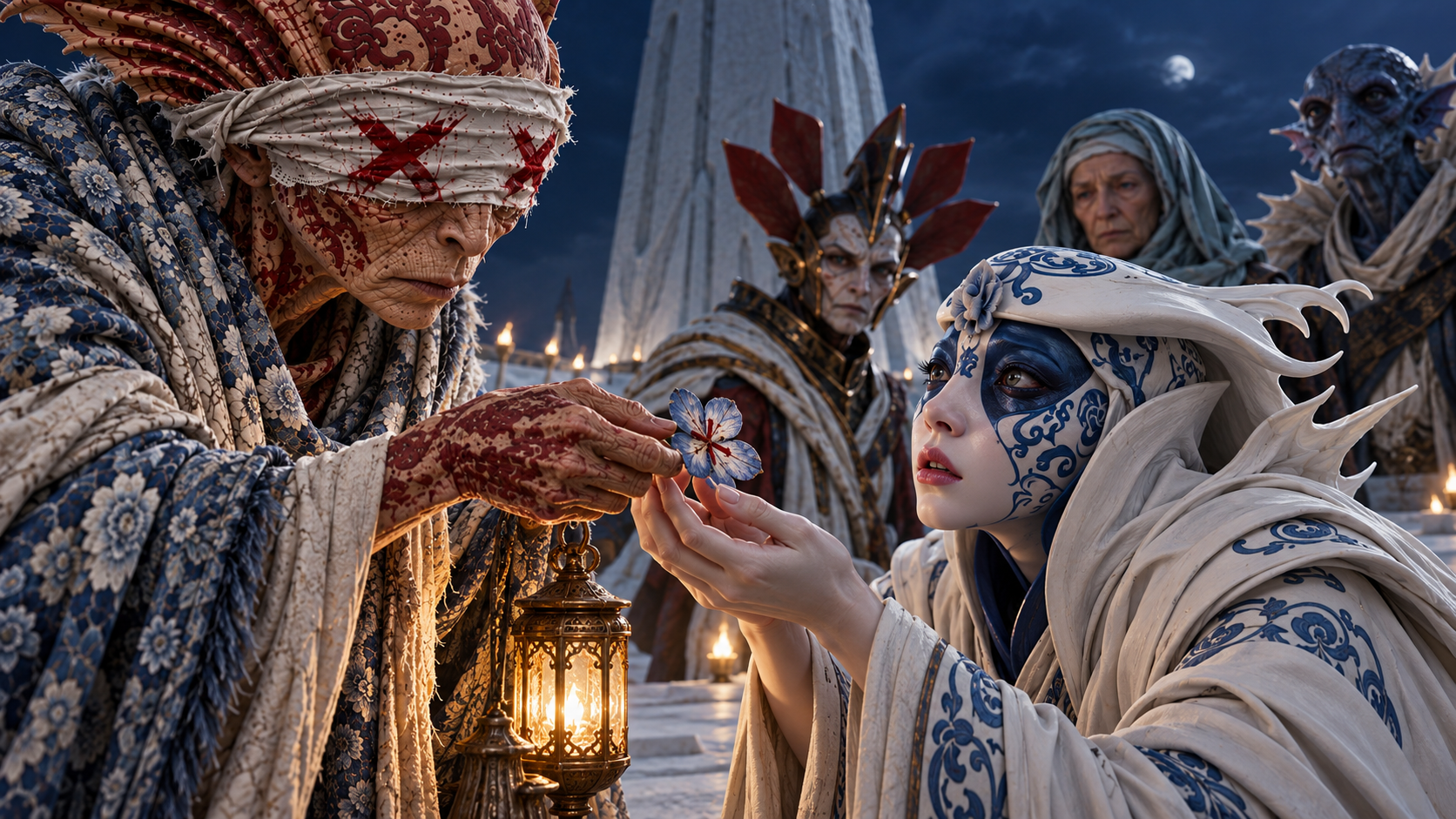
In 2045 Qaresse brought a pressed blue flower to the top of the Tessan. It came from the old man's garden in the Blue Hollow. She told the warden: It is from her father. Khaerith learned who her father was at a hundred and forty-one. She painted one cross on the flower and sent it back up.
The white falling
In the 2060s the glaze began to lift from everyone who had been fired with salt. It came away in scales, and the Coil went with it. Under it was skin the glaze had held back for decades, suddenly old. The Ilvenne call it the Flaking. It was the sixth line of the Law, a century late: the white will fall after.
The flaked went to the Blue Hollow, where nobody keeps vows. The refusers took them in. A woman named Ennesse, whose own tears had crazed her glaze, began to lift the failing glaze away with a thin knife for anyone who asked. Over the graves of the flaked, white flowers came up that no one had planted.
In 2079 Ishwen came home to Wennar on her red marriage couch, her glaze falling from her like petals. Her brother Orrin cut a fleece from the Keeper's flock the day she arrived. He has not let it be spun.
The ones who would not count
In the east, a salt-raker named Alvak woke one morning to find the dot-beetles had eaten half the debts off his face in the night. He laughed. He crossed out the rest with salt and declared himself clean. The Reckoner of the day could not decide whether that was theft or something else. She never ruled. He walks the roads now with a beetle on his tongue, crossing out the debts of anyone who asks.
Nobody had planned any of this. It began to look like a second answer to the cutting.
7. The Gathering
In 2085 Khaerith painted a broken cross on a strip of hide and sent it up the stair. It was Qaresse's broken oath, which she had held on her own throat for forty-four years.
Among the Kharrin, an oath broken and presented by the one who kept it is the oldest way to call a Reckoning. The hide went east along the Ember Road to Darrak, Darra's son, who had inherited her office and every debt on her face. In the autumn of 2087 the Reckoning of the Shedding opened at the Lid-Stone, the white pillar at the centre of the basin, where the sea last stood.
The circle
Four peoples sit around the stone, and a fifth judges.
The Kiln-Elders of the Ulmaeth sit on reed mats and cough in the cold. The Ilvenne sit on folding stools, and their glaze clicks when they move. The Weneth sit very still. Orrin is among them with his unspun fleece across his knees. The Hollow sits apart, near the salt-rakes, with Qorran's ruff ticking in the wind. Darrak sits facing the stone. He wears bronze blades beside his eyes so he can only look straight ahead, and four red fans on his head, one for each people. None of the fans has folded.
Every morning Amarwen stands at the foot of the stone with her shawl over her head and recites the Law in a language no living people speaks. Then no one speaks. Then Darrak counts the six hundred and four debts on his face aloud. Then the day begins.
Who else has come
More have come than were summoned.
Qaresse comes, in porcelain, as witness and accused at once. Hessal, the eldest surviving kiln-master of the ninth tower, has come for his nine dead. With him is the young Qarukh, flaked, whose bare face now carries southern crosses. He is the first of the fired to let the south paint him once his Coil came away. Kelesse has come down from the Hollow. She was never fired, and her scales grew into blue plumes, which the kiln takes from everyone else. Ulvas has come, the Hollow's floor-guard captain, in a red coat cut from ninth-tower cloth, with southern crosses painted on his blue face.
Wessan has come from Wennar. He is the son of Ishwen and Vessan, pale-skinned and Weneth, with a Coil his father inked into him that is slowly fading like lace. He stands between the man who killed his father and the people his father's salt unmade.
Neshwen has come, the caravan-mistress whose salt-crusted drivers carried the salt for sixty years. So has Kelak, a Kharrin physician in a mask of fired lace, who treats both shedding and flaking because both are sicknesses of the skin. Saelesse has come, who inks chosen vows onto the soft blue skin of adult refusers, so that a vow can be redrawn. To Sael-Qor this is heresy.
Alvak came uninvited, walking in off the Bone with a beetle on his tongue. He sleeps by the rakes and hums while Darrak counts.
Who has not come
Khaerith called the Reckoning and does not attend it. Carriers do not leave the galleries.
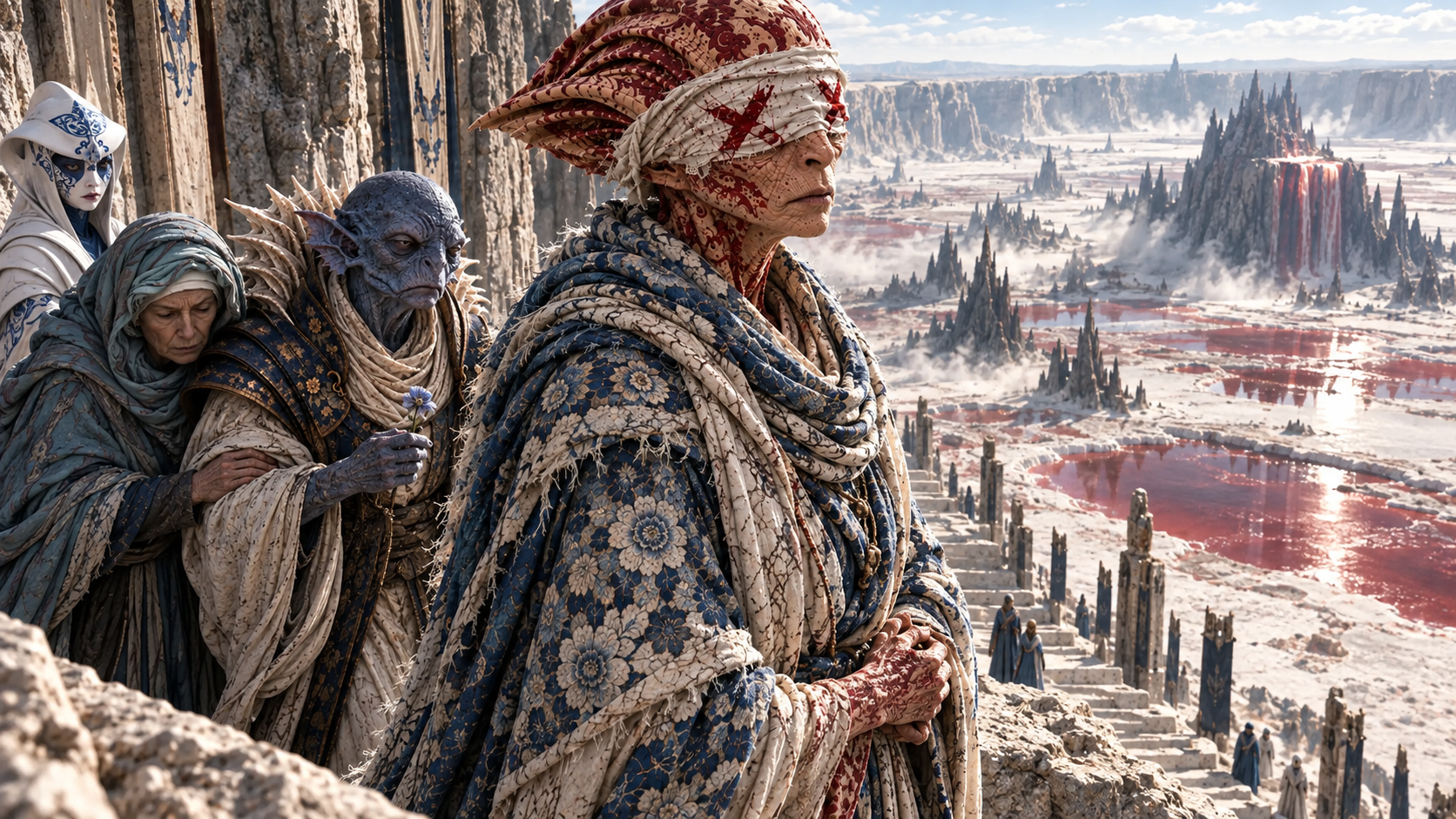
At the top of the stair, a warden named Namar has bound her eyes with a cloth marked with two red crosses. The law says an ashed man may never come down the Tessan while anyone remembers the ashing. Khaerith remembers everything. But to the Ulmaeth, a thing not witnessed has not happened. If no warden sees Khaerith's father on the stair, he has not come back. So Namar keeps the noon watch blind, and waits for whoever will carry him.
In the new drying-hall above the sealed ones, a young woman named Vaelith has begun to copy onto herself the dead who came after the Shedding. Nobody has been carrying them. Khaerith carries the before. Vaelith carries the after. They have never spoken.
Ishwen lies at Wennar under moss and has asked to be brought to the stone. On the twelfth day Qorran offered to carry her himself.
8. Breathing
They think they have been called to settle a debt. The Daughters say otherwise.
The rim
Out on the eastern rim of the Bone, past the salt-rakes, a Kharrin named Neshval lives alone on the crust. He wears a mask against the air and a brass lens over one eye. He draws breath from the hairline cracks through tubes and measures it. Since the Shedding the floor has breathed a little every year. This year it is breathing more. He has walked in to the Lid-Stone twice to say so. Nobody has wanted to hear it while they are counting the last cutting.
A young Kharrin named Kharrish has come in with him. When Kharrish raises his hands over the brine-pans, the water rises with them. Nobody taught him. He says he is not calling it. He says it is answering.
The red earth
In the red mountains of the east, an ember-digger named Khoralv has worked the pits for longer than anyone can count. He has six arms, and his debt-dots have melted together in the heat. Every cross ever painted in the south was made from earth like his. The Ulmaeth believe their red is their own. It was always borrowed. If the Reckoning asks how the south can repaint its dead, the answer will have to come from him.
The Eighth Reader
Before Qaresse there were eight Readers. The eighth walked past the edge of every map around 1840 and never came back. His book sits unopened in Sael-Qor with seven others.
This autumn something came up out of the sea beyond the red mountains, wearing his glaze. It is a porcelain shell crazed all over, with gold run into the cracks. Inside is something red and wet that grew there in the country he found. That country lies past every map. Its floor was cut long ago. The sea came up and stayed. The thing in his shell calls itself Irunas, son of the Deep. It has come back to read the book aloud, if anyone will let it.
Someone came after him. Her name is Orune. Her people keep the past a sixth way. They do not paint it, fire it, weave it, plant it or count it. They coat it. A grief is covered in pearl, layer by layer, until it shines and cannot be seen. She has seen the Reckoning, and a whole people's grief laid out on the Bone in the open. She is offering to coat it for them.
The maps
After the Breaking, a refuser named Imaresse carried the eight unread books out of the ninth tower before anyone could seal them again. She has been reading them ever since. She writes their routes onto her own skin: compass roses, distances, the coastlines of countries no one at the stone has heard of. Half her face is still blank. She is keeping it for routes no one has walked.
The books say the same thing the Daughters say. The Bone is not the only floor. There is still water under every floor in the world, and on top of each one there is a people who have forgotten it. And the hook Wen bent into a spindle was not the only hook Ulv made. The others are still straight.
Noon
At noon, in the hour of silence, you can lie flat on the Bone and hear the water breathing. It is louder than it was.