Chapter 1: The Twelfth Day
1. The Law
Amarwen recited the Law at first light, as she had for eleven mornings. She stood at the foot of the Lid-Stone with her shawl over her head and spoke the seven lines in the old speech. No one alive spoke it but her. Her voice was thin, and it carried a long way. There was nothing on the Bone to stop it.
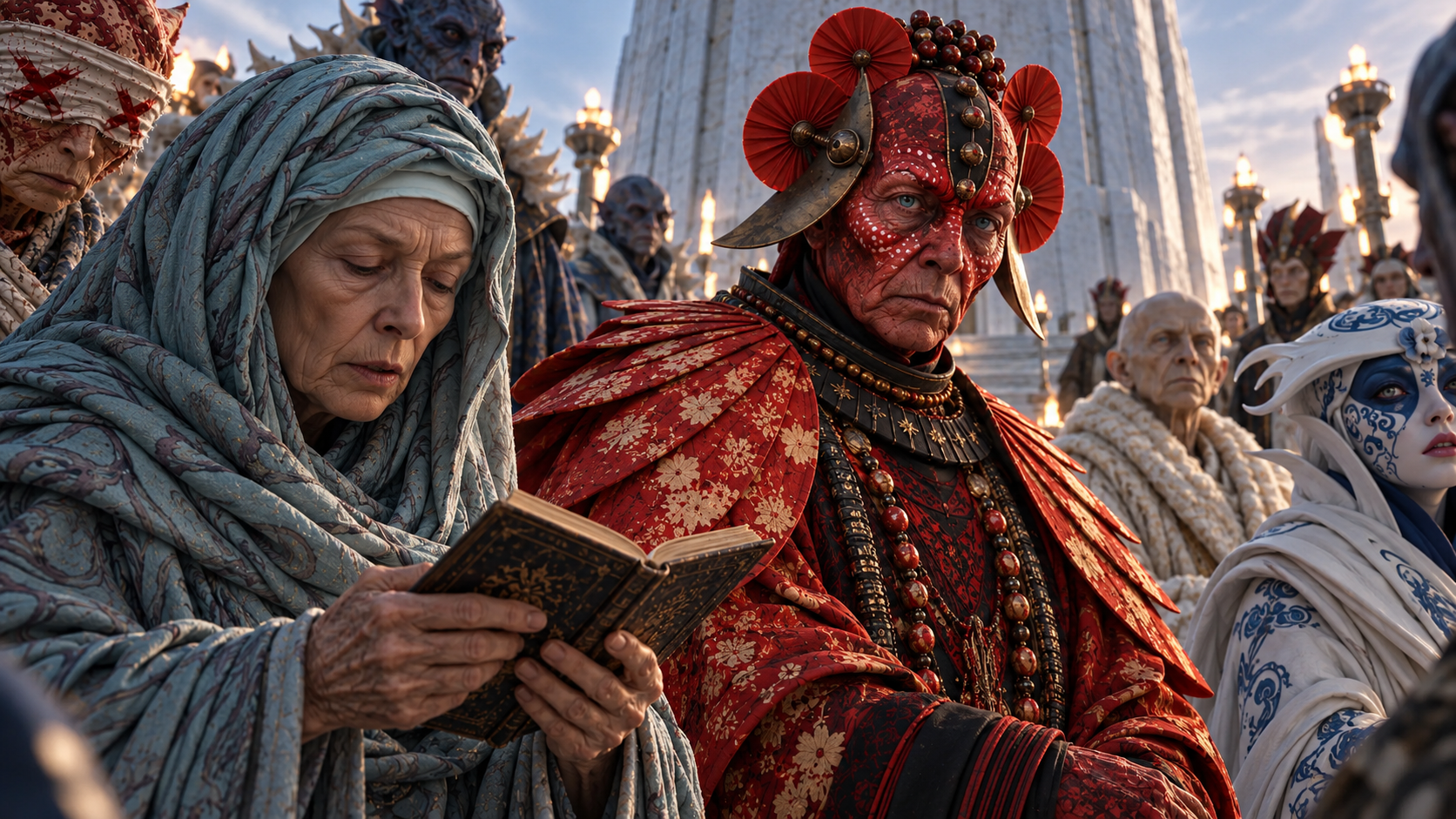
Darrak listened with his eyes on the stone. The bronze blades at his temples let him see nothing else, so he knew the circle by sound. The Kiln-Elders of the south sat to his left on reed mats and coughed in the cold. The Ilvenne sat to his right on folding stools, and their glaze clicked when they moved. The Weneth sat behind Amarwen, very still. The Hollow sat apart, near the salt-rakes. He could hear Qorran's ruff of kiln-spurs ticking in the wind.
The four fans stood open on his headdress. They had been open for twelve days. None of them had moved.
When Amarwen finished, nobody spoke. That was the rule. The Law was allowed its silence.
Then Darrak counted aloud, as the Kharrin do before they speak. The debts he counted were the ones on his own face. He counted the Compact dot low on his left cheek, which his mother had laid in 1951. He counted the Shedding dot on his brow, which he had laid himself. He counted the small dot near his right ear, ringed in red, that nobody had ever claimed. Six hundred and four. The same as yesterday.
From somewhere out by the rakes, the whole time he counted, someone hummed.
It was Alvak. He had walked in off the Bone in the first week, uninvited, with a beetle on his tongue. He slept on the open crust and hummed through every count. Darrak had not told him to stop. The ringed dot near his ear was Alvak's. His mother had laid it fifty-three years ago, for a case she could not decide.
"Nothing has been paid," Darrak said. "Nothing has been added. We begin."
Amarwen
He liked Amarwen. He could not see her, but he could hear how carefully she sat down. She was a hundred and twenty-seven, and her eyes were going. Every morning she read out a warning that had sat unread for fourteen centuries, part of it in her own people's cloth. Then she sat down and listened to everyone argue about who should have read it.
On the first day, before the sitting, she had said to him quietly: "I would rather be wrong." He told her the Kharrin had a word for that. It meant a debt you hope someone will forgive. She asked who could forgive this one. He said he did not know. She did not ask him again.
The man from the rim
At the edge of the circle, behind the Hollow, a Kharrin in a brass-lensed mask stood up as if to speak. It was Neshval, the rake-master, who lived out on the eastern crust measuring what came up through the cracks. He had come in twice already.
Darrak could not see him. He did not need to. Neshval's breathing tubes rattled when he stood.
"Not today," Darrak said. "We are counting the last cutting."
Neshval sat down. Darrak heard him say something to the young Kharrin beside him, who laughed and then stopped laughing. He did not catch what it was.
2. The Ninth Tower
The first to stand was Hessal Qor-Ven, the eldest of the kiln-masters who had survived the ninth tower. He walked round to stand in front of Darrak, as everyone who spoke had to. He was fired white and old, with three blue seams of mending across his jaw, one for each time he had cracked and lived.
His apprentice walked a step behind him. Qarukh was young, in tower porcelain to the ankle, but his face was bare. The salt glaze had come off it two winters ago and taken his Coil with it. Since then he had let a Hollow painter lay southern crosses on the soft skin underneath. The Ilvenne on their stools looked anywhere but at him.
"Thirteen died," Hessal said. "Nine of them were mine. Vessan was mine. We have waited twelve days to hear their names. We have heard about the salt. We have heard about the floor. We have not heard about our dead."
"You will," Darrak said.
"When?"
"Last."
Hessal kept his voice level. "Then they will be weighed against everything else. Against the Shedding, and a people's history. Nine kiln-workers will look small next to that."
"They will look exactly their size," Darrak said. "That is what last is for."
Behind Hessal someone else stood. Darrak heard the spurs before he heard the voice. Qorran came round into the space in front of the stone and stood beside the kiln-master. He did not look at him.
"He is right," Qorran said. "Judge me now. I have asked eleven times."
"And I have said no eleven times."
"Then say yes once. Let him go home with something."
Hessal turned on him. "You do not speak for my dead."
"No," Qorran said. "I made them."
It went very quiet. Darrak could see them both now, side by side in the narrow space his blades allowed. One was white and seamed, the other blue and scaled. They were the same height. Qorran's armour was made from the ninth tower's own tally tiles. Hessal had fired some of them himself. Over Qorran's heart sat the tile for the summer of 1961.
Qarukh looked at that tile for a long moment. Then he looked at his master. Hessal did not look back.
Then Qaresse stood up on the Ilvenne side. She did not come round to the front. She spoke from where she was, which broke the rule, and Darrak let it pass.
"Hessal," she said. "I kept the tallies. You know I did. If you want someone to blame for the nine, I am closer to it than he is."
"You wrote numbers."
"I wrote: cutting continues. It is over his heart. Read it."
Hessal did not answer her. He looked at Qorran for a long time. Then he went back to his stool. He moved slowly, the way the old fired do, afraid of a knock. Qarukh went with him and stood at his shoulder, bare-faced, with the south on it.
Qorran stayed where he was.
"Sit down," Darrak said. "I will judge you last because you want to be judged first. A man who asks to be punished is trying to pay for something. I want to know what before I take it."
Qorran sat. Qaresse sat. Neither of them looked at the other. They had argued in the camps every night for twelve days. Darrak had heard them through the tent walls, low and bitter. They argued like family. In a sense they were. The old man in the north who had raised Qorran among the flowers was Qaresse's uncle.
3. The Fleece
Orrin sat on the Weneth mats with the raw fleece across his knees. He had carried it from Wennar and would not let anyone else hold it. It was grey with dust now and smelled of the road.
At noon, in the hour of silence, someone came across the Bone from the west. He walked in the Weneth way, slow and in step with himself, with his feet wrapped in wool. He was tall and pale and wore red. When he came close, the Ilvenne on their stools went still. The Coil on his face was cobalt, but it was not fired. It had been inked into soft skin and had spread and greyed like lace.
It was Wessan, Ishwen's son. His father had been Vessan of the ninth tower. He had been born at Sael-Qor with Weneth skin that could not be glazed, so his father had tried to Coil him anyway, with a needle. He had lived at Wennar since his mother came home.
He knelt by Orrin and spoke into his ear. Darrak could not hear what he said. He saw Amarwen's hands go still in her lap. He saw Qorran, across the circle, look at the young man in red and then look down.
When the silence ended, Orrin stood up. He walked round to the front of the stone. He had not spoken in the Reckoning yet. Twelve days, and not one word.
"My sister is worse," he said.
Darrak waited.
"The glaze has come off her throat. The crossing Vessan wrote there came away in the night, and the weavers sewed it to her gown. She told me once that when it fell, the Compact would end by itself. Now it has fallen." He stopped. "She has asked to be brought here."
On the Ilvenne side someone said, "We asked for that weeks ago."
"Yes," Orrin said. "And we said no. Moving her begins her burial. She knows that. She has asked anyway."
"Then bring her."
"It is four days to Wennar and four back. She cannot sit up. She cannot be jolted. The Weneth carry the dying on a board, with eight bearers walking in step. We have eight bearers at Wennar, and none of them will do it. They say it is my place to decide how the Compact ends. If I will not decide it, they will not carry her to it."
He held up the fleece. It was the first time anyone in the circle had seen him lift it.
"They want me to spin this first."
"Will you?" Darrak asked.
Orrin lowered the fleece. "I gave her away when she was thirteen. I stood at the Salt Fold and watched them cut her sleeve off so she would arrive with nothing woven. I do not know how to end that. I have been trying for eight years."
Wessan stood behind him and said nothing. It was his mother being argued over, and his father's Compact.
Amarwen stood up. She came forward with one hand out, and Orrin took it without looking. Every evening at Wennar she guided his fingers over Ishwen's gown so he could read what the weavers had added that day. She did the same now, with his hand and the fleece. She laid his fingers on the raw wool and held them there.
"You do not have to know how it ends," she said. "You only have to know how it goes on."
Orrin did not answer. But when he sat down, he did not let go of her hand.
4. Noon
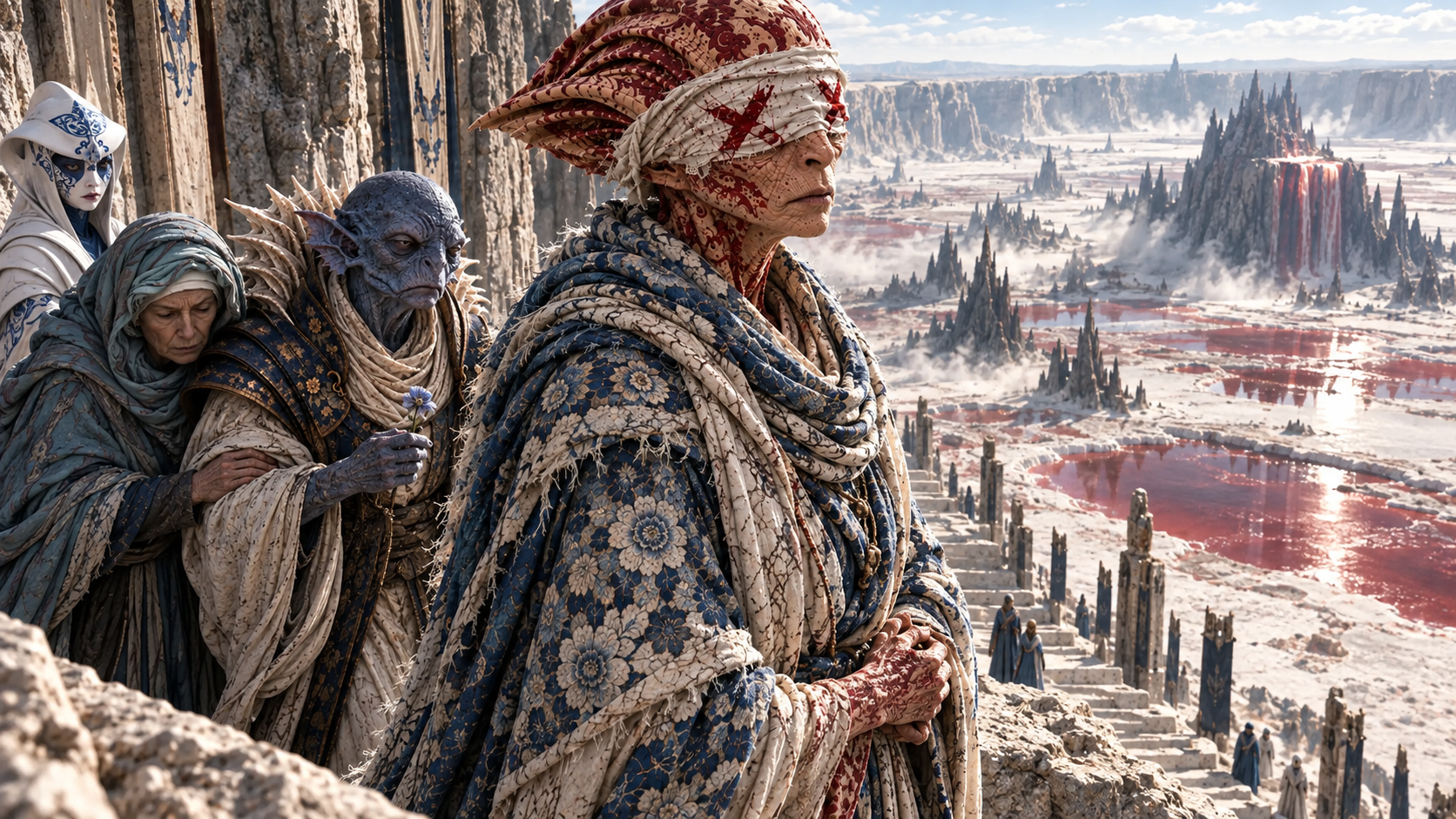
The Kiln-Scarp is an hour across the crust from the Lid-Stone. At the top of it, where the Tessan begins, Namar stood on the first step with her staff.
She had bound her eyes on the first day of the Reckoning. The linen was torn from a drying-hall shroud, and the eldest warden had painted a red cross over each eye. The red had spattered as it went on. Namar would not let anyone clean it. She wore a white cloak printed with cobalt flowers that was not hers, and her hands were laced with the red curls of four hundred strangers she had seen come down this stair.
She heard Qaresse before noon, as she did every day. Glaze makes a sound on stone. It is a small click, like a cup set down carefully.
Qaresse stopped on the top step. She was close enough that Namar could feel the cold come off her.
"I am asking to come down," Qaresse said.
"Na amar," said Namar. I see no one.
The bell on her staff rang the hour. After that, nobody spoke.
Qaresse did not go down. Nobody would have stopped her. No warden would have seen her pass. She stood on the top step through the whole hour of silence, as she had for twelve days. She had broken an oath on this stair. She wanted to be seen coming back. She would not take the stair unseen.
Namar understood that. She did not agree with it. She stood beside her anyway, in her cloak.
When the hour ended, Qaresse turned and walked back across the Bone. Namar listened to the clicking until it was gone.
Dusk
In the evening someone came up the stair from below. The step was light and quick. It was young.
Vaelith climbed the Tessan every evening at this hour. She lived in the new drying-hall, where the skins of those who had died since the Shedding were hung. Nobody had been carrying those dead. Four years ago she had begun to copy them onto herself without anyone's leave. She still had room. She still wore cloth.
"How is she?" Vaelith asked.
Namar always told her the truth. "She asked me this morning what his flowers smell like."
Vaelith was quiet. "What did you tell her?"
"That I did not know. That I would ask."
"Did she ask about me?"
"No," Namar said.
Vaelith did not say anything for a while. Namar could hear her breathing.
"Please don't look at me," Namar said, "when I tell you things like that."
"You can't see me."
"I know. Don't look anyway."
Vaelith laughed, once, unhappily. Then she sat down on the step below and stayed until it was dark.
5. The Lowest Hall
Under the Kiln-Scarp, nine galleries down, Khaerith walked the old drying-hall with a lamp.
A few blank skins still hung from the ceiling. Their marks had crumbled away long ago. She knew whose each one had been, because she had copied every cross before it went. She carried them all on her head and throat and shoulders, laid over each other until the red at the centre of her crown had gone nearly black.
She was a hundred and eighty-three. Her eyes were the pale blue the Ulmaeth call well-water. All her life she had been told that colour came from looking at the dark. For forty-two years she had known it came from her father.
She stopped at the end of the hall, at the empty hook where the oldest skin had hung. It had turned to dust the winter after she copied it. She had not known what it said. She had carried it behind her ear for most of a century anyway. Now everyone knew what it said, and it was still hers to carry.
The shoulder
She could not see her own right shoulder blade. She knew exactly what was on it. It was a single cross, copied from the skin of an Elder who had died long before the Shedding. He had been marked for one deed in 1904: a fire-taker found among the kilns, his mark struck with ash.
She had laid it on herself without knowing what it was. Now she knew. Her father's ashing was painted on her own body. Up on the Bone they were asking whether she still remembered it. It was not a matter of remembering. She carried it. To lift it she would have to strike a cross off her own skin. She had never destroyed a mark in her life.
Namar
The first time Namar came down blindfolded, eleven days ago, Khaerith had reached up and touched the two crosses painted over her eyes. Namar had not explained, and Khaerith had not asked. She understood it at once. It was the kindest thing anyone had done for her in a hundred years, and it was a trick. It would let her father come down the stair without her ever having to choose. It would also mean that when he came, it would not count. She could never lay a cross for it.
She had not decided yet whether she could bear that.
The flower
She had one of his flowers in her pocket. It had come down the Tessan forty-two years ago, with a sentence the warden had been asked to pass on: It is from her father. She had painted a single cross on it and sent it back up. Three springs later it had come down again, with no message. She had kept it ever since.
She sat on the floor of the lowest hall and took it out. It was brittle and still faintly blue. Her cross was on it in faded red.
She thought about the cousin who had sworn an oath to her on the Lid-Stone and broken it the same night. She thought about the arm of the cross she had broken on her own throat afterwards, with a wet thumb. She thought about the father her mother had left off the record to keep her safe. She thought about the people up on the Bone arguing over her history as if it were a debt.
It was not a debt. It was a grief. A grief is not paid. You carry it until someone helps you, and then you carry it together.
She looked at the inside of her left wrist. It was the one place on her body she had never marked.
She took out her reed and her pot of red earth.
6. The Offer
That evening, after the sitting, Qorran walked to the Weneth camp. He went alone, and he left his ruff behind. The spurs were heavy, and the Weneth had never seen him without them. He looked smaller. His ear-fins were torn at the edges from the mines.
Orrin was sitting outside his tent with the fleece. Amarwen was beside him. Wessan sat a little apart, by the fire, in his red. None of them stood up.
"I will carry her," Qorran said.
Orrin looked at him.
"The Hollow has bearers," Qorran said. "We carry the flaked to the shelters every week. We have carried people who lose skin if you touch them. I can have eight at Wennar in five days."
Wessan stood up.
"You killed my father," he said.
"Yes."
"You want to carry my mother."
"If she will let me." Qorran stood with his arms at his sides. "Ask her. Send your runner back. Go yourself. If she says no, I will go back to my tent and you will never hear of it again."
Wessan looked at him for a long time. The ink on his face had spread with the years until the Coil his father wrote there could barely be read. Qorran had never seen it up close. He found he could not look away from it.
Amarwen spoke without looking up. "Why?"
Qorran was quiet for a while. "When I was nine," he said, "a gallery in the Seam came down on my parents. They were cutting cobalt to pay for your salt carts. Sael-Ennu dug them out with his hands. He was already old. He carried them to the Hollow one at a time and buried them in the spoil and planted over them. He never asked who owed what. I have been angry for sixty-eight years. I broke a tower with it. I would like to carry something instead."
Orrin turned the fleece over in his lap. He did not answer for a long time. The light went off the Bone, and it turned grey, then blue.
"The night she came home," he said at last, "she asked me why I never came to see her in the north. Not once in a hundred and twenty-five years. I told her the Keeper cannot leave the hall. It was not true. I could not look at what I had done."
He looked up at Qorran.
"I will walk beside the board," he said. "All the way. If she says yes."
Neshwen
Someone laughed in the dark behind the tents. It was not unkind. A woman in a wide hat came into the firelight. Salt glittered on her face and arms like frost.
"Your bearers will drop her on the first plate," Neshwen said. "The Bone is not a mine floor. You do not walk on it. You walk with it. I drove the salt caravans for sixty years. I walked her north to the Salt Fold when she was thirteen." She looked at Orrin. "I watched them cut her sleeve."
Orrin did not answer.
"I will teach them," Neshwen said to Qorran. "Eight days. Then they can carry anyone." She looked at Wessan. "Even someone who is angry with them."
Wessan sat back down. He did not say yes. He did not say no.
Amarwen put her hand on Orrin's arm. Qorran nodded once to Neshwen and went back across the Bone in the dark.
Hessal
On the way he passed the Ilvenne tents. Hessal Qor-Ven was sitting outside one of them by lamplight, painting a cobalt seam over a fresh crack in his own wrist. Qarukh held the lamp for him. Qorran stopped. Hessal did not look up.
"The flaked in the Hollow," Qorran said. "Some of them are your workers' families. Their children are there. I can bring them to you, if you want to see them."
Hessal's brush stopped moving. He said nothing. Qarukh looked at his master, then at Qorran, and the lamp shook a little in his hand.
After a while Qorran went on.
7. What Came Up the Stair
Darrak did not sleep during a Reckoning. A Reckoner who sleeps can be told things he did not hear. He sat on his mat facing the stone, as he had for twelve nights. The four fans were folded down beside him for the dark.
Near midnight a light came across the Bone from the Kiln-Scarp. It moved slowly and very straight, as if the person carrying it was counting steps.
It was a stair-warden. She stopped directly in front of him, where his blades would let him see her. Her eyes were bound with linen marked with two red crosses. She carried a lamp she could not see by. She held it up anyway, so that he could see. In her other hand was something flat.
She did not speak. The Ulmaeth do not speak when they carry a message. The mark speaks for them.
Darrak could read Kharrin dots and a little of the Ilvenne Coil. He could not read a southern cross well enough to be sure of it. He asked the warden to wait. He sent for Qaresse.
Qaresse came with her hood down and her orchid in her hand, as if she had already been awake. She saw the warden before she saw anything else. She stopped. The warden turned her bound face toward the click of glaze and did not move.
Then Qaresse knelt and looked at what the warden was holding.
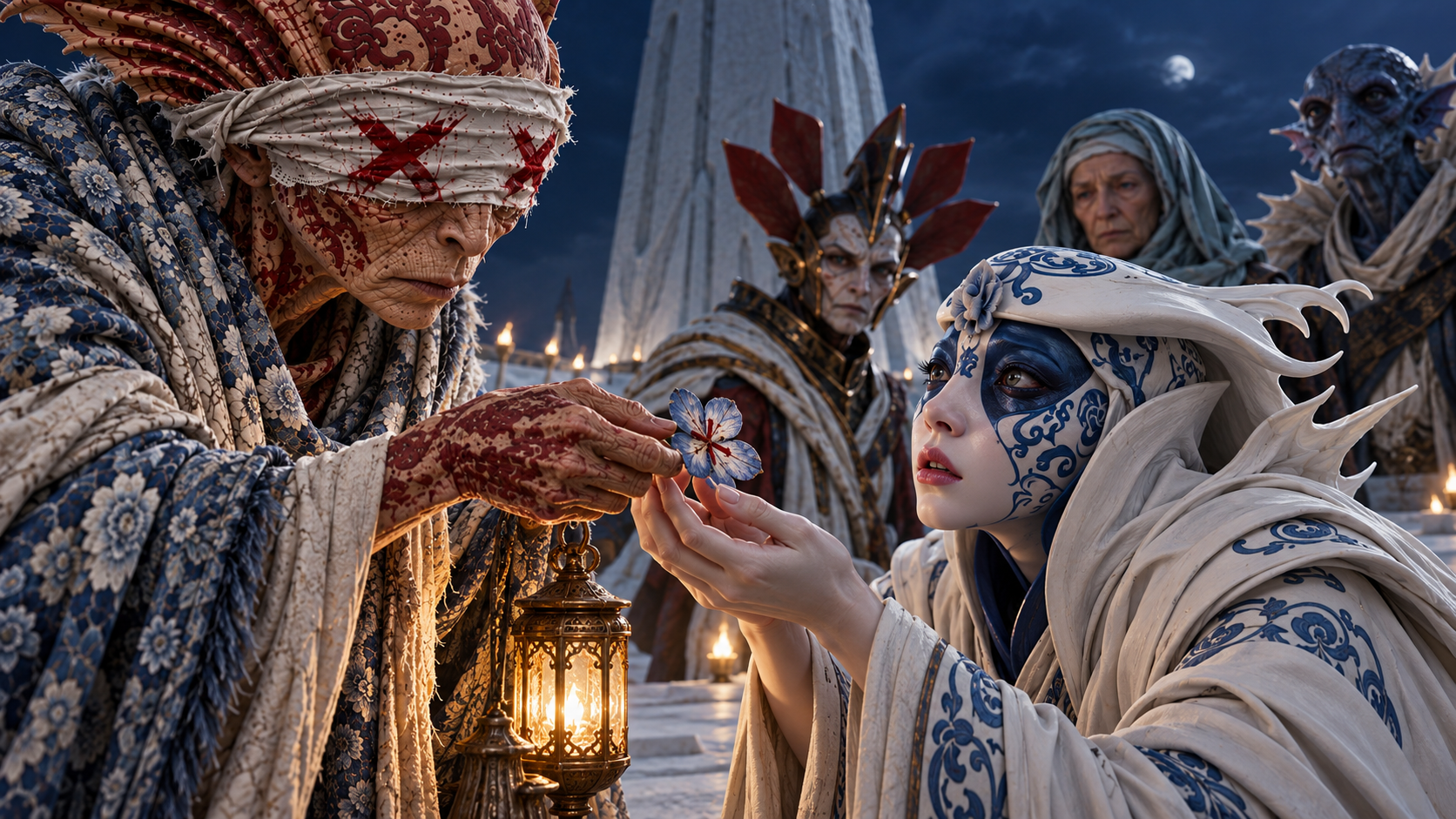
It was a flower. It had been pressed flat and dried for so long it was nearly paper. It was still faintly blue. A single faded cross lay across it in old red. Over the cross, freshly painted, the red still wet, was a second bar.
Qaresse put her hand over her mouth.
"What is it?" Darrak said.
"It is the flower my uncle sent her," Qaresse said. "In 2045. She painted one cross on it then. A witnessed deed. It meant I know." Her voice went. "This is a kharu-tal. An oath kept to its end."
"Whose oath?"
Qaresse touched her own brow, under the orchid. A hundred and forty-seven years ago, her uncle had fired a southern cross there, onto a northern face. No one in the north had been able to read it.
"Mine," she said. "She has mended it."
The warden laid the flower in Qaresse's hands. Then she turned and walked back toward the stair with her lamp, counting her steps. Qaresse stayed kneeling, holding the flower in both hands.
Out by the salt-rakes, for the first time in twelve nights, Alvak had stopped humming.
Darrak looked straight ahead at the stone. He went through every mark his office held. There were six hundred and four dots: debts owed, witnessed, settled and inherited. There was one ringed in red, near his ear, that his mother had never been able to place. There was no mark among them for this. A debt can be paid, or forgiven, or carried. This was none of those. Someone had given back a thing that was broken, mended, and asked for nothing.
He sat with it until morning, and did not know where on his face it would go.